
人类耳聋相关连接蛋白 30 T5M 突变导致轻度听力损失,并降低敲入小鼠耳蜗非感觉细胞之间的生化偶联。
The human deafness-associated connexin 30 T5M mutation causes mild hearing loss and reduces biochemical coupling among cochlear non-sensory cells in knock-in mice.
机构信息
Institut fuer Genetik, Rheinische Friedrich-Wilhelms-Universitaet Bonn, Roemerstrasse 164, D-53117 Bonn, Germany.
出版信息
Hum Mol Genet. 2010 Dec 15;19(24):4759-73. doi: 10.1093/hmg/ddq402. Epub 2010 Sep 21.
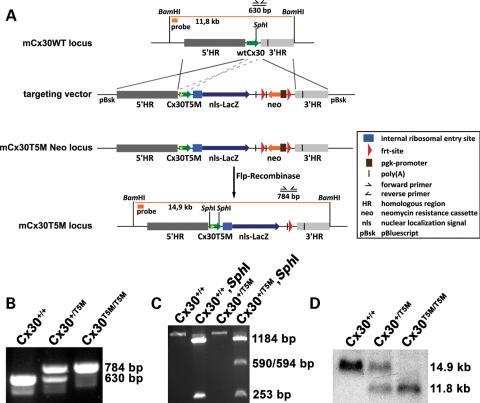
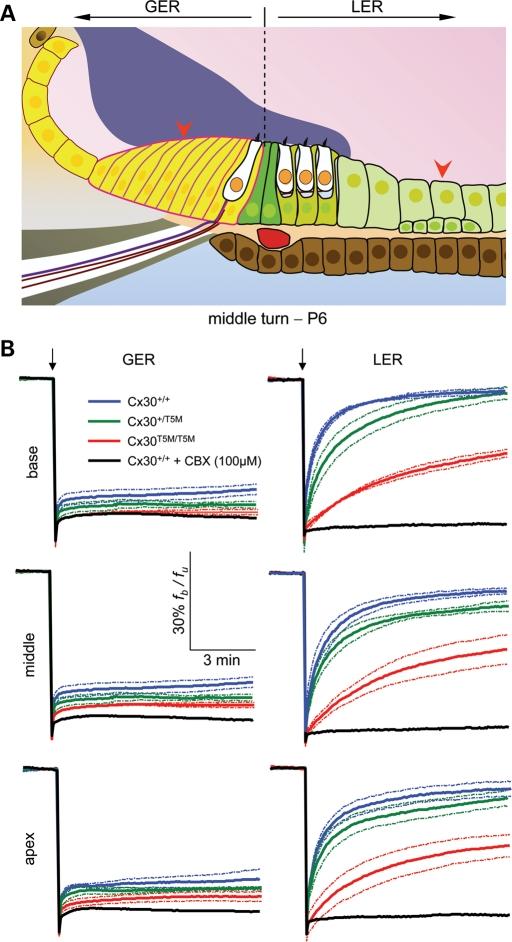
Mutations in the GJB2 and GJB6 genes, respectively, coding for connexin26 (Cx26) and connexin30 (Cx30) proteins, are the most common cause for prelingual non-syndromic deafness in humans. In the inner ear, Cx26 and Cx30 are expressed in different non-sensory cell types, where they largely co-localize and may form heteromeric gap junction channels. Here, we describe the generation and characterization of a mouse model for human bilateral middle/high-frequency hearing loss based on the substitution of an evolutionarily conserved threonine by a methionine residue at position 5 near the N-terminus of Cx30 (Cx30T5M). The mutation was inserted in the mouse genome by homologous recombination in mouse embryonic stem cells. Expression of the mutated Cx30T5M protein in these transgenic mice is under the control of the endogenous Cx30 promoter and was analysed via activation of the lacZ reporter gene. When probed by auditory brainstem recordings, Cx30(T5M/T5M) mice exhibited a mild, but significant increase in their hearing thresholds of about 15 dB at all frequencies. Immunolabelling with antibodies to Cx26 or Cx30 suggested normal location of these proteins in the adult inner ear, but western blot analysis showed significantly down-regulated the expression levels of Cx26 and Cx30. In the developing cochlea, electrical coupling, probed by dual patch-clamp recordings, was normal. However, transfer of the fluorescent tracer calcein between cochlear non-sensory cells was reduced, as was intercellular Ca(2+) signalling due to spontaneous ATP release from connexin hemichannels. Our findings link hearing loss to decreased biochemical coupling due to the point-mutated Cx30 in mice.
GJB2 和 GJB6 基因分别编码连接蛋白 26(Cx26)和连接蛋白 30(Cx30),是导致人类先天性非综合征性耳聋的最常见原因。在内耳中,Cx26 和 Cx30 表达在不同的非感觉细胞类型中,在这些细胞中它们主要共定位并可能形成异源间隙连接通道。在这里,我们描述了一种基于 Cx30 (Cx30T5M)N 端附近位置的保守苏氨酸被蛋氨酸取代的小鼠模型的生成和特征,该模型用于模拟人类双侧中/高频听力损失。该突变通过同源重组在小鼠胚胎干细胞中插入到小鼠基因组中。这些转基因小鼠中突变的 Cx30T5M 蛋白的表达受内源性 Cx30 启动子的控制,并通过激活 lacZ 报告基因进行分析。当通过听觉脑干记录进行探测时,Cx30(T5M/T5M)小鼠在所有频率下的听力阈值均表现出轻微但显著的增加,约为 15 dB。用针对 Cx26 或 Cx30 的抗体进行免疫标记表明这些蛋白质在成年内耳中的正常位置,但 Western blot 分析表明 Cx26 和 Cx30 的表达水平显著下调。在发育中的耳蜗中,通过双膜片钳记录探测到的电耦合是正常的。然而,荧光示踪剂 calcein 在耳蜗非感觉细胞之间的转移减少,由于连接蛋白半通道自发释放 ATP,细胞间 Ca(2+)信号也减少。我们的研究结果将听力损失与由于 Cx30 点突变导致的生化耦合减少联系起来。




 Zotero 插件