Biomolecular Diagnostics Laboratory, Instituto de Tecnologia Química e Biológica, Universidade Nova de Lisboa, Apartado 127, 2781-901 Oeiras, Portugal.
J Nanobiotechnology. 2010 Oct 7;8:24. doi: 10.1186/1477-3155-8-24.
Nanotechnology has the potential to provide agriculture with new tools that may be used in the rapid detection and molecular treatment of diseases and enhancement of plant ability to absorb nutrients, among others. Data on nanoparticle toxicity in plants is largely heterogeneous with a diversity of physicochemical parameters reported, which difficult generalizations. Here a cell biology approach was used to evaluate the impact of Quantum Dots (QDs) nanocrystals on plant cells, including their effect on cell growth, cell viability, oxidative stress and ROS accumulation, besides their cytomobility.
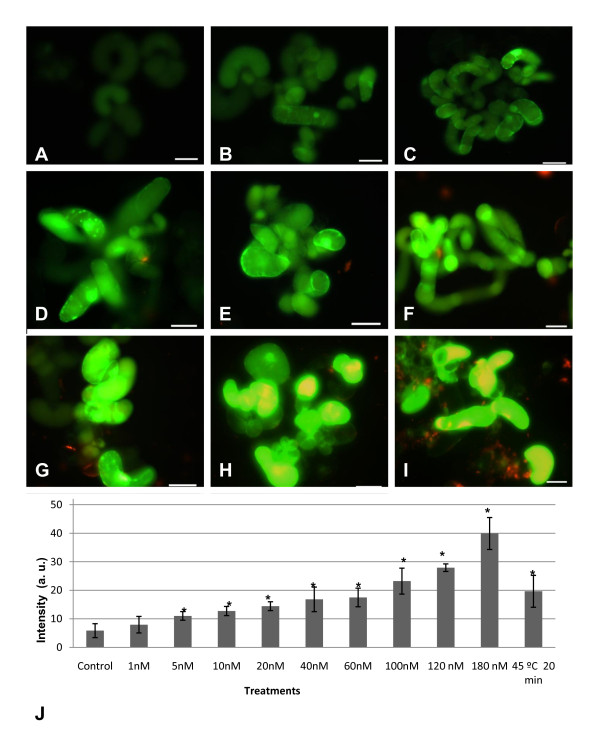
A plant cell suspension culture of Medicago sativa was settled for the assessment of the impact of the addition of mercaptopropanoic acid coated CdSe/ZnS QDs. Cell growth was significantly reduced when 100 mM of mercaptopropanoic acid -QDs was added during the exponential growth phase, with less than 50% of the cells viable 72 hours after mercaptopropanoic acid -QDs addition. They were up taken by Medicago sativa cells and accumulated in the cytoplasm and nucleus as revealed by optical thin confocal imaging. As part of the cellular response to internalization, Medicago sativa cells were found to increase the production of Reactive Oxygen Species (ROS) in a dose and time dependent manner. Using the fluorescent dye H2DCFDA it was observable that mercaptopropanoic acid-QDs concentrations between 5-180 nM led to a progressive and linear increase of ROS accumulation.
Our results showed that the extent of mercaptopropanoic acid coated CdSe/ZnS QDs cytotoxicity in plant cells is dependent upon a number of factors including QDs properties, dose and the environmental conditions of administration and that, for Medicago sativa cells, a safe range of 1-5 nM should not be exceeded for biological applications.
纳米技术有可能为农业提供新的工具,可用于快速检测和分子治疗疾病,以及增强植物吸收营养的能力等。关于纳米颗粒对植物的毒性的数据差异很大,报道的理化参数多种多样,难以进行概括。在这里,我们采用细胞生物学方法来评估量子点(QD)纳米晶体对植物细胞的影响,包括它们对细胞生长、细胞活力、氧化应激和 ROS 积累的影响,以及它们的细胞迁移能力。
我们使用紫花苜蓿悬浮细胞培养物来评估添加巯基丙酸(MPA)包覆的 CdSe/ZnS QD 的影响。当在指数生长期添加 100mM 的巯基丙酸-QD 时,细胞生长显著降低,添加巯基丙酸-QD 72 小时后,不到 50%的细胞存活。它们被紫花苜蓿细胞摄取,并在细胞质和核内积累,这一点通过光学薄的共焦成像揭示出来。作为细胞内化反应的一部分,紫花苜蓿细胞被发现以剂量和时间依赖的方式增加活性氧物种(ROS)的产生。使用荧光染料 H2DCFDA,可以观察到 5-180nM 的巯基丙酸-QD 浓度导致 ROS 积累的逐渐和线性增加。
我们的结果表明,MPA 包覆的 CdSe/ZnS QD 在植物细胞中的细胞毒性程度取决于许多因素,包括 QD 的性质、剂量以及给药的环境条件,对于紫花苜蓿细胞,为了进行生物应用,不应超过 1-5nM 的安全范围。