Center for Neural Development and Disease, Aab Institute of Biomedical Sciences, University of Rochester School of Medicine and Dentistry, Rochester, NY 14642, USA.
Dis Model Mech. 2011 Jan;4(1):120-5. doi: 10.1242/dmm.006114. Epub 2010 Oct 19.
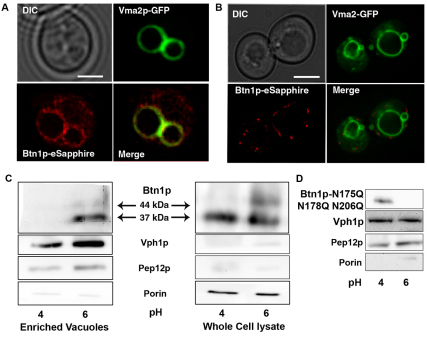
Btn1p the yeast homolog of human CLN3, which is associated with juvenile Batten disease has been implicated in several cellular pathways. Yeast cells lacking BTN1 are unable to couple ATP hydrolysis and proton pumping activities by the vacuolar ATPase (V-ATPase). In this work, we demonstrate that changes in extracellular pH result in altered transcription of BTN1, as well as a change in the glycosylation state and localization of Btn1p. At high pH, Btn1p expression was increased and the protein was mainly located in vacuolar membranes. However, low pH decreased Btn1p expression and changed its location to undefined punctate membranes. Moreover, our results suggest that differential Btn1p localization may be regulated by its glycosylation state. Underlying pathogenic implications for Batten disease of altered cellular distribution of CLN3 are discussed.
Btn1p 是酵母与人 CLN3 的同源物,CLN3 与少年型巴滕病有关,它与几个细胞途径有关。缺乏 BTN1 的酵母细胞无法将 vacuolar ATPase(V-ATPase)的 ATP 水解和质子泵送活动偶联。在这项工作中,我们证明了细胞外 pH 的变化导致 BTN1 的转录发生改变,以及 Btn1p 的糖基化状态和定位发生改变。在高 pH 下,Btn1p 的表达增加,并且该蛋白主要位于液泡膜中。然而,低 pH 降低了 Btn1p 的表达,并将其位置改变为未定义的点状膜。此外,我们的结果表明,Btn1p 定位的差异可能受其糖基化状态的调节。讨论了 CLN3 细胞分布改变对巴滕病的潜在发病机制影响。