Section of Pharmacology and Toxicology, Department of Experimental Medicine, University of Genoa, Genoa, Italy.
PLoS One. 2011 Feb 8;6(2):e16911. doi: 10.1371/journal.pone.0016911.
Although converging evidence has suggested that nicotinic acetylcholine receptors (nAChR) play a role in the modulation of GABA release in rat hippocampus, the specific involvement of different nAChR subtypes at presynaptic level is still a matter of debate. In the present work we investigated, using selective α7 and α4β2 nAChR agonists, the presence of different nAChR subtypes on hippocampal GABA nerve endings to assess to what extent and through which mechanisms they stimulate endogenous GABA release.
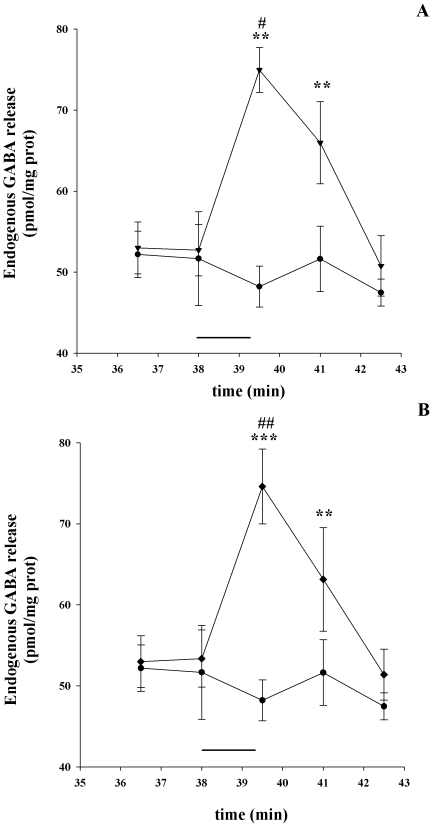
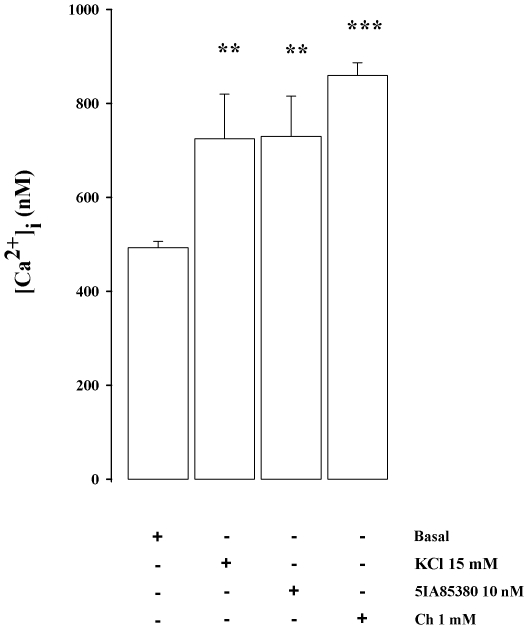
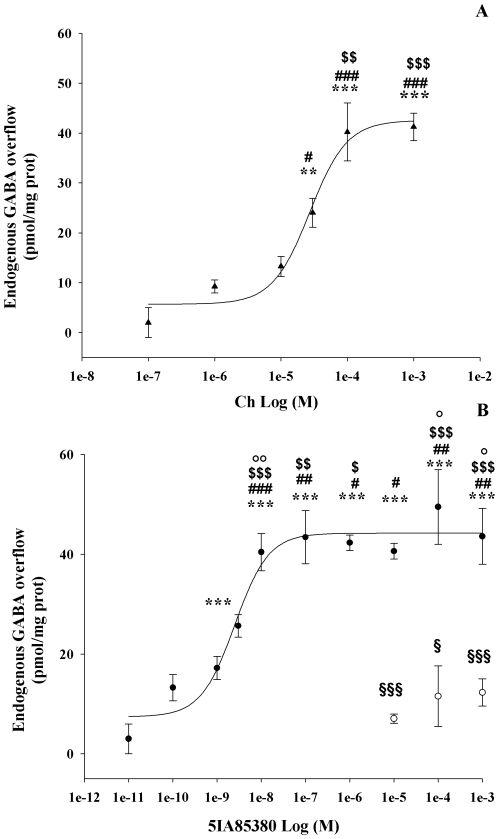
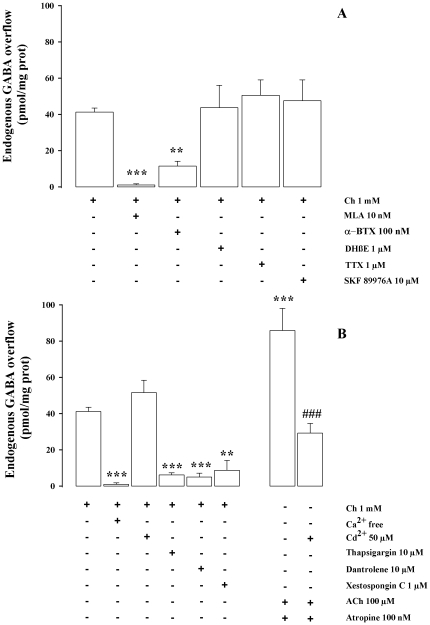
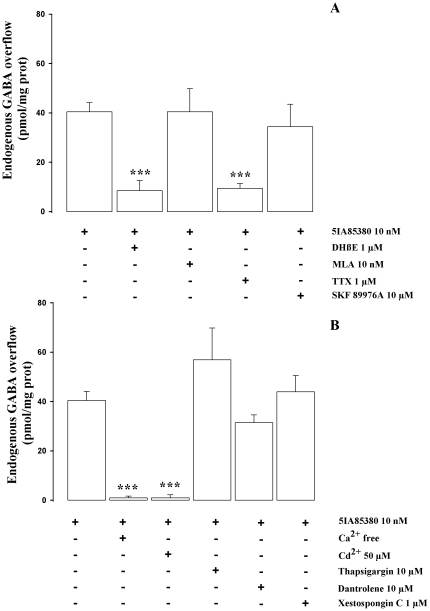
METHODOLOGY/FINDINGS: All agonists elicited GABA overflow. Choline (Ch)-evoked GABA overflow was dependent to external Ca(2+), but unaltered in the presence of Cd(2+), tetrodotoxin (TTX), dihydro-β-erythroidine (DHβE) and 1-(4,4-Diphenyl-3-butenyl)-3-piperidinecarboxylic acid hydrochloride SKF 89976A. The effect of Ch was blocked by methyllycaconitine (MLA), α-bungarotoxin (α-BTX), dantrolene, thapsigargin and xestospongin C, suggesting that GABA release might be triggered by Ca(2+) entry into synaptosomes through the α7 nAChR channel with the involvement of calcium from intracellular stores. Additionally, 5-Iodo-A-85380 dihydrochloride (5IA85380) elicited GABA overflow, which was Ca(2+) dependent, blocked by Cd(2+), and significantly inhibited by TTX and DHβE, but unaffected by MLA, SKF 89976A, thapsigargin and xestospongin C and dantrolene. These findings confirm the involvement of α4β2 nAChR in 5IA85380-induced GABA release that seems to occur following membrane depolarization and opening calcium channels.
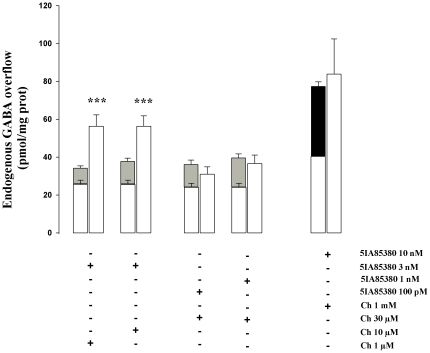
CONCLUSIONS/SIGNIFICANCE: Rat hippocampal synaptosomes possess both α7 and α4β2 nAChR subtypes, which can modulate GABA release via two distinct mechanisms of action. The finding that GABA release evoked by the mixture of sub-maximal concentration of 5IA85380 plus sub-threshold concentrations of Ch was significantly larger than that elicited by the sum of the effects of the two agonists is compatible with the possibility that they coexist on the same nerve terminals. These findings would provide the basis for possible selective pharmacological strategies to treat neuronal disorders that involve the dysfunction of hippocampal cholinergic system.
尽管越来越多的证据表明烟碱型乙酰胆碱受体(nAChR)在调节大鼠海马 GABA 释放中起作用,但不同 nAChR 亚型在突触前水平的具体参与仍存在争议。在本研究中,我们使用选择性的 α7 和 α4β2 nAChR 激动剂,研究了海马 GABA 神经末梢上不同 nAChR 亚型的存在情况,以评估它们在多大程度上以及通过何种机制刺激内源性 GABA 释放。
方法/结果:所有激动剂均引起 GABA 溢出。Ch 诱导的 GABA 溢出依赖于外 Ca(2+),但在 Cd(2+)、河豚毒素(TTX)、二氢-β-石蒜碱(DHβE)和 1-(4,4-二苯基-3-丁烯基)-3-哌啶羧酸盐酸盐 SKF 89976A 存在下无变化。Ch 的作用被甲基-lycaconitine(MLA)、α-银环蛇毒素(α-BTX)、丹曲林、thapsigargin 和 xestospongin C 阻断,表明 GABA 释放可能是由 Ca(2+)通过 α7 nAChR 通道进入突触小体引起的,涉及细胞内储存的钙。此外,5-碘-A-85380 二盐酸盐(5IA85380)引起 GABA 溢出,该溢出依赖于 Ca(2+),被 Cd(2+)阻断,并且明显被 TTX 和 DHβE 抑制,但不受 MLA、SKF 89976A、thapsigargin 和 xestospongin C 和丹曲林的影响。这些发现证实了 α4β2 nAChR 在 5IA85380 诱导的 GABA 释放中的参与,该释放似乎发生在膜去极化和打开钙通道之后。
结论/意义:大鼠海马突触小体具有 α7 和 α4β2 nAChR 两种亚型,它们可以通过两种不同的作用机制调节 GABA 释放。发现混合物(亚最大浓度的 5IA85380 加亚阈值浓度的 Ch)引起的 GABA 释放明显大于两个激动剂的作用总和引起的 GABA 释放,这与它们可能共存于同一神经末梢的可能性一致。这些发现为治疗涉及海马胆碱能系统功能障碍的神经元疾病的可能选择性药物治疗策略提供了基础。