
肺部超声与早期急性呼吸窘迫综合征患者肺复张:一项初步研究。
Lung sonography and recruitment in patients with early acute respiratory distress syndrome: a pilot study.
机构信息
Department of Radiology, Evaggelismos Hospital, Ipsilantou 45-47, 10676 Athens, Greece.
出版信息
Crit Care. 2011 Aug 4;15(4):R185. doi: 10.1186/cc10338.
INTRODUCTION
Bedside lung sonography is a useful imaging tool to assess lung aeration in critically ill patients. The purpose of this study was to evaluate the role of lung sonography in estimating the nonaerated area changes in the dependent lung regions during a positive end-expiratory pressure (PEEP) trial of patients with early acute respiratory distress syndrome (ARDS).
METHODS
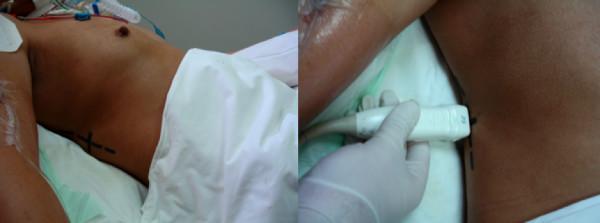
Ten patients (mean ± standard deviation (SD): age 64 ± 7 years, Acute Physiology and Chronic Health Evaluation II (APACHE II) score 21 ± 4) with early ARDS on mechanical ventilation were included in the study. Transthoracic sonography was performed in all patients to depict the nonaerated area in the dependent lung regions at different PEEP settings of 5, 10 and 15 cm H2O. Lung sonographic assessment of the nonaerated lung area and arterial blood gas analysis were performed simultaneously at the end of each period. A control group of five early ARDS patients matched for APACHE II score was also included in the study.
RESULTS
The nonaerated areas in the dependent lung regions were significantly reduced during PEEP increases from 5 to 10 to 15 cm H2O (27 ± 31 cm2 to 20 ± 24 cm2 to 11 ± 12 cm2, respectively; P < 0.01). These changes were associated with a significant increase in arterial oxygen partial pressure (74 ± 15 mmHg to 90 ± 19 mmHg to 102 ± 26 mmHg; P < 0.001, respectively). No significant changes were observed in the nonaerated areas in the dependent lung regions in the control group.
CONCLUSIONS
In this study, we show that transthoracic lung sonography can detect the nonaerated lung area changes during a PEEP trial of patients with early ARDS. Thus, transthoracic lung sonography might be considered as a useful clinical tool in the management of ARDS patients.
简介
床边肺部超声是一种用于评估危重病患者肺部通气的有用影像学工具。本研究的目的是评估肺部超声在评估早期急性呼吸窘迫综合征(ARDS)患者在呼气末正压(PEEP)试验中依赖区非充气区域变化中的作用。
方法
本研究纳入了 10 名(平均±标准偏差(SD):年龄 64±7 岁,急性生理学和慢性健康评估 II 评分(APACHE II)21±4)在机械通气期间患有早期 ARDS 的患者。对所有患者进行经胸超声检查,以描绘不同 PEEP 设置(5、10 和 15 cm H2O)下依赖区的非充气区域。在每个时期结束时,同时进行肺部超声评估非充气肺区和动脉血气分析。本研究还纳入了一组 5 名 APACHE II 评分匹配的早期 ARDS 患者作为对照组。
结果
随着 PEEP 从 5 增加到 10 再增加到 15 cm H2O,依赖区的非充气区域显著减少(分别为 27±31 cm2、20±24 cm2 和 11±12 cm2;P<0.01)。这些变化与动脉氧分压的显著增加相关(分别为 74±15 mmHg、90±19 mmHg 和 102±26 mmHg;P<0.001)。对照组中依赖区的非充气区域没有观察到显著变化。
结论
在本研究中,我们表明经胸肺部超声可以检测早期 ARDS 患者 PEEP 试验期间的非充气肺区变化。因此,经胸肺部超声可能被认为是 ARDS 患者管理的一种有用的临床工具。



 Zotero 插件