Department of Entomology, Pennsylvania State University, University Park, Pennsylvania, United States of America.
PLoS One. 2011;6(8):e23799. doi: 10.1371/journal.pone.0023799. Epub 2011 Aug 18.
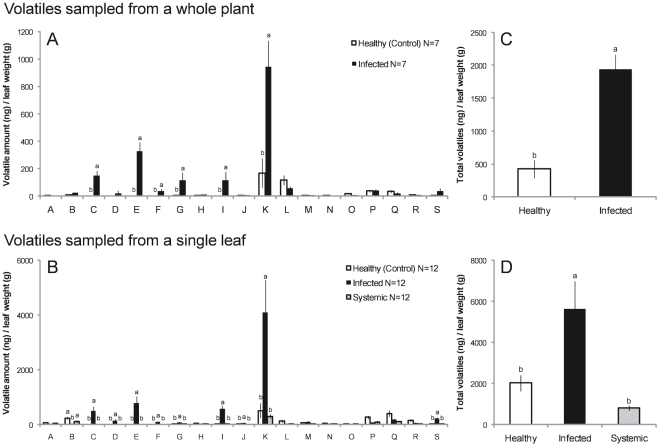
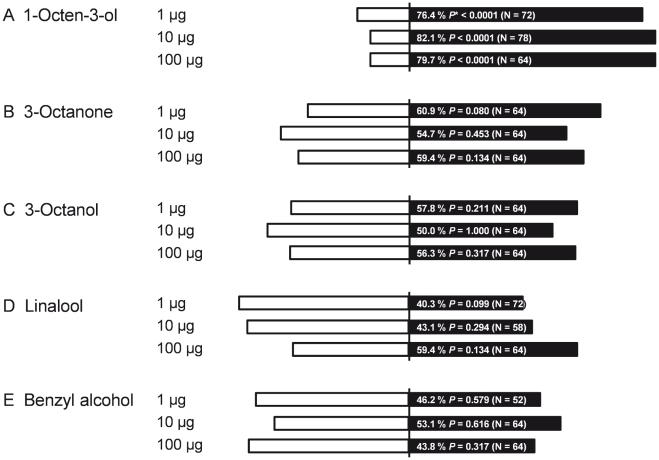
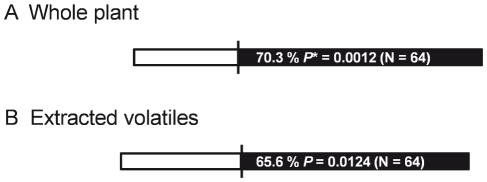
Powdery mildews (Erysiphales) are economically important plant pathogens that attack many agricultural crops. Conventional management strategies involving fungicide application face challenges, including the evolution of resistance and concerns over impacts on non-target organisms, that call for investigation of more sustainable alternatives. Mycophagous ladybird beetles (Coleoptera: Coccinellidae) feed on powdery mildew and have considerable potential as biological control agents; however, the foraging ecology and behavior of these beetles is not well understood. Here we document the olfactory cues presented by squash plants (Cucurbita moschata) infected by powdery mildew (Podosphaera sp.) and the behavioral responses of twenty-spotted ladybird beetles (Psyllobora vigintimaculata) to these cues. Volatile analyses through gas chromatography revealed a number of volatile compounds characteristic of infected plants, including 3-octanol and its analogues 1-octen-3-ol and 3-octanone. These compounds are typical "moldy" odorants previously reported in volatiles collected from other fungi. In addition, infected plants exhibited elevated emissions of several compounds also observed in collections from healthy leaves, including linalool and benzyl alcohol, which are reported to have anti-fungal properties. In Y-tube choice assays, P. vigintimaculata beetles displayed a significant preference for the odors of infected plants compared to those of healthy plants. Moreover, beetles exhibited strong attraction to one individual compound, 1-octen-3-ol, which was the most abundant of the characteristic fungal compounds identified. These results enhance our understanding of the olfactory cues that guide foraging by mycophagous insects and may facilitate the development of integrated disease-management strategies informed by an understanding of underlying ecological mechanisms.
白粉菌(Erysiphales)是一类重要的植物病原菌,可侵害许多农作物。传统的杀菌剂管理策略面临着一些挑战,包括抗药性的进化以及对非目标生物的影响等问题,因此需要研究更可持续的替代方法。食菌瓢虫(鞘翅目:瓢虫科)以白粉菌为食,具有作为生物防治剂的巨大潜力;然而,这些甲虫的觅食生态学和行为还没有得到很好的理解。在这里,我们记录了被白粉菌(Podosphaera sp.)感染的南瓜植株(Cucurbita moschata)呈现的嗅觉线索,以及二十斑红瓢虫(Psyllobora vigintimaculata)对这些线索的行为反应。通过气相色谱进行的挥发性分析显示了一些受感染植物特有的挥发性化合物,包括 3-辛醇及其类似物 1-辛烯-3-醇和 3-辛酮。这些化合物是先前在其他真菌收集的挥发物中报道的典型“发霉”气味剂。此外,受感染的植物表现出几种化合物的排放量增加,这些化合物也在健康叶片的收集物中观察到,包括芳樟醇和苯甲醇,据报道它们具有抗真菌特性。在 Y 型管选择试验中,P. vigintimaculata 甲虫对感染植物的气味表现出明显的偏好,而不是对健康植物的气味偏好。此外,甲虫对一种单一化合物 1-辛烯-3-醇表现出强烈的吸引力,而这种化合物是鉴定出的特征真菌化合物中最丰富的一种。这些结果增强了我们对指导食菌昆虫觅食的嗅觉线索的理解,并且可以促进基于对潜在生态机制理解的综合疾病管理策略的发展。