• 文献检索
  • 文档翻译
  • 深度研究
  • 学术资讯
  • Suppr Zotero 插件Zotero 插件
  • 邀请有礼
  • 套餐&价格
  • 历史记录
应用&插件
Suppr Zotero 插件Zotero 插件浏览器插件Mac 客户端Windows 客户端微信小程序
定价
高级版会员购买积分包购买API积分包
服务
文献检索文档翻译深度研究API 文档MCP 服务
关于我们
关于 Suppr公司介绍联系我们用户协议隐私条款
关注我们

Suppr 超能文献

核心技术专利:CN118964589B侵权必究
粤ICP备2023148730 号-1Suppr @ 2026

文献检索

告别复杂PubMed语法,用中文像聊天一样搜索,搜遍4000万医学文献。AI智能推荐,让科研检索更轻松。

立即免费搜索

文件翻译

保留排版,准确专业,支持PDF/Word/PPT等文件格式,支持 12+语言互译。

免费翻译文档

深度研究

AI帮你快速写综述,25分钟生成高质量综述,智能提取关键信息,辅助科研写作。

立即免费体验

多食性和专食性捕食螨(蜱螨亚纲:植绥螨科)对食物胁迫的性别特异性发育可塑性

Sex-specific developmental plasticity of generalist and specialist predatory mites (Acari: Phytoseiidae) in response to food stress.

作者信息

Walzer Andreas, Schausberger Peter

机构信息

Institute of Plant Protection, Department of Applied Plant Sciences and Plant Biotechnology, University of Natural Resources and Applied Life Sciences, 1190 Vienna, Austria.

出版信息

Biol J Linn Soc Lond. 2011 Mar;102(3):650-660. doi: 10.1111/j.1095-8312.2010.01593.x.

DOI:10.1111/j.1095-8312.2010.01593.x
PMID:22003259
原文链接:https://pmc.ncbi.nlm.nih.gov/articles/PMC3191859/
Abstract

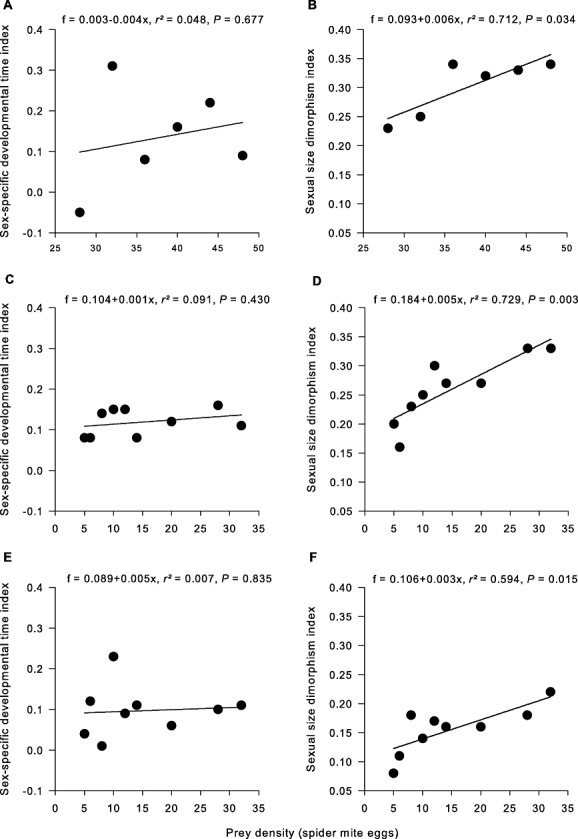
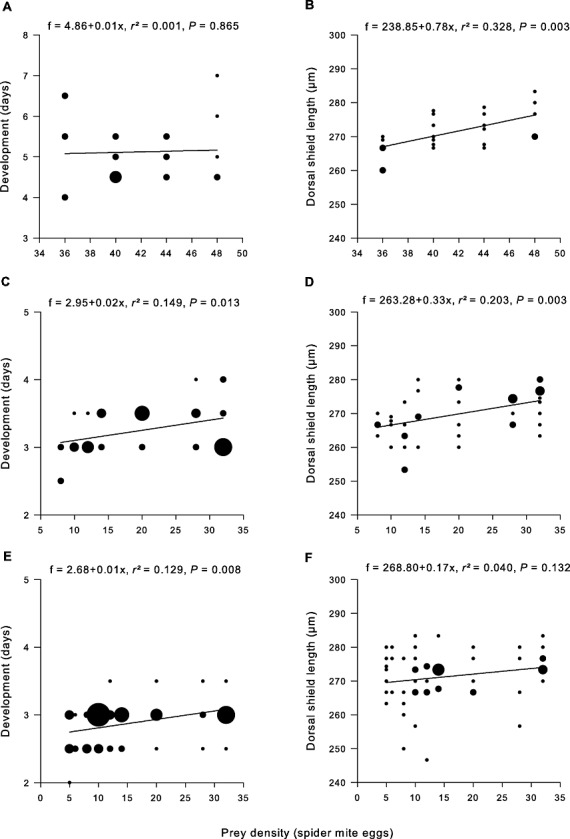
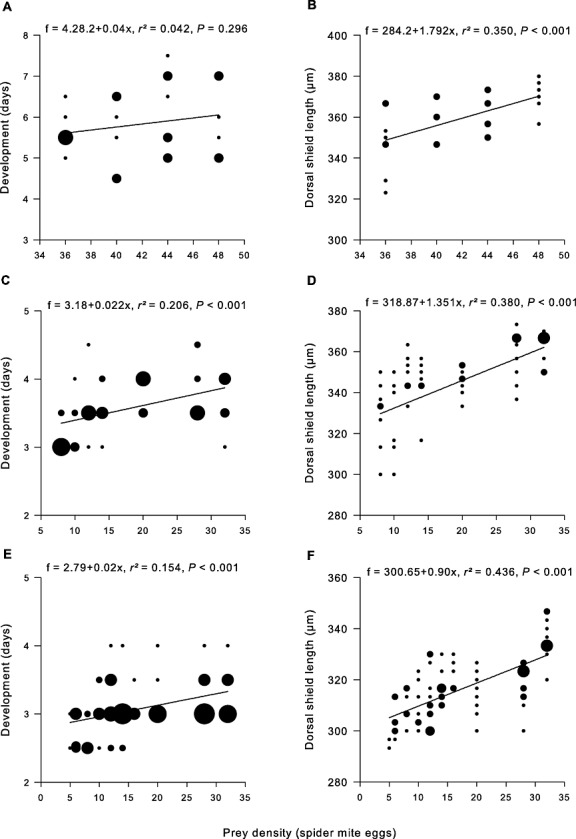
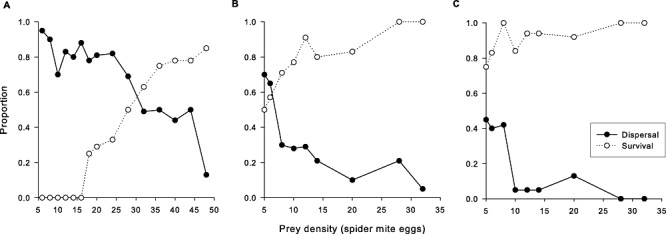
We studied developmental plasticity under food stress in three female-biased size dimorphic predatory mite species, Phytoseiulus persimilis, Neoseiulus californicus, and Amblyseius andersoni. All three species prey on two-spotted spider mites but differ in the degree of adaptation to this prey. Phytoseiulus persimilis is a specialized spider mite predator, N. californicus is a generalist with a preference for spider mites, and A. andersoni is a broad generalist. Immature predators were offered prey patches of varying density and their survival chances, dispersal tendencies, age and size at maturity measured. Amblyseius andersoni dispersed earlier from and had lower survival chances in low density prey patches than N. californicus and P. persimilis. Age at maturity was not affected by prey density in the generalist A. andersoni, whereas both the specialist P. persimilis and the generalist N. californicus accelerated development at low prey densities. Species-specific plasticity in age at maturity reflects opposite survival strategies when confronted with limited prey: to prematurely leave and search for other food (A. andersoni) or to stay and accelerate development (P. persimilis, N. californicus). In all species, size at maturity was more plastic in females than males, indicating that males incur higher fitness costs from deviations from optimal body size.

摘要

我们研究了三种雌性偏多的体型二态性捕食螨类,即智利小植绥螨、加州新小绥螨和安德森钝绥螨,在食物胁迫下的发育可塑性。这三种捕食螨均以二斑叶螨为食,但对这种猎物的适应程度有所不同。智利小植绥螨是一种专门捕食叶螨的捕食者,加州新小绥螨是一种偏好叶螨的广食性捕食者,而安德森钝绥螨是一种宽泛的广食性捕食者。为未成熟的捕食螨提供不同密度的猎物斑块,并测量它们的生存机会、扩散倾向、成熟时的年龄和体型。与加州新小绥螨和智利小植绥螨相比,安德森钝绥螨在低密度猎物斑块中更早扩散,且生存机会更低。广食性的安德森钝绥螨成熟时的年龄不受猎物密度的影响,而专门捕食者智利小植绥螨和广食性的加州新小绥螨在低猎物密度下都会加速发育。成熟时年龄的物种特异性可塑性反映了在面对有限猎物时相反的生存策略:过早离开并寻找其他食物(安德森钝绥螨)或留下来加速发育(智利小植绥螨、加州新小绥螨)。在所有物种中,雌性成熟时的体型比雄性更具可塑性,这表明雄性偏离最佳体型会产生更高的适合度成本。
https://cdn.ncbi.nlm.nih.gov/pmc/blobs/46c4/4548406/cfef344f7410/bij0102-0650-f4.jpg
https://cdn.ncbi.nlm.nih.gov/pmc/blobs/46c4/4548406/eab72849cc9b/bij0102-0650-f1.jpg
https://cdn.ncbi.nlm.nih.gov/pmc/blobs/46c4/4548406/9c2a019be0fc/bij0102-0650-f2.jpg
https://cdn.ncbi.nlm.nih.gov/pmc/blobs/46c4/4548406/d54dfee59706/bij0102-0650-f3.jpg
https://cdn.ncbi.nlm.nih.gov/pmc/blobs/46c4/4548406/cfef344f7410/bij0102-0650-f4.jpg
https://cdn.ncbi.nlm.nih.gov/pmc/blobs/46c4/4548406/eab72849cc9b/bij0102-0650-f1.jpg
https://cdn.ncbi.nlm.nih.gov/pmc/blobs/46c4/4548406/9c2a019be0fc/bij0102-0650-f2.jpg
https://cdn.ncbi.nlm.nih.gov/pmc/blobs/46c4/4548406/d54dfee59706/bij0102-0650-f3.jpg
https://cdn.ncbi.nlm.nih.gov/pmc/blobs/46c4/4548406/cfef344f7410/bij0102-0650-f4.jpg

相似文献

1
Sex-specific developmental plasticity of generalist and specialist predatory mites (Acari: Phytoseiidae) in response to food stress.多食性和专食性捕食螨(蜱螨亚纲:植绥螨科)对食物胁迫的性别特异性发育可塑性
Biol J Linn Soc Lond. 2011 Mar;102(3):650-660. doi: 10.1111/j.1095-8312.2010.01593.x.
2
Food stress causes sex-specific maternal effects in mites.食物压力会在螨虫中引发特定性别的母体效应。
J Exp Biol. 2015 Aug;218(Pt 16):2603-9. doi: 10.1242/jeb.123752. Epub 2015 Jun 18.
3
Amblyseius andersoni Chant (Acari: Phytoseiidae), a successful predatory mite on Rosa spp.安德森钝绥螨(Acari: Phytoseiidae),一种在蔷薇属植物上成功定殖的捕食螨。
Commun Agric Appl Biol Sci. 2004;69(3):157-63.
4
Population dynamics of interacting predatory mites, Phytoseiulus persimilis and Neoseiulus californicus, held on detached bean leaves.置于离体豆叶上的捕食性螨类智利小植绥螨和加州新小绥螨相互作用的种群动态
Exp Appl Acarol. 2001;25(9):731-43. doi: 10.1023/a:1016332129137.
5
Ontogenetic shifts in intraguild predation on thrips by phytoseiid mites: the relevance of body size and diet specialization.植绥螨对蓟马的集团内捕食的个体发育转变:体型大小与食性特化的相关性
Bull Entomol Res. 2004 Dec;94(6):577-84. doi: 10.1079/ber2004329.
6
Intraguild interactions between the predatory mites Neoseiulus californicus and Phytoseiulus persimilis.捕食性螨类加州新小绥螨和智利小植绥螨之间的集团内相互作用。
Exp Appl Acarol. 2006;38(1):33-46. doi: 10.1007/s10493-005-6247-7.
7
Foraging time and spatial patterns of predation in experimental populations : A comparative study of three mite predator-prey systems (Acari: Phytoseiidae, Tetranychidae).实验种群中捕食的觅食时间和空间模式:三种螨类捕食者 - 猎物系统(蜱螨亚纲:植绥螨科、叶螨科)的比较研究
Oecologia. 1992 May;90(2):185-196. doi: 10.1007/BF00317175.
8
Spatiotemporal within-plant distribution of the spider mite Tetranychus urticae and associated specialist and generalist predators.二斑叶螨及其相关的专食性和广食性捕食者在植物内的时空分布。
Bull Entomol Res. 2009 Oct;99(5):457-66. doi: 10.1017/S0007485308006494. Epub 2009 Jan 21.
9
Sublethal effects of chlorfenapyr and acequinocyl on the functional and numerical responses of the predatory mites Phytoseiulus persimilis and Neoseiulus californicus (Acari: Phytoseiidae) feeding on Tetranychus urticae (Acari: Tetranychidae).虫螨腈和乙螨唑对以二斑叶螨为食的智利小植绥螨和加州新小绥螨(蜱螨亚纲:植绥螨科)功能反应和数值反应的亚致死效应
Exp Appl Acarol. 2024 Dec 30;94(1):20. doi: 10.1007/s10493-024-00984-7.
10
Phenotypic plasticity in anti-intraguild predator strategies: mite larvae adjust their behaviours according to vulnerability and predation risk.种内捕食者策略的表型可塑性:螨幼虫根据易损性和捕食风险调整行为。
Exp Appl Acarol. 2013 May;60(1):95-115. doi: 10.1007/s10493-012-9624-z. Epub 2012 Oct 28.

引用本文的文献

1
Early life food intake modulates effects of diet restriction on lifespan and fecundity in later life in a predatory mite (Acari: Phytoseiidae).早期食物摄入量调节了节食对捕食性螨类(蜱螨亚纲:植绥螨科)后期寿命和繁殖力的影响。
Curr Zool. 2024 Sep 12;71(3):295-303. doi: 10.1093/cz/zoae047. eCollection 2025 Jun.
2
Phenotypic plasticity in the sailfin molly III: Geographic variation in reaction norms of growth and maturation to temperature and salinity.帆鳍鳉的表型可塑性III:生长和成熟对温度及盐度的反应规范的地理变异
Ecol Evol. 2024 May 31;14(6):e11482. doi: 10.1002/ece3.11482. eCollection 2024 Jun.
3
Reproducing during Heat Waves: Influence of Juvenile and Adult Environment on Fecundity of a Pest Mite and Its Predator.

本文引用的文献

1
FITNESS SENSITIVITY AND THE CANALIZATION OF LIFE-HISTORY TRAITS.适应性敏感性与生活史性状的发育稳定性
Evolution. 1994 Oct;48(5):1438-1450. doi: 10.1111/j.1558-5646.1994.tb02186.x.
2
ADAPTIVE PHENOTYPIC PLASTICITY IN GROWTH, DEVELOPMENT, AND BODY SIZE IN THE YELLOW DUNG FLY.黄粪蝇生长、发育和体型的适应性表型可塑性
Evolution. 1998 Oct;52(5):1394-1407. doi: 10.1111/j.1558-5646.1998.tb02021.x.
3
Effects of habitat drying on size at and time to metamorphosis in the tree hole mosquito Aedes triseriatus.栖息地干燥对树洞蚊三带喙库蚊变态时的大小和变态时间的影响。
在热浪期间繁殖:幼螨和成螨环境对害虫螨及其捕食者繁殖力的影响。
Biology (Basel). 2023 Apr 5;12(4):554. doi: 10.3390/biology12040554.
4
Trans- and Within-Generational Developmental Plasticity May Benefit the Prey but Not Its Predator during Heat Waves.跨代及代内发育可塑性在热浪期间可能使猎物受益,但对其捕食者则不然。
Biology (Basel). 2022 Jul 27;11(8):1123. doi: 10.3390/biology11081123.
5
Association Between Air Pollutants and Pediatric Respiratory Outpatient Visits in Zhoushan, China.中国舟山空气中污染物与儿科呼吸门诊就诊之间的关联
Front Public Health. 2022 Apr 4;10:865798. doi: 10.3389/fpubh.2022.865798. eCollection 2022.
6
Founder effects on trans-generational dynamics of closed inbreeding lineages of the predatory mite Phytoseiulus persimilis.封闭近交系捕食螨智利小植绥螨跨代动态的奠基者效应。
PLoS One. 2019 Apr 11;14(4):e0215360. doi: 10.1371/journal.pone.0215360. eCollection 2019.
7
Balancing in- and out-breeding by the predatory mite Phytoseiulus persimilis.捕食螨智利小植绥螨的内交和外交平衡
Exp Appl Acarol. 2018 Feb;74(2):159-169. doi: 10.1007/s10493-018-0225-3. Epub 2018 Feb 19.
8
Low level of polyandry constrains phenotypic plasticity of male body size in mites.低水平的一妻多夫制限制了螨虫雄性体型的表型可塑性。
PLoS One. 2017 Nov 30;12(11):e0188924. doi: 10.1371/journal.pone.0188924. eCollection 2017.
9
Sex-dependent effects of larval food stress on adult performance under semi-natural conditions: only a matter of size?半自然条件下幼虫食物胁迫对成虫表现的性别依赖性影响:仅仅是大小问题吗?
Oecologia. 2017 Jul;184(3):633-642. doi: 10.1007/s00442-017-3903-7. Epub 2017 Jul 6.
10
Transgenerational loss and recovery of early learning ability in foraging predatory mites.捕食性螨类早期学习能力的跨代丧失与恢复
Exp Appl Acarol. 2017 Mar;71(3):243-258. doi: 10.1007/s10493-017-0122-1. Epub 2017 Apr 13.
Oecologia. 1994 Apr;97(3):369-376. doi: 10.1007/BF00317327.
4
Sex differences in phenotypic plasticity affect variation in sexual size dimorphism in insects: from physiology to evolution.性别差异对表型可塑性的影响,会影响昆虫性二型性的变化:从生理学到进化。
Annu Rev Entomol. 2010;55:227-45. doi: 10.1146/annurev-ento-112408-085500.
5
Effect of multiple mating on reproduction and longevity of the phytoseiid mite Neoseiulus californicus.多次交配对植绥螨加州新小绥螨繁殖和寿命的影响。
Exp Appl Acarol. 2008 Mar;44(3):185-97. doi: 10.1007/s10493-008-9143-0. Epub 2008 Apr 1.
6
Mating behavior of the predatory mite Kampimodromus aberrans (Acari: Phytoseiidae).捕食螨异形坎氏螨(蜱螨亚纲:植绥螨科)的交配行为。
Exp Appl Acarol. 2005;36(3):187-97. doi: 10.1007/s10493-005-5303-7.
7
Effect of temperature on life history of the predatory mite Amblyseius (Neoseiulus) californicus (Acari: Phytoseiidae).温度对捕食螨加利福尼亚钝绥螨(蜱螨亚纲:植绥螨科)生活史的影响
Exp Appl Acarol. 2004;32(1-2):15-30. doi: 10.1023/b:appa.0000018192.91930.49.
8
Life-styles of Phytoseiid mites and their roles in biological control.植绥螨的生活方式及其在生物防治中的作用。
Annu Rev Entomol. 1997;42:291-321. doi: 10.1146/annurev.ento.42.1.291.
9
Climbing to reach females: Romeo should be small.为接近雌性而攀爬:罗密欧应该体型小。
Evolution. 2002 Feb;56(2):420-5. doi: 10.1111/j.0014-3820.2002.tb01351.x.
10
Compensation for a bad start: grow now, pay later?为糟糕开局做出补偿:现在成长,日后付出代价?
Trends Ecol Evol. 2001 May 1;16(5):254-260. doi: 10.1016/s0169-5347(01)02124-3.