Department of Oromaxillofacial-Head & Neck Surgery, School of Stomatology, China Medical University, No, 117, Nanjing Bei Jie, Heping District, Shenyang, Liaoning, 110002, China.
World J Surg Oncol. 2011 Oct 23;9:135. doi: 10.1186/1477-7819-9-135.
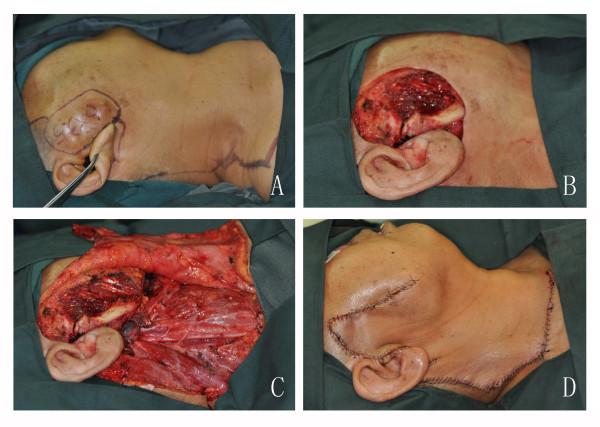
The large defects resulting from head and neck tumour surgeries present a reconstructive challenge to surgeons. Although numerous methods can be used, they all have their own limitations. In this paper, we present our experience with cervicofacial and cervicothoracic rotation flaps to help expand the awareness and application of this useful system of flaps.
Twenty-one consecutive patients who underwent repair of a variety of defects of the head and neck with cervicofacial or cervicothoracic flaps in our hospital from 2006 to 2009 were retrospectively analysed. Statistics pertaining to the patients' clinical factors were gathered.
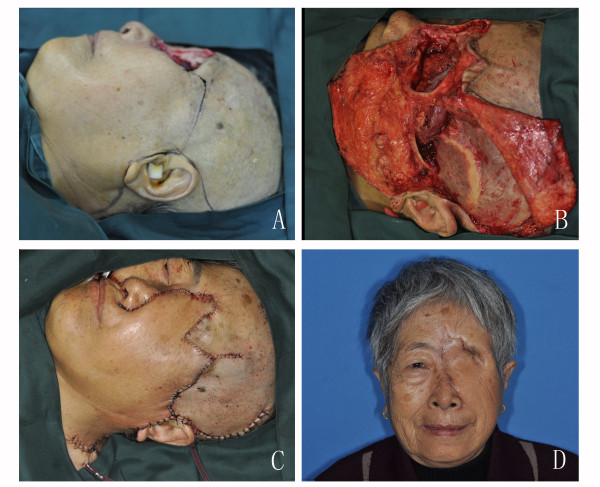
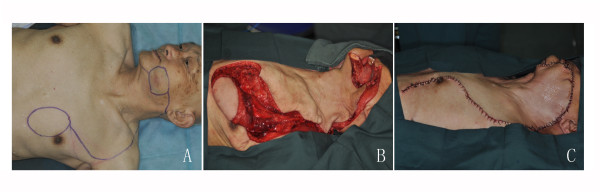
Cheek neoplasms are the most common indication for cervicofacial and cervicothoracic rotation flaps, followed by parotid tumours. Among the 12 patients with medical comorbidities, the most common was hypertension. Defects ranging from 1.5 cm × 1.5 cm to 7 cm × 6 cm were reconstructed by cervicofacial flap, and defects from 3 cm × 2 cm to 16 cm × 7 cm were reconstructed by cervicothoracic flap. The two flaps also exhibited versatility in these reconstructions. When combined with the pectoralis major myocutaneous flap, the cervicothoracic flap could repair through-and-through cheek defects, and in combination with a temporalis myofacial flap, the cervicofacial flap was able to cover orbital defects. Additionally, 95% patients were satisfied with their resulting contour results.
Cervicofacial and cervicothoracic flaps provide a technically simple, reliable, safe, efficient and cosmetic means to reconstruct defects of the head and neck.
头颈部肿瘤手术后的大面积缺损给外科医生带来了重建挑战。虽然有许多方法可以使用,但它们都有自己的局限性。本文介绍了我们使用颈颌和颈胸旋转皮瓣的经验,以帮助扩大对这一有用皮瓣系统的认识和应用。
回顾性分析 2006 年至 2009 年我院 21 例头颈部各种缺损患者行颈颌或颈胸旋转皮瓣修复的临床资料。收集患者的临床因素相关统计学资料。
颊部肿瘤是颈颌和颈胸旋转皮瓣最常见的适应证,其次是腮腺肿瘤。12 例合并内科疾病的患者中,最常见的是高血压。颈颌皮瓣重建缺损范围为 1.5cm×1.5cm 至 7cm×6cm,颈胸皮瓣重建缺损范围为 3cm×2cm 至 16cm×7cm。两种皮瓣在这些重建中也表现出多功能性。颈胸皮瓣与胸大肌肌皮瓣联合可修复贯穿颊部的缺损,颈颌皮瓣与颞肌筋膜瓣联合可覆盖眶部缺损。此外,95%的患者对重建后的轮廓效果满意。
颈颌和颈胸皮瓣为头颈部缺损的重建提供了一种技术简单、可靠、安全、有效和美容的方法。