Department of Oral Biological and Medical Science, The University of British Columbia, Wesbrook Mall, Vancouver, Canada.
BMC Cancer. 2011 Oct 25;11:462. doi: 10.1186/1471-2407-11-462.
Oral cancer is a major health problem worldwide. The 5-year survival rate ranges from 30-60%, and has remained unchanged in the past few decades. This is mainly due to late diagnosis and high recurrence of the disease. Of the patients who receive treatment, up to one third suffer from a recurrence or a second primary tumor. It is apparent that one major cause of disease recurrence is clinically unrecognized field changes which extend beyond the visible tumor boundary. We have previously developed an approach using fluorescence visualization (FV) technology to improve the recognition of the field at risk surrounding a visible oral cancer that needs to be removed and preliminary results have shown a significant reduction in recurrence rates.
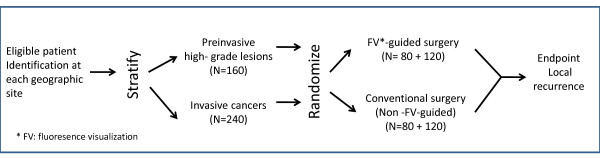
METHOD/DESIGN: This paper describes the study design of a randomized, multi-centre, double blind, controlled surgical trial, the COOLS trial. Nine institutions across Canada will recruit a total of 400 patients with oral severe dysplasia or carcinoma in situ (N = 160) and invasive squamous cell carcinoma (N = 240). Patients will be stratified by participating institution and histology grade and randomized equally into FV-guided surgery (experimental arm) or white light-guided surgery (control arm). The primary endpoint is a composite of recurrence at or 1 cm within the previous surgery site with 1) the same or higher grade histology compared to the initial diagnosis (i.e., the diagnosis used for randomization); or 2) further treatment due to the presence of severe dysplasia or higher degree of change at follow-up. This is the first randomized, multi-centre trial to validate the effectiveness of the FV-guided surgery.
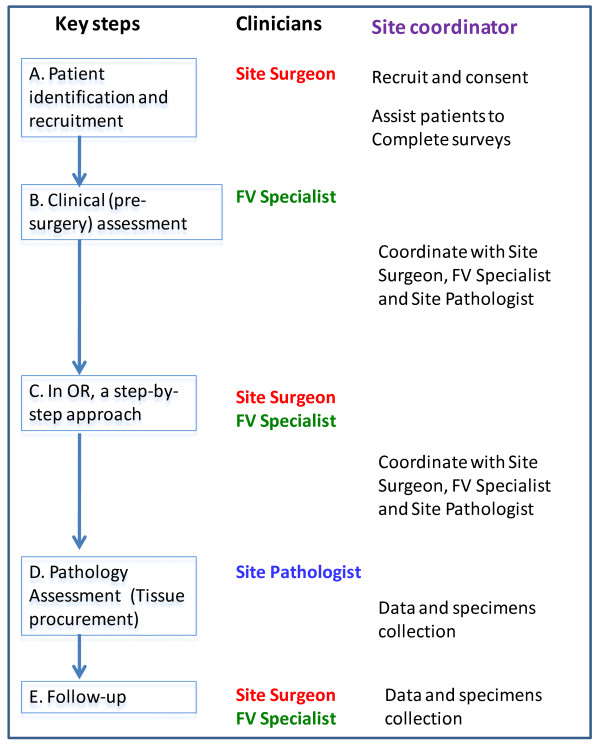
In this paper we described the strategies, novelty, and challenges of this unique trial involving a surgical approach guided by the FV technology. The success of the trial requires training, coordination, and quality assurance across multiple sites within Canada. The COOLS trial, an example of translational research, may result in reduced recurrence rates following surgical treatment of early-stage oral cancer with significant impacts on survival, morbidity, patients' quality of life and the cost to the health care system.
Clinicaltrials.gov NCT01039298.
口腔癌是全球范围内的一个主要健康问题。5 年生存率在 30-60%之间,在过去几十年中没有变化。这主要是由于诊断较晚和疾病复发率高所致。在接受治疗的患者中,多达三分之一的患者复发或出现第二原发肿瘤。显然,疾病复发的一个主要原因是临床无法识别超出可见肿瘤边界的扩展的场变化。我们之前开发了一种使用荧光可视化 (FV) 技术的方法来改善对需要切除的可见口腔癌周围风险场的识别,初步结果显示复发率显著降低。
方法/设计:本文介绍了一项随机、多中心、双盲、对照手术试验——COOLS 试验的研究设计。加拿大的 9 家机构将总共招募 400 名患有口腔重度发育不良或原位癌(N=160)和侵袭性鳞状细胞癌(N=240)的患者。患者将根据参与机构和组织学分级进行分层,并平均随机分为 FV 引导手术(实验组)或白光引导手术(对照组)。主要终点是在先前手术部位或 1 厘米内复发的复合结果,同时满足以下条件之一:1)与初始诊断相比,组织学分级相同或更高(即用于随机分组的诊断);或 2)在随访中因重度发育不良或更高级别的变化而需要进一步治疗。这是第一项验证 FV 引导手术有效性的随机、多中心试验。
在本文中,我们描述了这项独特试验的策略、新颖性和挑战,该试验涉及由 FV 技术引导的手术方法。试验的成功需要在加拿大的多个地点进行培训、协调和质量保证。COOLS 试验是转化研究的一个范例,可能会降低早期口腔癌手术后的复发率,对生存、发病率、患者生活质量和医疗保健系统成本产生重大影响。
Clinicaltrials.gov NCT01039298。