
术后切除腔内的水囊可改善上颌窦癌放射治疗中靶区的剂量分布。
Water-filled balloon in the postoperative resection cavity improves dose distribution to target volumes in radiotherapy of maxillary sinus carcinoma.
作者信息
Zhang Qun, Lin Shi-Rong, He Fang, Kang De-Hua, Chen Guo-Zhang, Luo Wei
机构信息
State Key Laboratory of Oncology in South China, Guangzhou, Guangdong 510060, P. R. China.
出版信息
Chin J Cancer. 2011 Nov;30(11):786-93. doi: 10.5732/cjc.011.10168.
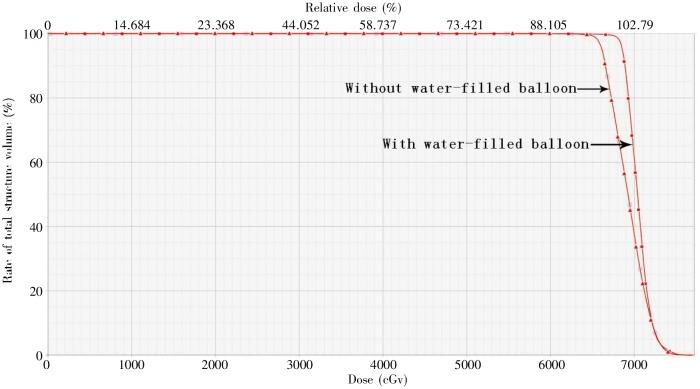
Postoperative radiotherapy is a major treatment for patients with maxillary sinus carcinoma. However, the irregular resection cavity poses a technical difficulty for this treatment, causing uneven dose distribution to target volumes. In this study, we evaluated the dose distribution to target volumes and normal tissues in postoperative intensity-modulated radiotherapy (IMRT) after placing a water-filled balloon into the resection cavity. Three postoperative patients with advanced maxillary sinus carcinoma were selected in this trial. Water-filled balloons and supporting dental stents were fabricated according to the size of the maxillary resection cavity. Simulation CT scans were performed with or without water-filled balloons, IMRT treatment plans were established, and dose distribution to target volumes and organs at risk were evaluated. Compared to those in the treatment plan without balloons, the dose (D98) delivered to 98% of the gross tumor volume (GTV) increased by 2.1 Gy (P = 0.009), homogeneity index (HI) improved by 2.3% (P = 0.001), and target volume conformity index (TCI) of 68 Gy increased by 18.5% (P = 0.011) in the plan with balloons. Dosimetry endpoints of normal tissues around target regions in both plans were not significantly different (P > 0.05) except for the optic chiasm. In the plan without balloons, 68 Gy high-dose regions did not entirely cover target volumes in the ethmoid sinus, posteromedial wall of the maxillary sinus, or surgical margin of the hard palate. In contrast, 68 Gy high-dose regions entirely covered the GTV in the plan with balloons. These results suggest that placing a water-filled balloon in the resection cavity for postoperative IMRT of maxillary sinus carcinoma can reduce low-dose regions and markedly and simultaneously increase dose homogeneity and conformity of target volumes.
术后放疗是上颌窦癌患者的主要治疗手段。然而,不规则的切除腔给这种治疗带来了技术难题,导致靶区剂量分布不均。在本研究中,我们评估了在上颌窦癌术后调强放疗(IMRT)中,将充水球囊置入切除腔后靶区和正常组织的剂量分布情况。本试验选取了3例上颌窦癌术后患者。根据上颌骨切除腔的大小制作充水球囊和配套牙托。分别在有或没有充水球囊的情况下进行模拟CT扫描,制定IMRT治疗计划,并评估靶区和危及器官的剂量分布。与无球囊治疗计划相比,有球囊计划中给予98%大体肿瘤体积(GTV)的剂量(D98)增加了2.1 Gy(P = 0.009),均匀性指数(HI)提高了2.3%(P = 0.001),68 Gy的靶区适形指数(TCI)提高了18.5%(P = 0.011)。除视交叉外,两个计划中靶区周围正常组织的剂量学终点无显著差异(P > 0.05)。在无球囊计划中,68 Gy高剂量区未完全覆盖筛窦、上颌窦后壁或硬腭手术切缘的靶区。相比之下,在有球囊计划中,68 Gy高剂量区完全覆盖了GTV。这些结果表明,在上颌窦癌术后IMRT中,在切除腔内放置充水球囊可减少低剂量区,并显著同时增加靶区剂量均匀性和适形性。



 Zotero 插件