• 文献检索
  • 文档翻译
  • 深度研究
  • 学术资讯
  • Suppr Zotero 插件Zotero 插件
  • 邀请有礼
  • 套餐&价格
  • 历史记录
应用&插件
Suppr Zotero 插件Zotero 插件浏览器插件Mac 客户端Windows 客户端微信小程序
定价
高级版会员购买积分包购买API积分包
服务
文献检索文档翻译深度研究API 文档MCP 服务
关于我们
关于 Suppr公司介绍联系我们用户协议隐私条款
关注我们

Suppr 超能文献

核心技术专利:CN118964589B侵权必究
粤ICP备2023148730 号-1Suppr @ 2026

文献检索

告别复杂PubMed语法,用中文像聊天一样搜索,搜遍4000万医学文献。AI智能推荐,让科研检索更轻松。

立即免费搜索

文件翻译

保留排版,准确专业,支持PDF/Word/PPT等文件格式,支持 12+语言互译。

免费翻译文档

深度研究

AI帮你快速写综述,25分钟生成高质量综述,智能提取关键信息,辅助科研写作。

立即免费体验

转录因子NFI和NFIII/oct-1独立发挥作用,采用不同机制增强腺病毒DNA复制。

Transcription factors NFI and NFIII/oct-1 function independently, employing different mechanisms to enhance adenovirus DNA replication.

作者信息

Mul Y M, Verrijzer C P, van der Vliet P C

机构信息

Laboratory for Physiological Chemistry, University of Utrecht, The Netherlands.

出版信息

J Virol. 1990 Nov;64(11):5510-8. doi: 10.1128/JVI.64.11.5510-5518.1990.

DOI:10.1128/JVI.64.11.5510-5518.1990
PMID:2214023
原文链接:https://pmc.ncbi.nlm.nih.gov/articles/PMC248603/
Abstract

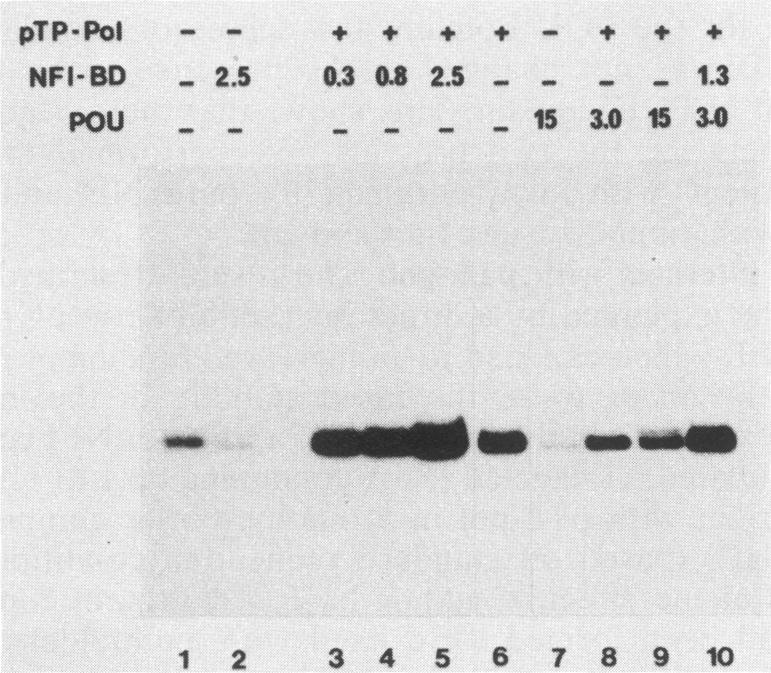
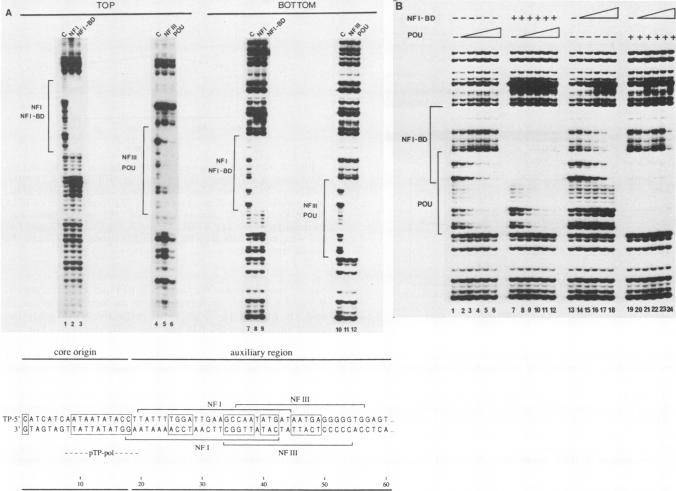
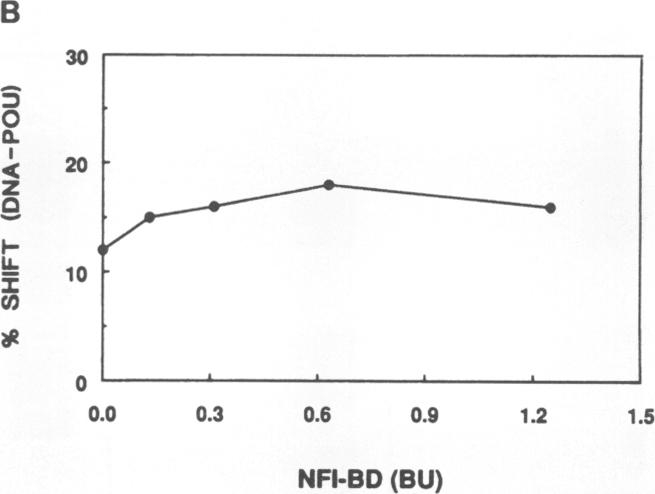
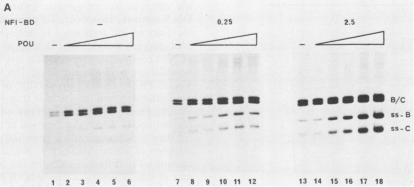
Initiation of adenovirus DNA replication is strongly enhanced by two transcription factors, nuclear factor I (NFI) and nuclear factor III (NFIII/oct-1). These proteins bind to two closely spaced recognition sequences in the origin. We produced NFI and NFIII/oct-1, as well as their biologically active, replication-competent DNA-binding domains (NFI-BD and the POU domain), in a vaccinia virus expression system and purified these polypeptides to apparent homogeneity. By DNase I footprinting and gel retardation, we show that the two proteins, as well as their purified DNA-binding domains, bind independently and without cooperative effects to their recognition sequences. By using a reconstituted system consisting of the purified viral proteins (precursor terminal protein-DNA polymerase complex (pTP-pol) and DNA-binding protein, we show that NFIII/oct-1 or the POU domain stimulates DNA replication in the absence of NFI or NFI-BD and vice versa. When added together, the enhancing effect of the two transcription factors was independent and nonsynergistic. Interestingly, stimulation by NFI or NFI-BD was strongly dependent on the concentration of the pTP-pol complex. At low pTP-pol concentrations, NFI or NFI-BD stimulated up to 50-fold, while at high concentrations, the stimulation was less than twofold, indicating that the need for NFI can be overcome by high pTP-pol concentrations. In contrast, stimulation by NFIII/oct-1 or the POU domain was much less dependent on the pTP-pol concentration. These data support a model in which NFI enhances initiation through an interaction with pTP-pol. Glutaraldehyde cross-linking experiments indicate contacts between pTP-pol and NFI but not NFIII/oct-1. The site of interaction is located in the NFI-BD domain.

摘要

腺病毒DNA复制的起始受到两种转录因子的强烈增强,即核因子I(NFI)和核因子III(NFIII/oct-1)。这些蛋白质与起始位点中两个紧密间隔的识别序列结合。我们在痘苗病毒表达系统中产生了NFI和NFIII/oct-1,以及它们具有生物学活性、能进行复制的DNA结合结构域(NFI-BD和POU结构域),并将这些多肽纯化至表观均一性。通过DNase I足迹法和凝胶阻滞实验,我们表明这两种蛋白质以及它们纯化的DNA结合结构域独立结合且无协同效应地与其识别序列结合。通过使用由纯化的病毒蛋白(前体末端蛋白-DNA聚合酶复合物(pTP-pol)和DNA结合蛋白)组成的重构系统,我们表明在没有NFI或NFI-BD的情况下,NFIII/oct-1或POU结构域能刺激DNA复制,反之亦然。当两者一起添加时,这两种转录因子的增强作用是独立且无协同性的。有趣的是,NFI或NFI-BD的刺激强烈依赖于pTP-pol复合物的浓度。在低pTP-pol浓度下,NFI或NFI-BD的刺激作用高达50倍,而在高浓度下,刺激作用小于两倍,这表明高pTP-pol浓度可以克服对NFI的需求。相比之下,NFIII/oct-1或POU结构域的刺激对pTP-pol浓度的依赖性要小得多。这些数据支持了一种模型,即NFI通过与pTP-pol相互作用来增强起始。戊二醛交联实验表明pTP-pol与NFI之间存在相互作用,但与NFIII/oct-1不存在相互作用。相互作用位点位于NFI-BD结构域。

https://cdn.ncbi.nlm.nih.gov/pmc/blobs/4957/248603/a3086065c4bc/jvirol00066-0294-a.jpg
https://cdn.ncbi.nlm.nih.gov/pmc/blobs/4957/248603/8e2daf365a9c/jvirol00066-0290-a.jpg
https://cdn.ncbi.nlm.nih.gov/pmc/blobs/4957/248603/649dcc693d04/jvirol00066-0291-a.jpg
https://cdn.ncbi.nlm.nih.gov/pmc/blobs/4957/248603/7b1f578e0f8d/jvirol00066-0292-a.jpg
https://cdn.ncbi.nlm.nih.gov/pmc/blobs/4957/248603/1da72843b0e1/jvirol00066-0292-b.jpg
https://cdn.ncbi.nlm.nih.gov/pmc/blobs/4957/248603/8619f6d66b4a/jvirol00066-0293-a.jpg
https://cdn.ncbi.nlm.nih.gov/pmc/blobs/4957/248603/999a801dcfdb/jvirol00066-0293-b.jpg
https://cdn.ncbi.nlm.nih.gov/pmc/blobs/4957/248603/a3086065c4bc/jvirol00066-0294-a.jpg
https://cdn.ncbi.nlm.nih.gov/pmc/blobs/4957/248603/8e2daf365a9c/jvirol00066-0290-a.jpg
https://cdn.ncbi.nlm.nih.gov/pmc/blobs/4957/248603/649dcc693d04/jvirol00066-0291-a.jpg
https://cdn.ncbi.nlm.nih.gov/pmc/blobs/4957/248603/7b1f578e0f8d/jvirol00066-0292-a.jpg
https://cdn.ncbi.nlm.nih.gov/pmc/blobs/4957/248603/1da72843b0e1/jvirol00066-0292-b.jpg
https://cdn.ncbi.nlm.nih.gov/pmc/blobs/4957/248603/8619f6d66b4a/jvirol00066-0293-a.jpg
https://cdn.ncbi.nlm.nih.gov/pmc/blobs/4957/248603/999a801dcfdb/jvirol00066-0293-b.jpg
https://cdn.ncbi.nlm.nih.gov/pmc/blobs/4957/248603/a3086065c4bc/jvirol00066-0294-a.jpg

相似文献

1
Transcription factors NFI and NFIII/oct-1 function independently, employing different mechanisms to enhance adenovirus DNA replication.转录因子NFI和NFIII/oct-1独立发挥作用,采用不同机制增强腺病毒DNA复制。
J Virol. 1990 Nov;64(11):5510-8. doi: 10.1128/JVI.64.11.5510-5518.1990.
2
Two regions within the DNA binding domain of nuclear factor I interact with DNA and stimulate adenovirus DNA replication independently.核因子I的DNA结合域内的两个区域与DNA相互作用,并独立刺激腺病毒DNA复制。
Mol Cell Biol. 1996 Aug;16(8):4073-80. doi: 10.1128/MCB.16.8.4073.
3
Nuclear factor I enhances adenovirus DNA replication by increasing the stability of a preinitiation complex.核因子I通过提高起始前复合物的稳定性来增强腺病毒DNA复制。
EMBO J. 1992 Feb;11(2):751-60. doi: 10.1002/j.1460-2075.1992.tb05108.x.
4
Enhancement of DNA replication by transcription factors NFI and NFIII/Oct-1 depends critically on the positions of their binding sites in the adenovirus origin of replication.转录因子NFI和NFIII/Oct-1对DNA复制的增强作用严重依赖于它们在腺病毒复制起点中结合位点的位置。
Biochim Biophys Acta. 1991 Aug 27;1090(1):61-9. doi: 10.1016/0167-4781(91)90037-m.
5
The Oct-1 POU domain stimulates adenovirus DNA replication by a direct interaction between the viral precursor terminal protein-DNA polymerase complex and the POU homeodomain.Oct-1 POU结构域通过病毒前体末端蛋白-DNA聚合酶复合物与POU同源结构域之间的直接相互作用刺激腺病毒DNA复制。
EMBO J. 1994 Nov 15;13(22):5401-9. doi: 10.1002/j.1460-2075.1994.tb06875.x.
6
Protein-protein interactions between adenovirus DNA polymerase and nuclear factor I mediate formation of the DNA replication preinitiation complex.腺病毒DNA聚合酶与核因子I之间的蛋白质-蛋白质相互作用介导了DNA复制起始前复合物的形成。
J Biol Chem. 1990 Oct 25;265(30):18634-42.
7
Interaction between the octamer-binding protein nuclear factor III and the adenovirus origin of DNA replication.八聚体结合蛋白核因子III与腺病毒DNA复制起点之间的相互作用。
J Virol. 1988 Sep;62(9):3092-102. doi: 10.1128/JVI.62.9.3092-3102.1988.
8
The Oct-1 POU homeodomain stabilizes the adenovirus preinitiation complex via a direct interaction with the priming protein and is displaced when the replication fork passes.Oct-1 POU 同源结构域通过与引发蛋白的直接相互作用稳定腺病毒预起始复合物,并在复制叉通过时被取代。
J Biol Chem. 1997 Feb 7;272(6):3398-405. doi: 10.1074/jbc.272.6.3398.
9
The adenovirus DNA binding protein effects the kinetics of DNA replication by a mechanism distinct from NFI or Oct-1.腺病毒DNA结合蛋白通过一种不同于NFI或Oct-1的机制影响DNA复制的动力学。
Nucleic Acids Res. 1993 Feb 11;21(3):641-7. doi: 10.1093/nar/21.3.641.
10
The NFIII/OCT-1 binding site stimulates adenovirus DNA replication in vivo and is functionally redundant with adjacent sequences.NFIII/OCT - 1结合位点在体内刺激腺病毒DNA复制,并且在功能上与相邻序列冗余。
J Virol. 1993 Jul;67(7):3931-9. doi: 10.1128/JVI.67.7.3931-3939.1993.

引用本文的文献

1
Bovine Adenoviral Vector-Based Platform for Vaccine Development.基于牛腺病毒载体的疫苗开发平台。
Vaccines (Basel). 2025 May 3;13(5):494. doi: 10.3390/vaccines13050494.
2
PIN1 is a novel interaction partner and a negative upstream regulator of the transcription factor NFIB.PIN1是一种新型的相互作用蛋白,也是转录因子NFIB的负向上游调节因子。
FEBS Lett. 2024 Dec;598(23):2910-2925. doi: 10.1002/1873-3468.15010. Epub 2024 Sep 8.
3
Genomics-based re-examination of the taxonomy and phylogeny of human and simian Mastadenoviruses: an evolving whole genomes approach, revealing putative zoonosis, anthroponosis, and amphizoonosis.

本文引用的文献

1
Crystallization of a fragment of the adenovirus DNA binding protein.腺病毒DNA结合蛋白片段的结晶
J Mol Biol. 1984 Jan 15;172(2):237-9. doi: 10.1016/s0022-2836(84)80042-x.
2
Adenovirus DNA replication in vitro: identification of a host factor that stimulates synthesis of the preterminal protein-dCMP complex.腺病毒DNA的体外复制:一种刺激末端前蛋白-dCMP复合物合成的宿主因子的鉴定。
Proc Natl Acad Sci U S A. 1982 Nov;79(21):6438-42. doi: 10.1073/pnas.79.21.6438.
3
Origin of adenovirus DNA replication. Role of the nuclear factor I binding site in vivo.
基于基因组的人类和猿猴巨细胞病毒的分类学和系统发育学的再研究:一种不断发展的全基因组方法,揭示了可能的人畜共患病、人兽共患病和人畜互传感染。
Cladistics. 2020 Aug;36(4):358-373. doi: 10.1111/cla.12422. Epub 2020 Jul 14.
4
Development and Application of a Fast Method to Acquire the Accurate Whole-Genome Sequences of Human Adenoviruses.一种快速获取人腺病毒准确全基因组序列方法的开发与应用
Front Microbiol. 2021 May 14;12:661382. doi: 10.3389/fmicb.2021.661382. eCollection 2021.
5
Viral and cellular interactions during adenovirus DNA replication.腺病毒 DNA 复制过程中的病毒和细胞相互作用。
FEBS Lett. 2019 Dec;593(24):3531-3550. doi: 10.1002/1873-3468.13695. Epub 2019 Dec 17.
6
Are adenoviruses zoonotic? A systematic review of the evidence.腺病毒是否为人畜共患病病毒?对现有证据的系统综述。
Emerg Microbes Infect. 2019;8(1):1679-1687. doi: 10.1080/22221751.2019.1690953.
7
Genomic characterization of human adenovirus type 4 strains isolated worldwide since 1953 identifies two separable phylogroups evolving at different rates from their most recent common ancestor.自 1953 年以来,从世界各地分离的人腺病毒 4 型毒株的基因组特征鉴定出两个可分离的进化枝,它们从最近的共同祖先以不同的速度进化。
Virology. 2019 Dec;538:11-23. doi: 10.1016/j.virol.2019.08.028. Epub 2019 Sep 8.
8
A Zoonotic Adenoviral Human Pathogen Emerged through Genomic Recombination among Human and Nonhuman Simian Hosts.一种人畜共患的腺病毒人类病原体通过人类和非人类灵长类宿主之间的基因组重组而出现。
J Virol. 2019 Aug 28;93(18). doi: 10.1128/JVI.00564-19. Print 2019 Sep 15.
9
A Survey of Recent Adenoviral Respiratory Pathogens in Hong Kong Reveals Emergent and Recombinant Human Adenovirus Type 4 (HAdV-E4) Circulating in Civilian Populations.一项关于香港近期腺病毒呼吸道病原体的调查显示,在普通人群中流行着新兴的和重组的人腺病毒 4 型(HAdV-E4)。
Viruses. 2019 Jan 31;11(2):129. doi: 10.3390/v11020129.
10
Adenoviromics: Mining the Human Adenovirus Species D Genome.腺病毒组学:挖掘人类腺病毒D种基因组
Front Microbiol. 2018 Sep 11;9:2178. doi: 10.3389/fmicb.2018.02178. eCollection 2018.
腺病毒DNA复制的起源。核因子I结合位点在体内的作用。
J Mol Biol. 1985 Nov 5;186(1):129-36. doi: 10.1016/0022-2836(85)90263-3.
4
Recognition site of nuclear factor I, a sequence-specific DNA-binding protein from HeLa cells that stimulates adenovirus DNA replication.核因子I的识别位点,一种来自HeLa细胞的序列特异性DNA结合蛋白,可刺激腺病毒DNA复制。
EMBO J. 1985 Jun;4(6):1515-21. doi: 10.1002/j.1460-2075.1985.tb03811.x.
5
Adenovirus DNA replication in vitro: site-directed mutagenesis of the nuclear factor I binding site of the Ad2 origin.腺病毒DNA的体外复制:腺病毒2型起源的核因子I结合位点的定点诱变
Nucleic Acids Res. 1985 Jul 11;13(13):4935-52. doi: 10.1093/nar/13.13.4935.
6
Sequence-specific interactions between cellular DNA-binding proteins and the adenovirus origin of DNA replication.细胞DNA结合蛋白与腺病毒DNA复制起点之间的序列特异性相互作用。
Mol Cell Biol. 1987 Feb;7(2):875-86. doi: 10.1128/mcb.7.2.875-886.1987.
7
Adenovirus origin of DNA replication: sequence requirements for replication in vitro.腺病毒DNA复制的起源:体外复制的序列要求
Mol Cell Biol. 1987 Feb;7(2):864-74. doi: 10.1128/mcb.7.2.864-874.1987.
8
Nuclear factor III, a novel sequence-specific DNA-binding protein from HeLa cells stimulating adenovirus DNA replication.核因子III,一种来自HeLa细胞的新型序列特异性DNA结合蛋白,可刺激腺病毒DNA复制。
Nature. 1986;322(6080):656-9. doi: 10.1038/322656a0.
9
Purification and characterization of OTF-1, a transcription factor regulating cell cycle expression of a human histone H2b gene.OTF-1的纯化与特性分析,OTF-1是一种调控人类组蛋白H2b基因细胞周期表达的转录因子。
Cell. 1987 Dec 4;51(5):773-81. doi: 10.1016/0092-8674(87)90100-0.
10
Promoter and enhancer elements containing a conserved sequence motif are recognized by nuclear factor III, a protein stimulating adenovirus DNA replication.含有保守序列基序的启动子和增强子元件可被核因子III识别,核因子III是一种刺激腺病毒DNA复制的蛋白质。
EMBO J. 1987 Dec 1;6(12):3771-8. doi: 10.1002/j.1460-2075.1987.tb02712.x.