Department of Microbiology and Immunology, University of Oklahoma Health Sciences Center, Oklahoma City, Oklahoma, United States of America.
PLoS One. 2011;6(12):e28619. doi: 10.1371/journal.pone.0028619. Epub 2011 Dec 6.
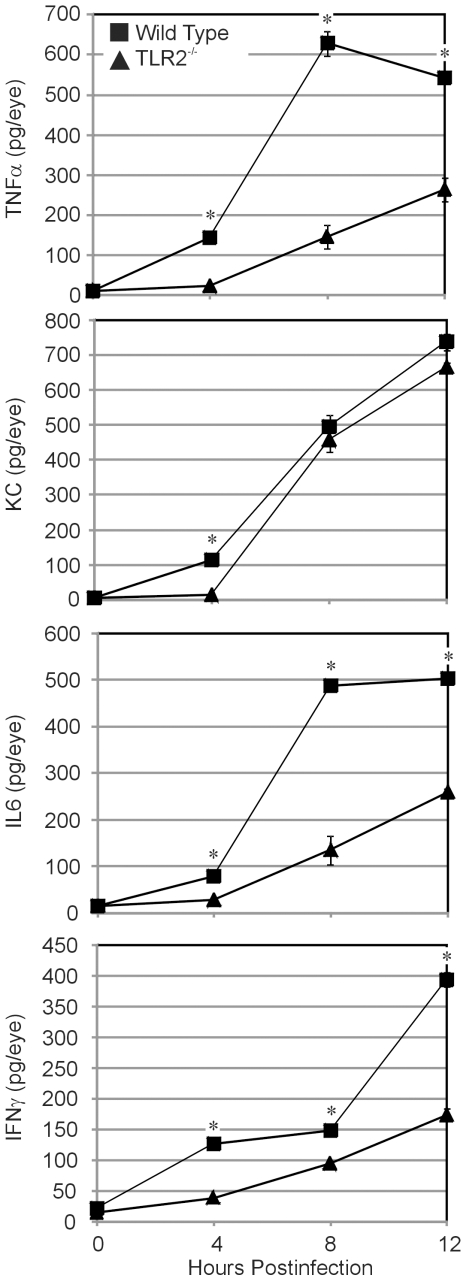
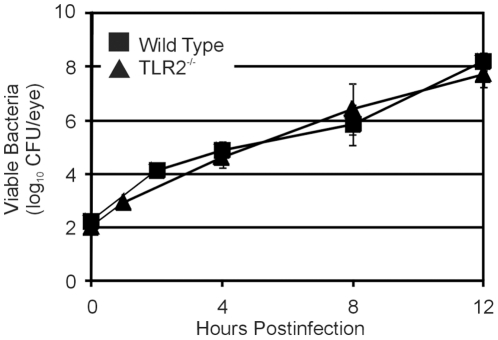
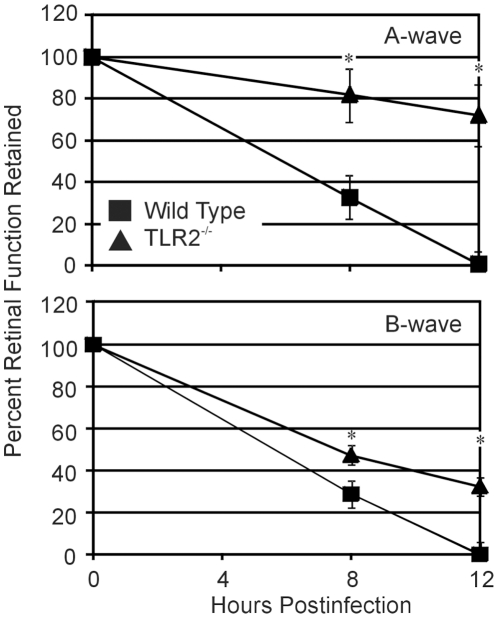
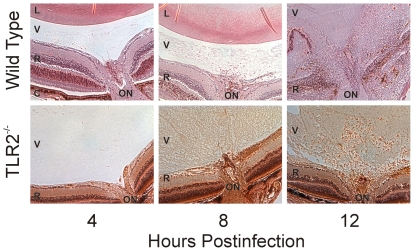
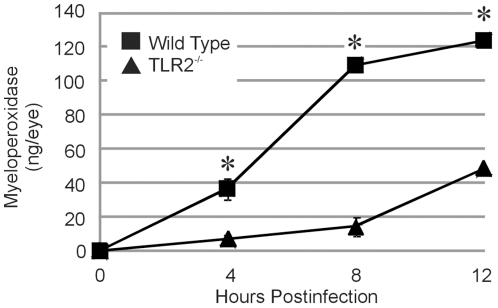
Bacillus cereus causes a uniquely rapid and blinding intraocular infection, endophthalmitis. B. cereus replicates in the eye, synthesizes numerous toxins, and incites explosive intraocular inflammation. The mechanisms involved in the rapid and explosive intraocular immune response have not been addressed. Because Toll-like receptors (TLRs) are integral to the initial recognition of organisms during infection, we hypothesized that the uniquely explosive immune response observed during B. cereus endophthalmitis is directly influenced by the presence of TLR2, a known gram-positive pathogen recognition receptor. To address this hypothesis, we compared the courses of experimental B. cereus endophthalmitis in wild type C57BL/6J mice to that of age-matched homozygous TLR2(-/-) mice. Output parameters included analysis of bacterial growth, inflammatory cell (PMN) infiltration, cytokine/chemokine kinetics, retinal function testing, and histology, with N≥4 eyes/assay/time point/mouse strain. B. cereus grew at similar rates to10(8) CFU/eye by 12 h, regardless of the mouse strain. Retinal function was preserved to a greater degree in infected TLR2(-/-) eyes compared to that of infected wild type eyes, but infected eyes of both mouse strains lost significant function. Retinal architecture was preserved in infected TLR2(-/-) eyes, with limited retinal and vitreal cellular infiltration compared to that of infected wild type eyes. Ocular myeloperoxidase activities corroborated these results. In general, TNFα, IFNγ, IL6, and KC were detected in greater concentrations in infected wild type eyes than in infected TLR2(-/-) eyes. The absence of TLR2 resulted in decreased intraocular proinflammatory cytokine/chemokine levels and altered recruitment of inflammatory cells into the eye, resulting in less intraocular inflammation and preservation of retinal architecture, and a slightly greater degree of retinal function. These results demonstrate TLR2 is an important component of the initial ocular response to B. cereus endophthalmitis.
蜡样芽胞杆菌引起独特的快速和致盲性眼内感染,即眼内炎。蜡样芽胞杆菌在眼内复制,合成大量毒素,并引发爆炸性眼内炎症。目前尚未研究涉及这种快速和爆炸性眼内免疫反应的机制。由于 Toll 样受体(TLR)是感染过程中识别生物体的重要组成部分,因此我们假设,在蜡样芽胞杆菌眼内炎中观察到的独特爆炸性免疫反应直接受到 TLR2 的影响,TLR2 是一种已知的革兰阳性病原体识别受体。为了验证这一假设,我们比较了野生型 C57BL/6J 小鼠和同窝出生的 TLR2(-/-) 小鼠实验性蜡样芽胞杆菌眼内炎的病程。观察参数包括细菌生长、炎性细胞(PMN)浸润、细胞因子/趋化因子动力学、视网膜功能测试和组织学,每组 N≥4 只眼/分析/时间点/小鼠品系。12 小时后,无论小鼠品系如何,蜡样芽胞杆菌的生长速度均相似,达到 10(8) CFU/眼。与感染野生型眼睛的眼睛相比,感染 TLR2(-/-)眼睛的视网膜功能保存程度更高,但两种小鼠品系的感染眼睛均丧失了明显的功能。与感染野生型眼睛相比,感染 TLR2(-/-)眼睛的视网膜结构得到了保留,视网膜和玻璃体细胞浸润有限。眼内髓过氧化物酶活性证实了这些结果。通常,与感染 TLR2(-/-)眼睛相比,感染野生型眼睛中 TNFα、IFNγ、IL6 和 KC 的浓度更高。TLR2 的缺失导致眼内促炎细胞因子/趋化因子水平降低,炎性细胞向眼内的募集减少,从而减少眼内炎症,保留视网膜结构,并在一定程度上保持视网膜功能。这些结果表明 TLR2 是对蜡样芽胞杆菌眼内炎的初始眼部反应的重要组成部分。