Programa de Pós-Graduação em Biologia Animal, Universidade Federal de Pernambuco, Av Professor Moraes Rego, Cidade Universitária, 50670-901 Recife, Pernambuco, Brazil.
J Insect Sci. 2011;11:114. doi: 10.1673/031.011.11401.
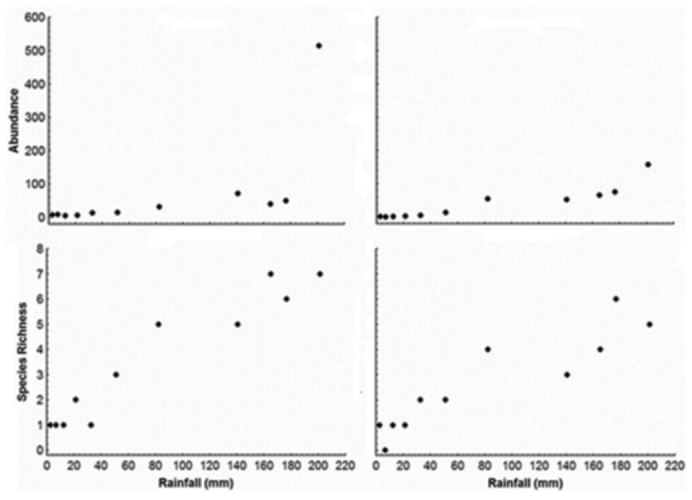
The aim of the present study was to evaluate how dung beetle communities respond to both environment and rainfall in the Caatinga, a semi-arid ecosystem in northeastern Brazil. The communities were sampled monthly from May 2006 to April 2007 using pitfall traps baited with human feces in two environments denominated "land use area" and "undisturbed area." Abundance and species richness were compared between the two environments and two seasons (dry and wet season) using a generalized linear model with a Poisson error distribution. Diversity was compared between the two environments (land use area and undisturbed area) and seasons (dry and wet) using the Two-Way ANOVA test. Non-metric multidimensional scaling was performed on the resemblance matrix of Bray-Curtis distances (with 1000 random restarts) to determine whether disturbance affected the abundance and species composition of the dung beetle communities. Spearman's correlation coefficient was used to determine whether rainfall was correlated with abundance and species richness. A total of 1097 specimens belonging to 13 species were collected. The most abundant and frequent species was Dichotomius geminatus Arrow (Coleoptera: Scarabaeidae). The environment exerted an influence over abundance. Abundance and diversity were affected by season, with an increase in abundance at the beginning of the wet season. The correlation coefficient values were high and significant for abundance and species richness, which were both correlated to rainfall. In conclusion, the restriction of species to some environments demonstrates the need to preserve these areas in order to avoid possible local extinction. Therefore, in extremely seasonable environments, such as the Caatinga, seasonal variation strongly affects dung beetle communities.
本研究旨在评估粪金龟群落如何对巴西东北部半干旱生态系统卡廷加的环境和降雨做出响应。2006 年 5 月至 2007 年 4 月,使用诱饵为人类粪便的陷阱每月在两个环境(“土地利用区”和“未受干扰区”)中对粪金龟群落进行采样。使用具有泊松误差分布的广义线性模型,比较了两个环境和两个季节(旱季和雨季)之间的丰度和物种丰富度。使用 Two-Way ANOVA 检验比较了两个环境(土地利用区和未受干扰区)和两个季节(旱季和雨季)之间的多样性。通过 Bray-Curtis 距离的相似性矩阵进行非度量多维尺度分析(1000 次随机重启),以确定干扰是否影响粪金龟群落的丰度和物种组成。Spearman 相关系数用于确定降雨量是否与丰度和物种丰富度相关。共采集到 1097 个标本,属于 13 个物种。最丰富和最常见的物种是 Dichotomius geminatus Arrow(鞘翅目:金龟科)。环境对丰度有影响。丰度和多样性受季节影响,雨季初期丰度增加。丰度和物种丰富度的相关系数值较高且显著,与降雨量相关。总之,某些物种对某些环境的限制表明需要保护这些区域,以避免可能的局部灭绝。因此,在像卡廷加这样季节性极强的环境中,季节性变化强烈影响粪金龟群落。