Myriad Genetic Laboratories, Salt Lake City, UT 84108, USA.
Cancer. 2012 Nov 1;118(21):5210-6. doi: 10.1002/cncr.27556. Epub 2012 Apr 27.
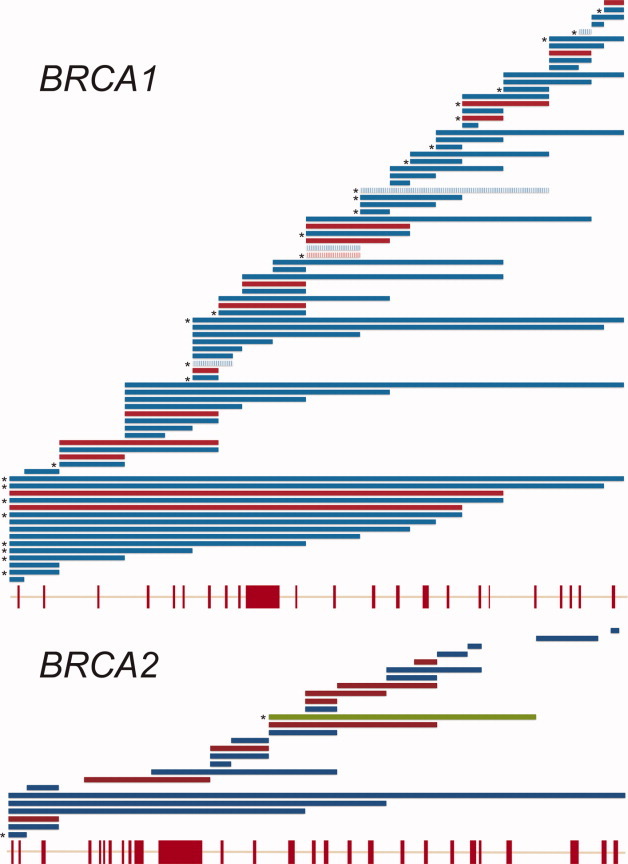
Current estimates of the contribution of large rearrangement (LR) mutations in the BRCA1 (breast cancer 1, early onset) and BRCA2 (breast cancer 2, early onset) genes responsible for hereditary breast and ovarian cancer are based on limited studies of relatively homogeneous patient populations. The prevalence of BRCA1/2 LRs was investigated in 48,456 patients with diverse clinical histories and ancestries, referred for clinical molecular testing for suspicion of hereditary breast and ovarian cancer.
Sanger sequencing analysis was performed for BRCA1/2 and LR testing for deletions and duplications using a quantitative multiplex polymerase chain reaction assay. Prevalence data were analyzed for patients from different risk and ethnic groups between July 2007 and April 2011. Patients were designated as "high-risk" if their clinical history predicted a high prior probability, wherein LR testing was performed automatically in conjunction with sequencing. "Elective" patients did not meet the high-risk criteria, but underwent LR testing as ordered by the referring health care provider.
Overall BRCA1/2 mutation prevalence among high-risk patients was 23.8% versus 8.2% for the elective group. The mutation profile for high-risk patients was 90.1% sequencing mutations versus 9.9% LRs, and for elective patients, 94.1% sequencing versus 5.9% LRs. This difference may reflect the bias in high-risk patients to carry mutations in BRCA1, which has a higher penetrance and frequency of LRs compared with BRCA2. There were significant differences in the prevalence and types of LRs in patients of different ancestries. LR mutations were significantly more common in Latin American/Caribbean patients.
Comprehensive LR testing in conjunction with full gene sequencing is an appropriate strategy for clinical BRCA1/2 analysis.
目前对 BRCA1(乳腺癌 1,早发)和 BRCA2(乳腺癌 2,早发)基因中导致遗传性乳腺癌和卵巢癌的大片段重排(LR)突变的贡献的估计是基于对相对同质的患者群体的有限研究。对 48456 名具有不同临床病史和种族的患者进行了 BRCA1/2 LR 的流行率调查,这些患者因怀疑遗传性乳腺癌和卵巢癌而接受临床分子检测。
对 BRCA1/2 进行 Sanger 测序分析,并使用定量多重聚合酶链反应(PCR)检测进行 LR 检测,用于缺失和重复。对 2007 年 7 月至 2011 年 4 月期间不同风险和种族组别的患者进行了患病率数据分析。如果患者的临床病史预测 LR 检测的先验概率较高,则将其指定为“高危”,LR 检测与测序一起自动进行。“选择性”患者不符合高危标准,但由转诊保健提供者下令进行 LR 检测。
高危患者的 BRCA1/2 突变总患病率为 23.8%,而选择性组为 8.2%。高危患者的突变谱为 90.1%测序突变,9.9%LR,而选择性患者为 94.1%测序,5.9%LR。这种差异可能反映了高危患者中 BRCA1 携带突变的偏向性,与 BRCA2 相比,BRCA1 具有更高的外显率和 LR 频率。不同种族患者的 LR 患病率和类型存在显著差异。LR 突变在拉丁美洲/加勒比患者中更为常见。
在全基因测序的基础上进行全面的 LR 检测,是临床 BRCA1/2 分析的合适策略。