
中心体蛋白对皮质微管组织和桥粒稳定性的调控
Control of cortical microtubule organization and desmosome stability by centrosomal proteins.
作者信息
Sumigray Kaelyn D, Lechler Terry
出版信息
Bioarchitecture. 2011 Sep 1;1(5):221-224. doi: 10.4161/bioa.18403.
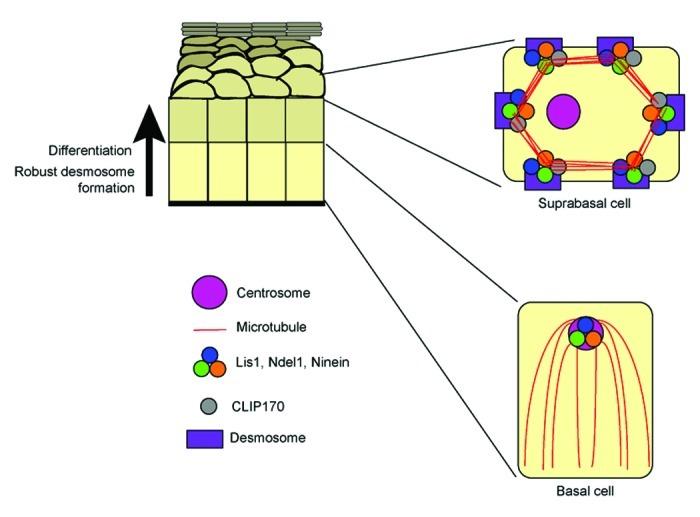
In many tissues microtubules reorganize into non-centrosomal arrays in differentiated cells. In the epidermis, proliferative basal cells have a radial array of microtubules organized around a centrosome, while differentiated cells have cortical microtubules. The desmosomal protein desmoplakin is required for the microtubules to organize around the cell cortex. Furthermore, the centrosomal and/or microtubule-associated proteins ninein, Lis1, Ndel1, and CLIP170 are recruited to the cell cortex, where they have been implicated in the cortical organization of microtubules. Recently, it has been shown that in Lis1-null epidermis, microtubules are disorganized in the differentiated layers of the epidermis. Furthermore, Lis1-null mice die perinatally due to dehydration. This is due, in part, to the unexpected desmosome phenotype observed in Lis1-null skin. Upon loss of Lis1, desmosomal proteins become less stable. Here, we propose that Lis1 may regulate desmosomal stability through its binding partners Nde1/Ndel1 and dynein.
在许多组织中,微管在分化细胞中重新组织形成非中心体阵列。在表皮中,增殖性基底细胞具有围绕中心体组织的微管径向阵列,而分化细胞具有皮质微管。桥粒蛋白桥粒斑蛋白是微管围绕细胞皮质组织所必需的。此外,中心体和/或微管相关蛋白九蛋白、Lis1、Ndel1和CLIP170被招募到细胞皮质,它们在微管的皮质组织中发挥作用。最近的研究表明,在Lis1基因缺失的表皮中,微管在表皮的分化层中排列紊乱。此外,Lis1基因缺失的小鼠在围产期因脱水而死亡。这部分是由于在Lis1基因缺失的皮肤中观察到的意外桥粒表型。Lis1缺失后,桥粒蛋白变得不稳定。在此,我们提出Lis1可能通过其结合伙伴Nde1/Ndel1和动力蛋白来调节桥粒的稳定性。

 Zotero 插件