TUM, Bioinformatik-I12, Informatik, Boltzmannstrasse 3, Garching 85748, Germany.
Bioinformatics. 2012 Sep 15;28(18):i458-i465. doi: 10.1093/bioinformatics/bts390.
Subcellular localization is one aspect of protein function. Despite advances in high-throughput imaging, localization maps remain incomplete. Several methods accurately predict localization, but many challenges remain to be tackled.
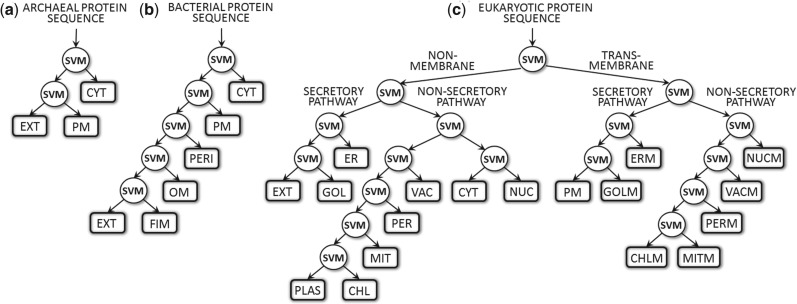
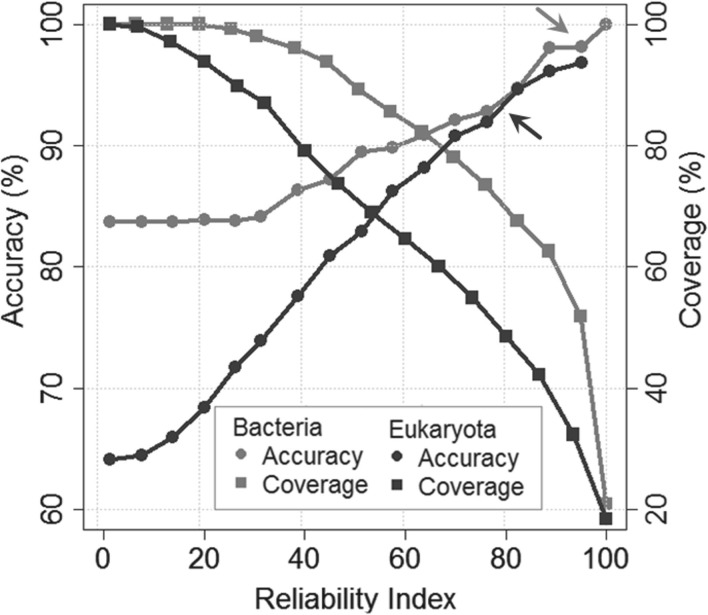
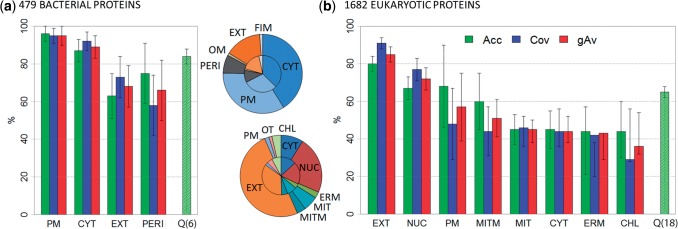
In this study, we introduced a framework to predict localization in life's three domains, including globular and membrane proteins (3 classes for archaea; 6 for bacteria and 18 for eukaryota). The resulting method, LocTree2, works well even for protein fragments. It uses a hierarchical system of support vector machines that imitates the cascading mechanism of cellular sorting. The method reaches high levels of sustained performance (eukaryota: Q18=65%, bacteria: Q6=84%). LocTree2 also accurately distinguishes membrane and non-membrane proteins. In our hands, it compared favorably with top methods when tested on new data.
Online through PredictProtein (predictprotein.org); as standalone version at http://www.rostlab.org/services/loctree2.
Supplementary data are available at Bioinformatics online.
亚细胞定位是蛋白质功能的一个方面。尽管高通量成像技术取得了进展,但定位图谱仍然不完整。有几种方法可以准确预测定位,但仍有许多挑战需要解决。
在这项研究中,我们引入了一个框架来预测生命的三个领域的定位,包括球状蛋白和膜蛋白(古菌 3 类;细菌 6 类;真核生物 18 类)。由此产生的方法 LocTree2 即使对于蛋白质片段也能很好地工作。它使用支持向量机的分层系统来模拟细胞分选的级联机制。该方法达到了较高的持续性能水平(真核生物:Q18=65%,细菌:Q6=84%)。LocTree2 还能准确地区分膜蛋白和非膜蛋白。在我们的测试中,与新数据相比,它与顶级方法相比表现出色。
通过 PredictProtein(predictprotein.org)在线提供;作为独立版本在 http://www.rostlab.org/services/loctree2 上提供。
补充数据可在生物信息学在线获得。