Department of Diagnostic Imaging and Radiation Oncology, Federico II University School of Medicine, via S. Pansini 5, 80131, Naples, Italy.
J Radiat Res. 2013 Mar 1;54(2):292-8. doi: 10.1093/jrr/rrs087. Epub 2012 Sep 26.
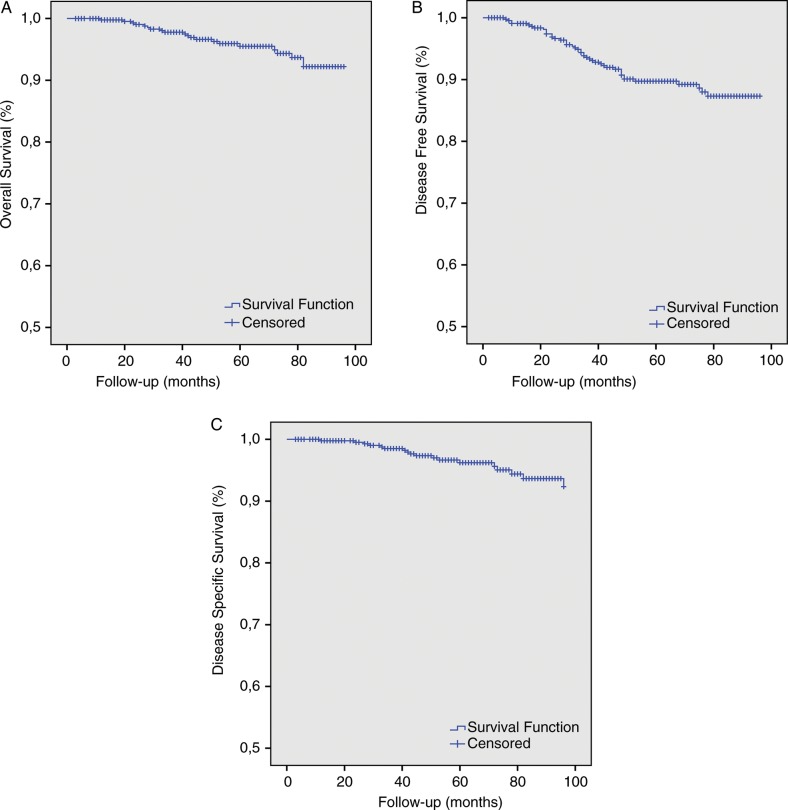
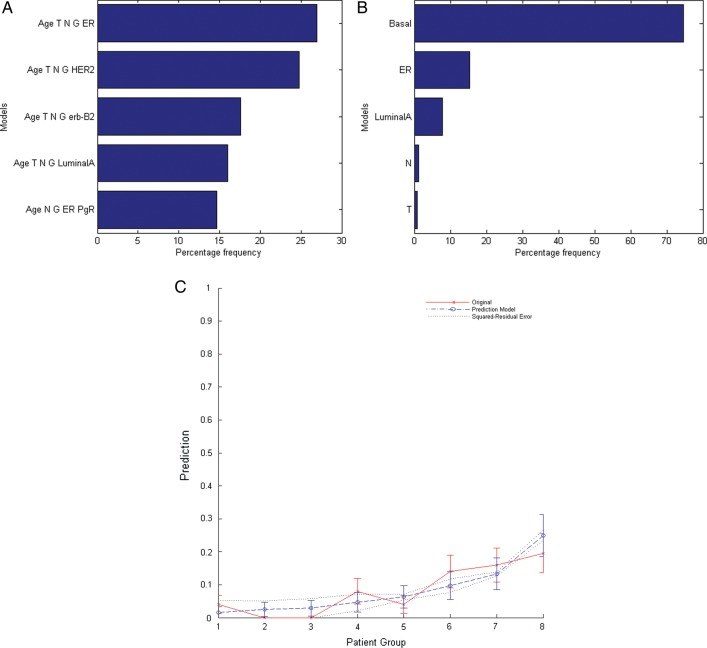
The purpose of this study was to evaluate the outcome prediction power of classical prognostic factors along with surrogate approximation of genetic signatures (AGS) subtypes in patients affected by localized breast cancer (BC) and treated with postoperative radiotherapy. We retrospectively analyzed 468 consecutive female patients affected by localized BC with complete immunohistochemical and pathological information available. All patients underwent surgery plus radiotherapy. Median follow-up was 59 months (range, 6-132) from the diagnosis. Disease recurrences (DR), local and/or distant, and contralateral breast cancer (CBC) were registered and analyzed in relation to subtypes (luminal A, luminal B, HER-2, and basal), and classical prognostic factors (PFs), namely age, nodal status (N), tumor classification (T), grading (G), estrogen receptors (ER), progesterone receptors and erb-B2 status. Bootstrap technique for variable selection and bootstrap resampling to test selection stability were used. Regarding AGS subtypes, HER-2 and basal were more likely to recur than luminal A and B subtypes, while patients in the basal group were more likely to have CBC. However, considering PFs along with AGS subtypes, the optimal multivariable predictive model for DR consisted of age, T, N, G and ER. A single-variable model including basal subtype resulted again as the optimal predictive model for CBC. In patients bearing localized BC the combination of classical clinical variables age, T, N, G and ER was still confirmed to be the best predictor of DR, while the basal subtype was demonstrated to be significantly and exclusively correlated with CBC.
本研究旨在评估经典预后因素以及替代近似遗传特征(AGS)亚型在接受术后放疗的局限性乳腺癌(BC)患者中的预后预测能力。我们回顾性分析了 468 例接受手术加放疗的局限性 BC 女性患者。所有患者均接受了手术加放疗。从诊断到中位随访时间为 59 个月(范围为 6-132)。登记并分析了局部和/或远处疾病复发(DR)、对侧乳腺癌(CBC)与亚型(luminal A、luminal B、HER-2 和基底)和经典预后因素(PFs)的关系,包括年龄、淋巴结状态(N)、肿瘤分类(T)、分级(G)、雌激素受体(ER)、孕激素受体和 erb-B2 状态。采用变量选择的 Bootstrap 技术和 Bootstrap 重采样来测试选择稳定性。关于 AGS 亚型,HER-2 和基底型比 luminal A 和 B 型更容易复发,而基底型患者更有可能发生 CBC。然而,考虑到 PFs 和 AGS 亚型,DR 的最佳多变量预测模型包括年龄、T、N、G 和 ER。单一变量模型包括基底亚型再次成为 CBC 的最佳预测模型。在患有局限性 BC 的患者中,经典临床变量年龄、T、N、G 和 ER 的组合仍然被证实是 DR 的最佳预测因子,而基底亚型与 CBC 显著且独立相关。