
热休克蛋白 Hsp90α 介导的神经突生长:抗精神病药物阿立哌唑的新靶点。
Neurite outgrowth mediated by the heat shock protein Hsp90α: a novel target for the antipsychotic drug aripiprazole.
机构信息
Division of Clinical Neuroscience, Chiba University Center for Forensic Mental Health, Chiba, Japan.
出版信息
Transl Psychiatry. 2012 Oct 16;2(10):e170. doi: 10.1038/tp.2012.97.
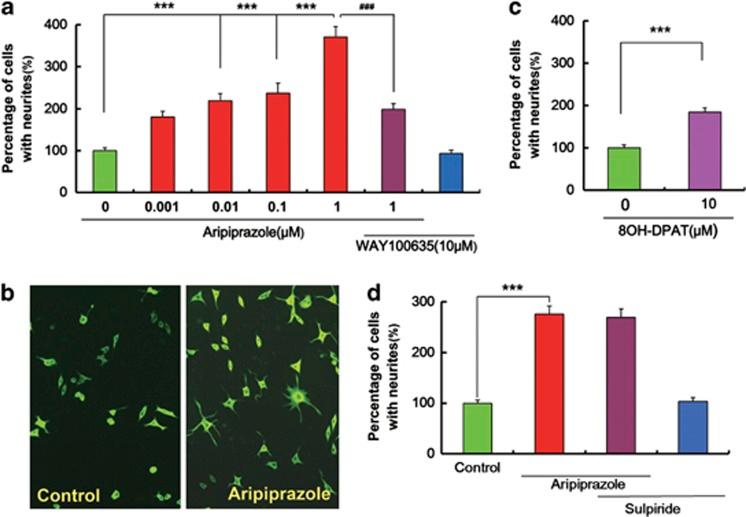
Aripiprazole is an atypical antipsychotic drug approved for the treatment of psychiatric disorders such as schizophrenia, bipolar disorder, major depressive disorder and autism. The drug shows partial agonistic activity at dopamine D(2) receptors and 5-hydroxytryptamine (5-HT) 5-HT(1A) receptors, and antagonistic activity at 5-HT(2A) receptors. However, the precise mechanistic pathways remain unclear. In this study, we examined the effects of aripiprazole on neurite outgrowth. Aripiprazole significantly potentiated nerve growth factor (NGF)-induced neurite outgrowth in PC12 cells, in a concentration-dependent manner. The 5-HT(1A) receptor antagonist WAY-100635, but not the dopamine D(2) receptor antagonist sulpiride, blocked the effects of aripiprazole, although, only partially. Specific inhibitors of inositol 1,4,5-triphosphate (IP(3)) receptors and BAPTA-AM, a chelator of intracellular Ca(2+), blocked the effects of aripiprazole. Moreover, specific inhibitors of several common signaling pathways phospholipase C-γ (PLC-γ), phosphatidylinositol-3 kinase (PI3K), mammalian target of rapamycin, p38 MAPK, c-Jun N-terminal kinase, Akt, Ras, Raf, ERK, MAPK) also blocked the effects of aripiprazole. Using proteomic analysis, we found that aripiprazole significantly increased levels of the heat shock protein Hsp90α in cultured cells. The effects of aripiprazole on NGF-induced neurite outgrowth were significantly attenuated by treatment with Hsp90α RNA interference, but not by the negative control of Hsp90α. These findings suggest that both 5-HT(1A) receptor activation and Ca(2+) signaling via IP(3) receptors, as well as their downstream cellular signaling pathways play a role in the promotion of aripiprazole-induced neurite outgrowth. Furthermore, aripiprazole-induced increases in Hsp90α protein expression may form part of the therapeutic mechanism for this drug.
阿立哌唑是一种新型抗精神分裂症药物,适用于治疗精神分裂症、双相情感障碍、重性抑郁障碍和自闭症等精神疾病。该药物对多巴胺 D2 受体和 5-羟色胺(5-HT)5-HT1A 受体具有部分激动活性,对 5-HT2A 受体具有拮抗活性。然而,确切的机制途径仍不清楚。在这项研究中,我们研究了阿立哌唑对神经突生长的影响。阿立哌唑显著增强了神经生长因子(NGF)诱导的 PC12 细胞的神经突生长,呈浓度依赖性。5-HT1A 受体拮抗剂 WAY-100635,但不是多巴胺 D2 受体拮抗剂舒必利,阻断了阿立哌唑的作用,尽管只是部分阻断。三磷酸肌醇(IP3)受体的特异性抑制剂和 BAPTA-AM,一种细胞内 Ca2+螯合剂,阻断了阿立哌唑的作用。此外,几种常见信号通路的特定抑制剂,包括磷脂酶 C-γ(PLC-γ)、磷脂酰肌醇-3 激酶(PI3K)、雷帕霉素靶蛋白(mTOR)、p38 丝裂原活化蛋白激酶(p38 MAPK)、c-Jun N 末端激酶(JNK)、Akt、Ras、Raf、ERK 和 MAPK,也阻断了阿立哌唑的作用。通过蛋白质组学分析,我们发现阿立哌唑显著增加了培养细胞中热休克蛋白 Hsp90α的水平。用 Hsp90α RNA 干扰处理后,阿立哌唑对 NGF 诱导的神经突生长的作用明显减弱,但用 Hsp90α 的阴性对照则没有。这些发现表明,5-HT1A 受体的激活和 IP3 受体介导的 Ca2+信号,以及它们的下游细胞信号通路在促进阿立哌唑诱导的神经突生长中发挥作用。此外,阿立哌唑诱导的 Hsp90α 蛋白表达增加可能是该药物治疗机制的一部分。



 Zotero 插件