
日本新潟县:林分疏伐 11 年后沿海松林(PinusthunbergiiParl.)的更新。
Regeneration of a coastal pine (Pinus thunbergii Parl.) forest 11 years after thinning, Niigata, Japan.
机构信息
State Key Laboratory of Forest and Soil Ecology, Institute of Applied Ecology, Chinese Academy of Sciences, Shenyang, China.
出版信息
PLoS One. 2012;7(10):e47593. doi: 10.1371/journal.pone.0047593. Epub 2012 Oct 16.
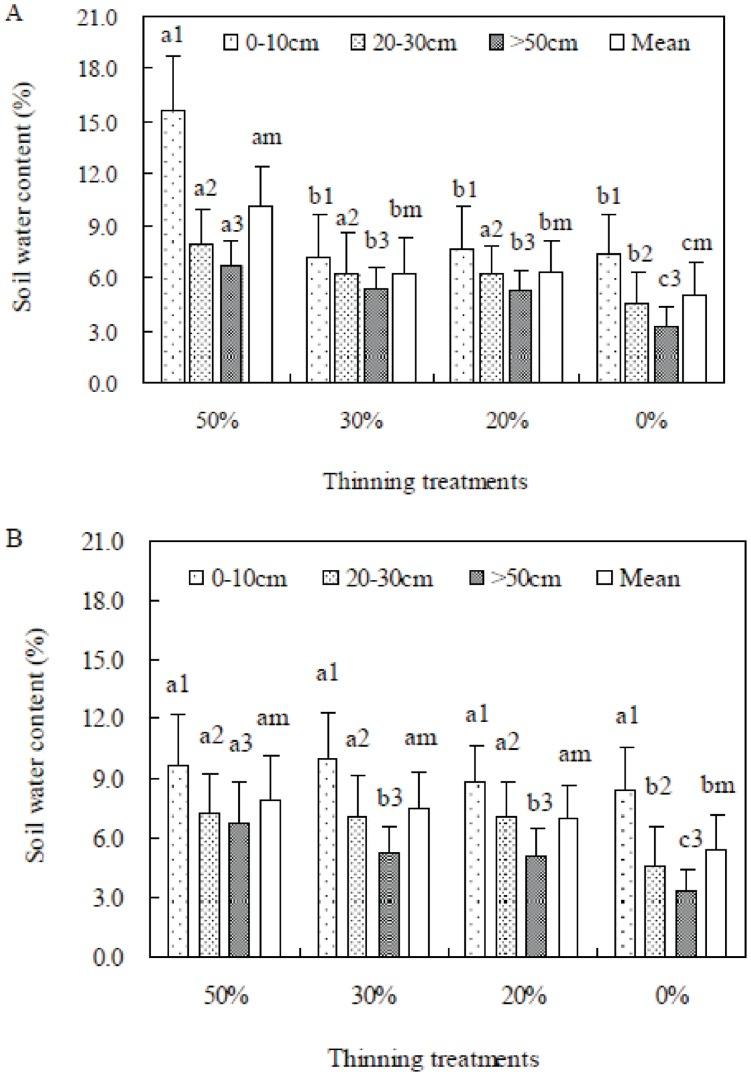
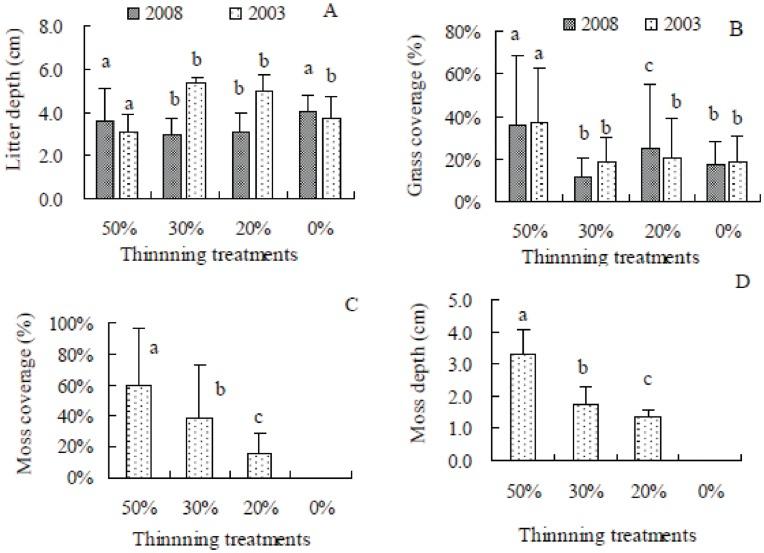
To examine the effects of thinning intensity on wind vulnerability and regeneration in a coastal pine (Pinus thunbergii) forest, thinning with intensities of 20%, 30% and 50% was conducted in December 1997; there was an unthinned treatment as the control (total 8 stands). We re-measured the permanent sites to assess the regeneration characteristics 11 years after thinning. In the 50% thinned stand, seedlings aged from 2 to 10 years exhibited the highest pine seedling density and growth. The age composition ranged from 1-3 years with densities of 9.9 and 5.1 seedlings m(-2) in 30% and 20% thinned stands; only 1-year-old seedlings with a density of 6.1 seedlings m(-2) in the unthinned stand. Similar trends were found for the regeneration of broadleaved species such as Robinia pseudoacacia and Prunus serrulata. We speculate that the canopy openness and moss coverage contributed to the regeneration success in the 50% thinned stand, while the higher litter depth and lack of soil moisture induced the regeneration failure in the unthinned stand. The stands thinned at 20% or 30% were less favourable for pine regeneration than the stands thinned at 50%. Therefore, thinning with less than 30% canopy openness (20% and 30% thinned stands) should be avoided, and thinning at higher than 30% canopy openness (50% thinned stand, approximately 1500 stems ha(-1) at ages 40-50 years) is suggested for increasing regeneration in the coastal pine forest. The implications of thinning-based silviculture in the coastal pine forest management are also discussed. The ongoing development of the broadleaved seedlings calls for further observations.
为了研究不同疏伐强度对滨海松林风倒和更新的影响,1997 年 12 月对 8 块林分分别进行了 20%、30%和 50%疏伐,未疏伐林分为对照。11 年后对固定样地进行复测,以评估更新特征。在 50%疏伐林分中,2-10 年生的幼苗表现出最高的苗密度和生长量。在 30%和 20%疏伐林分中,年龄组为 1-3 年的幼苗密度分别为 9.9 和 5.1 株/m(2);而在未疏伐林分中仅 1 年生幼苗密度为 6.1 株/m(2)。阔叶树种如刺槐和榆叶梅的更新趋势也类似。我们推测,50%疏伐林分中较高的林冠开度和地被物覆盖度促进了更新的成功,而未疏伐林分中较高的凋落物深度和土壤水分亏缺则导致了更新的失败。疏伐强度为 20%或 30%的林分不利于松树苗的更新,而疏伐强度为 50%的林分则有利于松树苗的更新。因此,林冠开度小于 30%(20%和 30%疏伐林分)的疏伐应该避免,而林冠开度大于 30%(50%疏伐林分,约 40-50 年生时林分内每公顷 1500 株)的疏伐则有助于提高滨海松林的更新。文中还讨论了基于疏伐的沿海松林经营管理的意义。阔叶树种幼苗的持续发育需要进一步的观测。



 Zotero 插件