
雌二醇抑制 C 反应蛋白诱导的血管内皮细胞促炎激活。
Estradiol inhibits vascular endothelial cells pro-inflammatory activation induced by C-reactive protein.
机构信息
Research Center, Montreal Heart Institute, 5000 Bélanger Street, Montreal, QC H1T 1C8, Canada.
出版信息
Mol Cell Biochem. 2013 Jan;373(1-2):137-47. doi: 10.1007/s11010-012-1482-9. Epub 2012 Oct 31.
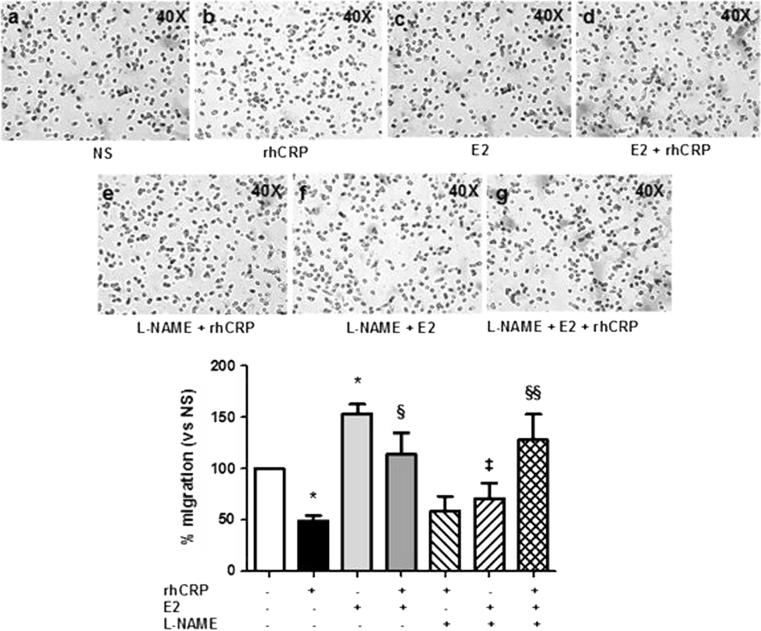
In addition of being an important inflammatory biomarker and a risk factor for cardiovascular disease, much evidence indicates that the C-reactive protein (CRP) contributes to the atherosclerosis development process. This plasmatic protein synthesized by hepatocytes in response to inflammation and tissue injury induces pro-inflammatory molecules' expression by endothelial cells (ECs). Previous studies showed that the 17β-estradiol (E2) has beneficial effects on vascular cells by reducing in vitro pro-inflammatory molecules expressions in EC. Therefore, we hypothesize that E2 blocks or reduces CRP-mediated inflammatory responses by modulating endogenous production of CRP in EC and/or activation mechanisms. Using human aortic ECs (HAECs), we first evaluated CRP production by vascular EC and second demonstrated its self-induction. Indeed, recombinant human CRP stimulation induces a fivefold increase of CRP expression. A 1-h pre-treatment of E2 at a physiologic dose (10(-9 )M) leads to an important decrease of CRP production suggesting a partial blockage of its amplification loop mechanism. Furthermore, in HAEC, E2 reduces the secretion of the most potent agonist of CRP induction, the IL-6, by 21 %. E2 pre-treatment also decreased the expression of pro-inflammatory molecules IL-8, VCAM-1, and ICAM-1 induced by CRP and involved in leukocytes recruitment. In addition, we demonstrated that E2 could restore vascular endothelial growth factor-mediated EC migration response impaired by CRP suggesting another pro-angiogenic property of this hormone. These findings suggest that E2 can interfere with CRP pro-inflammatory effects via activation signals using its rapid, non-genomic pathway that may provide a new mechanism to improve vascular repair.
除了作为一种重要的炎症生物标志物和心血管疾病的危险因素外,大量证据表明 C 反应蛋白 (CRP) 有助于动脉粥样硬化的发展过程。这种由肝细胞在炎症和组织损伤时合成的浆细胞蛋白,通过内皮细胞 (EC) 诱导促炎分子的表达。先前的研究表明,17β-雌二醇 (E2) 通过减少 EC 中体外促炎分子的表达,对血管细胞具有有益作用。因此,我们假设 E2 通过调节 EC 中 CRP 的内源性产生和/或激活机制来阻断或减少 CRP 介导的炎症反应。使用人主动脉内皮细胞 (HAEC),我们首先评估了血管内皮细胞中 CRP 的产生,其次证明了其自我诱导。事实上,重组人 CRP 刺激诱导 CRP 表达增加五倍。生理剂量 (10(-9) M) 的 E2 预处理 1 小时可导致 CRP 产生的重要减少,表明其放大环机制部分受阻。此外,在 HAEC 中,E2 减少了 CRP 诱导的最有效的 CRP 诱导物白细胞介素 6 (IL-6) 的分泌 21%。E2 预处理还降低了 CRP 诱导的促炎分子 IL-8、VCAM-1 和 ICAM-1 的表达,这些分子参与白细胞募集。此外,我们证明 E2 可以通过激活其快速非基因组途径来恢复 CRP 受损的血管内皮生长因子介导的 EC 迁移反应,这表明这种激素具有另一种促血管生成特性。这些发现表明,E2 可以通过激活其快速非基因组途径来干扰 CRP 的促炎作用,这可能为改善血管修复提供一种新的机制。


 Zotero 插件