Primary Care Research Group, University of Exeter Medical School, Exeter EX1 2LU, UK.
Trials. 2013 Jan 4;14:4. doi: 10.1186/1745-6215-14-4.
Recent years have seen an increase in primary care workload, especially following the introduction of a new General Medical Services contract in 2004. Telephone triage and telephone consultation with patients seeking health care represent initiatives aimed at improving access to care. Some evidence suggests that such approaches may be feasible but conclusions regarding GP workload, cost, and patients' experience of care, safety, and health status are equivocal. The ESTEEM trial aims to assess the clinical- and cost-effectiveness of nurse-led computer-supported telephone triage and GP-led telephone triage, compared to usual care, for patients requesting same-day consultations in general practice.
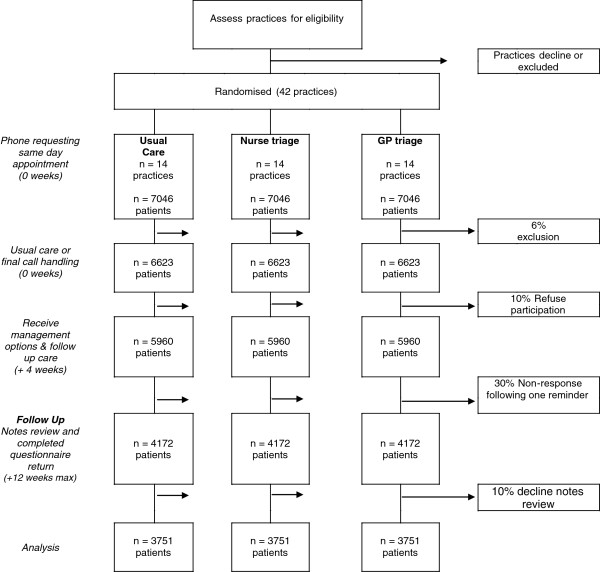
METHODS/DESIGN: ESTEEM is a pragmatic, multi-centre cluster randomised clinical trial with patients randomised at practice level to usual care, computer decision-supported nurse triage, or GP-led triage. Following triage of 350-550 patients per practice we anticipate estimating and comparing total primary care workload (volume and time), the economic cost to the NHS, and patient experience of care, safety, and health status in the 4-week period following the index same-day consultation request across the three trial conditions.We will recruit all patients seeking a non-emergency same-day appointment in primary care. Patients aged 12.0-15.9 years and temporary residents will be excluded from the study.The primary outcome is the number of healthcare contacts taking place in the 4-week period following (and including) the index same-day consultation request. A range of secondary outcomes will be examined including patient flow, primary care NHS resource use, patients' experience of care, safety, and health status.The estimated sample size required is 3,751 patients (11,253 total) in each of the three trial conditions, to detect a mean difference of 0.36 consultations per patient in the four week follow-up period between either intervention group and usual care 90% power, 5% alpha, and an estimated intracluster correlation coefficient ICC of 0.05. The primary analysis will be based on the intention-to-treat principle and take the form of a random effects regression analysis taking account of the hierarchical nature of the study design. Statistical models will allow for adjustment for practice level minimisation variables and patient-level baseline covariates shown to differ at baseline.
Current Controlled Trials ISCRTN20687662.
近年来,基层医疗工作量有所增加,尤其是 2004 年引入新的全科医生服务合同之后。电话分诊和与寻求医疗保健的患者进行电话咨询是旨在改善医疗服务可及性的举措。一些证据表明,这些方法可能是可行的,但关于全科医生工作量、成本以及患者对护理、安全性和健康状况的体验,结论尚无定论。ESTEEM 试验旨在评估护士主导的计算机支持的电话分诊和全科医生主导的电话分诊与常规护理相比,对在一般实践中请求当日就诊的患者的临床和成本效益。
方法/设计:ESTEEM 是一项实用的、多中心的集群随机临床试验,患者按实践水平随机分配到常规护理、计算机决策支持的护士分诊或全科医生主导的分诊。在每个实践中对 350-550 名患者进行分诊后,我们预计在三个试验条件下,在 4 周的时间内,估算和比较总基层医疗工作量(数量和时间)、NHS 的经济成本以及患者在当日就诊请求后的护理、安全性和健康状况的体验。我们将招募所有在初级保健中寻求非紧急当日预约的患者。12.0-15.9 岁的患者和临时居民将被排除在研究之外。主要结局是在(包括)当日就诊请求后的 4 周内发生的医疗保健接触次数。将检查一系列次要结局,包括患者流程、初级保健 NHS 资源使用、患者的护理体验、安全性和健康状况。每个试验条件下需要 3751 名患者(总计 11253 名患者),才能在 4 周随访期间检测到干预组与常规护理组之间每位患者平均差异为 0.36 次就诊,效能为 90%,α 值为 5%,并估计组内相关系数 ICC 为 0.05。主要分析将基于意向治疗原则,并采用随机效应回归分析的形式,考虑到研究设计的层次性质。统计模型将允许调整实践水平最小化变量和在基线时显示出差异的患者水平基线协变量。
当前对照试验 ISCRTN20687662。