Mo Lian-Jie, Ye Hong-Xing, Mao Ying, Yao Yu, Zhang Jian-Min
Department of Neurosurgery, Second Affiliated Hospital, School of Medicine, Zhejiang University, Hangzhou, Zhejiang 310009, P. R. China.
Chin J Cancer. 2013 Dec;32(12):653-60. doi: 10.5732/cjc.012.10228. Epub 2013 Jan 18.
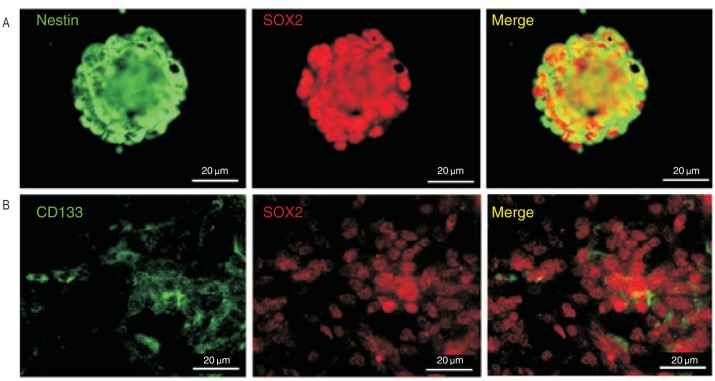
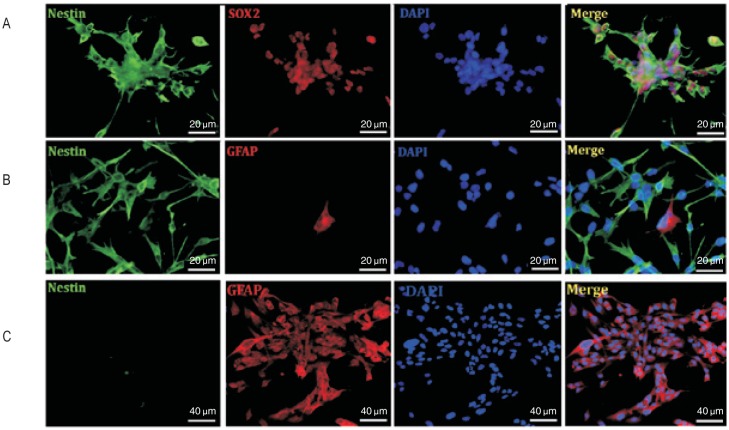
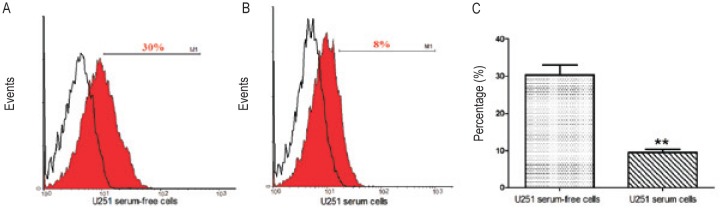
Previous studies indicated that B7-H4, the youngest B7 family, negatively regulates T cell-mediated immunity and is significantly overexpressed in many human tumors. Tumor stem cells are purported to play a role in tumor renewal and resistance to radiation and chemotherapy. However, the link between B7-H4 and tumor stem cells is unclear. In this study, we investigated B7-H4 expression in the medium of human glioma U251 cell cultures. Immunofluorescence results showed that U251 cells cultured in serum-free medium (supplemented with 2% B27, 20 ng/mL epidermal growth factor, 20 ng/mL basic fibroblast growth factor) maintained stem-like cell characteristics, including expression of stem cell marker CD133 and the neural progenitor cell markers nestin and SOX2. In contrast, U251 cells cultured in serum-containing medium highly expressed differentiation marker glial fibrillary acidic protein. Flow cytometry analysis showed serum-free medium-cultured U251 cells expressed higher intracellular B7-H4 than serum-containing medium-cultured U251 cells (24%-35% vs. 8%-11%, P < 0.001). Immunofluorescence in purified monocytes from normal human peripheral blood mononuclear cells revealed moderate expression of B7-H4 after stimulation with conditioned medium from U251 cells cultured in serum-containing medium. Moreover, conditioned medium from U251 stem-like cells had a significant stimulation effect on B7-H4 expression compared with serum-containing conditioned medium (P < 0.01). Negative costimulatory molecule B7-H4 was preferentially expressed in U251 stem-like cells, and conditioned medium from these cells more effectively induced monocytes to express B7-H4 than conditioned medium from U251 cells cultured in the presence of serum. Our results show that U251 stem-like cells may play a more crucial role in tumor immunoloregulation with high expression of B7-H4.
先前的研究表明,B7-H4作为B7家族中最新发现的成员,对T细胞介导的免疫反应具有负向调节作用,且在多种人类肿瘤中显著过表达。肿瘤干细胞被认为在肿瘤更新以及对放疗和化疗的抵抗中发挥作用。然而,B7-H4与肿瘤干细胞之间的联系尚不清楚。在本研究中,我们检测了人胶质瘤U251细胞培养上清中B7-H4的表达情况。免疫荧光结果显示,在无血清培养基(添加2% B27、20 ng/mL表皮生长因子、20 ng/mL碱性成纤维细胞生长因子)中培养的U251细胞保持了干细胞样特性,包括干细胞标志物CD133以及神经祖细胞标志物巢蛋白和SOX2的表达。相反,在含血清培养基中培养的U251细胞高表达分化标志物胶质纤维酸性蛋白。流式细胞术分析表明,与在含血清培养基中培养的U251细胞相比,在无血清培养基中培养的U251细胞胞内B7-H4表达更高(24%-35% 对8%-11%,P < 0.001)。对正常人外周血单个核细胞来源的纯化单核细胞进行免疫荧光检测发现,用含血清培养基培养的U251细胞的条件培养基刺激后,B7-H4呈中度表达。此外,与含血清的条件培养基相比,U251干细胞样细胞的条件培养基对B7-H4表达具有显著的刺激作用(P < 0.01)。负性共刺激分子B7-H4在U251干细胞样细胞中优先表达,且这些细胞的条件培养基比含血清培养的U251细胞的条件培养基更有效地诱导单核细胞表达B7-H4。我们的结果表明,U251干细胞样细胞可能通过高表达B7-H4在肿瘤免疫调节中发挥更关键的作用。