
帕金森病细胞系杂交细胞中线粒体的质量、动态和功能能力,这些细胞系是为表达路易体而选择的。
Mitochondrial quality, dynamics and functional capacity in Parkinson's disease cybrid cell lines selected for Lewy body expression.
机构信息
Parkinson's and Movement Disorders Center, Virginia Commonwealth University, Richmond, VA 23298, USA.
出版信息
Mol Neurodegener. 2013 Jan 26;8:6. doi: 10.1186/1750-1326-8-6.
BACKGROUND
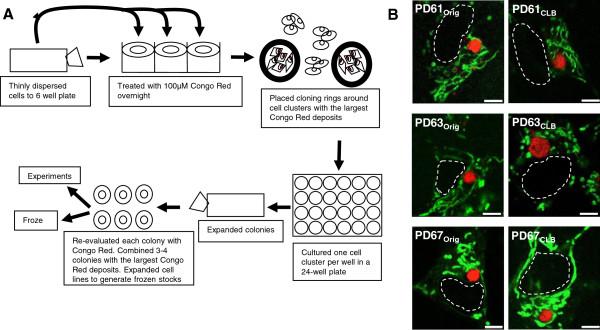
Lewy bodies (LB) are a neuropathological hallmark of Parkinson's disease (PD) and other synucleinopathies. The role their formation plays in disease pathogenesis is not well understood, in part because studies of LB have been limited to examination of post-mortem tissue. LB formation may be detrimental to neuronal survival or merely an adaptive response to other ongoing pathological processes. In a human cytoplasmic hybrid (cybrid) neural cell model that expresses mitochondrial DNA from PD patients, we observed spontaneous formation of intracellular protein aggregates ("cybrid LB" or CLB) that replicate morphological and biochemical properties of native, cortical LB. We studied mitochondrial morphology, bioenergetics and biogenesis signaling by creating stable sub-clones of three PD cybrid cell lines derived from cells expressing CLB.
RESULTS
Cloning based on CLB expression had a differential effect on mitochondrial morphology, movement and oxygen utilization in each of three sub-cloned lines, but no long-term change in CLB expression. In one line (PD63(CLB)), mitochondrial function declined compared to the original PD cybrid line (PD63(Orig)) due to low levels of mtDNA in nucleoids. In another cell line (PD61(Orig)), the reverse was true, and cellular and mitochondrial function improved after sub-cloning for CLB expression (PD61(CLB)). In the third cell line (PD67(Orig)), there was no change in function after selection for CLB expression (PD67(CLB)).
CONCLUSIONS
Expression of mitochondrial DNA derived from PD patients in cybrid cell lines induced the spontaneous formation of CLB. The creation of three sub-cloned cybrid lines from cells expressing CLB resulted in differential phenotypic changes in mitochondrial and cellular function. These changes were driven by the expression of patient derived mitochondrial DNA in nucleoids, rather than by the presence of CLB. Our studies suggest that mitochondrial DNA plays an important role in cellular and mitochondrial dysfunction in PD. Additional studies will be needed to assess the direct effect of CLB expression on cellular and mitochondrial function.
背景
路易体(LB)是帕金森病(PD)和其他突触核蛋白病的神经病理学标志。LB 的形成在疾病发病机制中的作用尚不清楚,部分原因是对 LB 的研究仅限于死后组织的检查。LB 的形成可能对神经元存活有害,或者仅仅是对其他正在进行的病理过程的适应性反应。在表达 PD 患者线粒体 DNA 的人类细胞质杂种(cybrid)神经细胞模型中,我们观察到细胞内蛋白质聚集体的自发形成(“cybrid LB”或 CLB),其复制了皮质 LB 的形态和生化特性。我们通过创建三个源自表达 CLB 的 PD 细胞系的稳定亚克隆,研究了线粒体形态、生物能量和生物发生信号。
结果
基于 CLB 表达的克隆对三个亚克隆系中的每一个的线粒体形态、运动和氧利用都有不同的影响,但 CLB 表达没有长期变化。在一个细胞系(PD63(CLB))中,由于核仁中的 mtDNA 水平低,线粒体功能与原始 PD 杂种细胞系(PD63(Orig))相比下降。在另一个细胞系(PD61(Orig))中,情况正好相反,在选择 CLB 表达后,细胞和线粒体功能得到改善(PD61(CLB))。在第三个细胞系(PD67(Orig))中,选择 CLB 表达后功能没有变化(PD67(CLB))。
结论
在 cybrid 细胞系中表达源自 PD 患者的线粒体 DNA 诱导了 CLB 的自发形成。从表达 CLB 的细胞中创建三个亚克隆 cybrid 系导致线粒体和细胞功能的表型差异。这些变化是由核仁中源自患者的线粒体 DNA 的表达驱动的,而不是由 CLB 的存在驱动的。我们的研究表明,线粒体 DNA 在 PD 中的细胞和线粒体功能障碍中发挥重要作用。需要进一步研究来评估 CLB 表达对细胞和线粒体功能的直接影响。



 Zotero 插件