The Birchall Centre, Lennard-Jones Laboratories, Keele University, Staffordshire, ST5 5BG, UK.
Sci Rep. 2013;3:1256. doi: 10.1038/srep01256. Epub 2013 Feb 13.
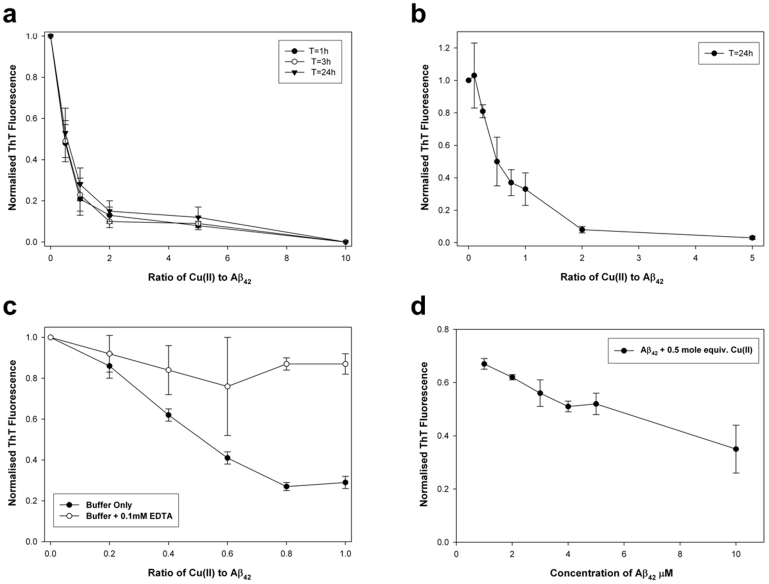
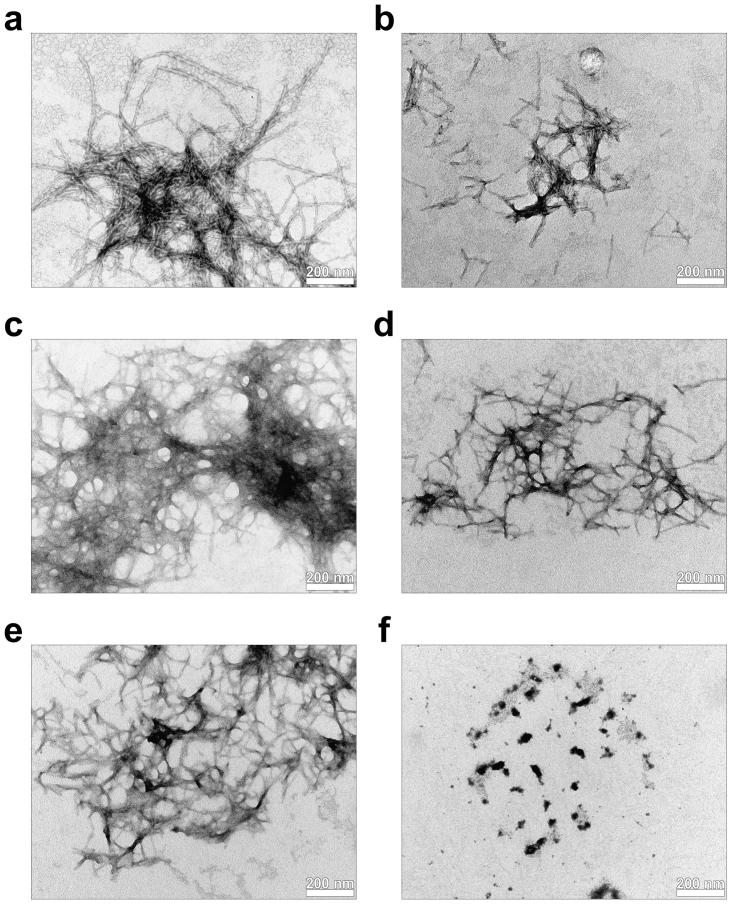
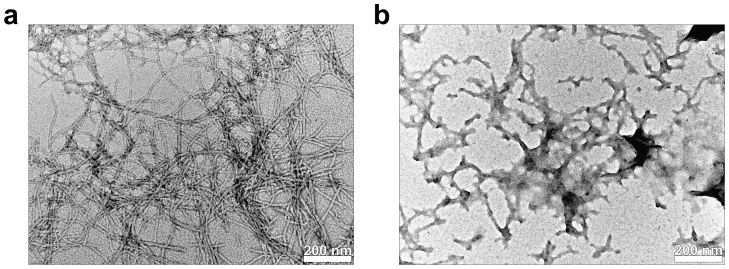
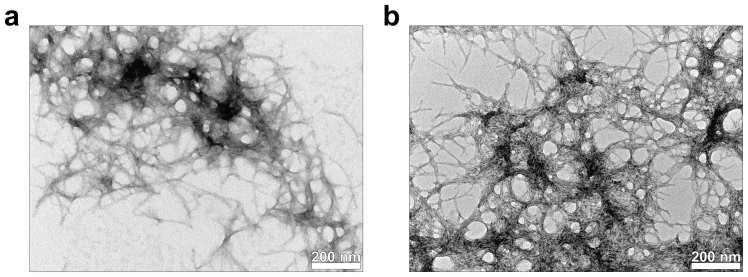
The aggregation and deposition of amyloid-β((1-42) )(Aβ(42)) in the brain is implicated in the aetiology of Alzheimer's disease (AD). While the mechanism underlying its deposition in vivo is unknown its precipitation in vitro is influenced by metal ions. For example, Aβ(42) is known to bind copper, Cu(II), in vitro and binding results in aggregation of the peptide. The biophysical properties of Cu(II)-Aβ(42) aggregates are of significant importance to their putative involvement in the amyloid cascade hypothesis of AD and are currently the subject of strong debate. In particular the question has been raised if sub- and super-stoichiometric concentrations of Cu(II) act in opposing ways in respectively accelerating and preventing amyloid fibril formation by Aβ(42). Herein we have used fluorimetry and transmission electron microscopy to provide unequivocal evidence that under near-physiological conditions both sub- and super-stoichiometric concentrations of Cu(II) prevented the assembly of Aβ(42) into ThT-positive β-sheet rich amyloid fibrils.
淀粉样蛋白-β((1-42) )(Aβ(42))在大脑中的聚集和沉积与阿尔茨海默病 (AD) 的发病机制有关。虽然其在体内沉积的机制尚不清楚,但它在体外的沉淀受到金属离子的影响。例如,Aβ(42)已知在体外与铜 (Cu(II)) 结合,结合导致肽的聚集。Cu(II)-Aβ(42) 聚集体的生物物理特性对其在 AD 淀粉样蛋白级联假说中的潜在作用非常重要,目前是激烈争论的主题。特别是,如果亚化学计量和超化学计量浓度的 Cu(II)以相反的方式作用,分别加速和阻止 Aβ(42)形成淀粉样纤维的问题已经提出。本文使用荧光法和透射电子显微镜提供了明确的证据,即在接近生理条件下,亚化学计量和超化学计量浓度的 Cu(II)都阻止了 Aβ(42)组装成 ThT 阳性β-折叠丰富的淀粉样纤维。