Sanseau Ana, Sampaolesi Juan, Suzuki Emilio Rintaro, Lopes Joao Franca, Borel Hector
Instituto de la Visión, Ciudad de Buenos Aires, Argentina.
Clin Ophthalmol. 2013;7:357-62. doi: 10.2147/OPTH.S38575. Epub 2013 Feb 18.
To assess ocular discomfort upon instillation and patient preference for brinzolamide/timolol relative to dorzolamide/timolol, in patients with open-angle glaucoma or ocular hypertension.
This was a multicenter, prospective, patient-masked, randomized, crossover study. On day 0, patients received one drop of brinzolamide/timolol in one eye and one drop of dorzolamide/timolol in the contralateral eye. On day 1, patients were randomly assigned to receive one drop of either brinzolamide/timolol or dorzolamide/timolol in both eyes; on day 2, patients received one drop of the alternate treatment in both eyes. Measures included a patient preference question on day 2 (primary) and mean ocular discomfort scale scores on days 1 and 2 (secondary). Safety assessments included adverse events, visual acuity, and slit-lamp examinations.
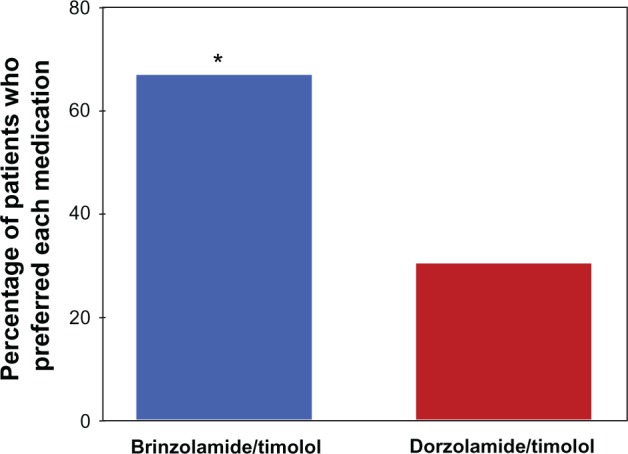
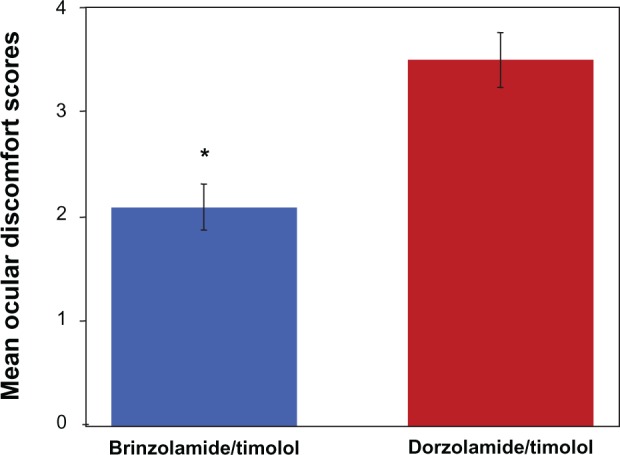
Of 120 patients who enrolled, 115 completed the study. Of these, 112 patients instilled both medications and expressed a study medication preference on day 2. A significantly greater percentage preferred brinzolamide/timolol to dorzolamide/timolol (67.0% versus 30.4%; P < 0.001). The ocular discomfort (expressed as mean [standard deviation]) with brinzolamide/timolol was significantly lower than with dorzolamide/timolol (day 2:1.9 [2.3] versus 3.7 [2.8], respectively [P = 0.0003]; both days combined: 2.1 [2.5] versus 3.5 [2.9], respectively [P = 0.00014]). On day 1, five patients receiving brinzolamide/timolol reported five nonserious adverse events (AEs): flu (n = 1), bitter taste (n = 2), and headache (n = 2). Four events, bitter taste (two events) and headache (two events), were considered related to brinzolamide/timolol. Events were mild in intensity, except bitter taste of moderate intensity reported by one patient. No AEs were reported at day 2. All AEs resolved without additional treatment. No clinically relevant changes from baseline were observed in best-corrected visual acuity or slit-lamp examinations of ocular signs.
Patients had less discomfort with brinzolamide/timolol than with dorzolamide/timolol, and more expressed a preference for brinzolamide/timolol. Both treatments were generally safe and well tolerated.
评估开角型青光眼或高眼压症患者滴用药物时的眼部不适情况,以及与多佐胺/噻吗洛尔相比,布林佐胺/噻吗洛尔的患者偏好性。
这是一项多中心、前瞻性、患者遮蔽、随机、交叉研究。在第0天,患者一只眼睛滴一滴布林佐胺/噻吗洛尔,对侧眼睛滴一滴多佐胺/噻吗洛尔。在第1天,患者被随机分配双眼滴一滴布林佐胺/噻吗洛尔或多佐胺/噻吗洛尔;在第2天,患者双眼滴用另一种治疗药物。测量指标包括第2天的患者偏好问题(主要指标)以及第1天和第2天的平均眼部不适量表评分(次要指标)。安全性评估包括不良事件、视力和裂隙灯检查。
120名入组患者中,115名完成了研究。其中,112名患者滴用了两种药物,并在第2天表达了对研究药物的偏好。与多佐胺/噻吗洛尔相比,明显更多的患者更喜欢布林佐胺/噻吗洛尔(67.0%对30.4%;P<0.001)。布林佐胺/噻吗洛尔引起的眼部不适(以平均值[标准差]表示)明显低于多佐胺/噻吗洛尔(第2天:分别为1.9[2.3]和3.7[2.8],[P = 0.0003];两天综合:分别为2.1[2.5]和3.5[2.9],[P = 0.00014])。在第1天,5名接受布林佐胺/噻吗洛尔治疗的患者报告了5起非严重不良事件(AE):流感(n = 1)、口苦(n = 2)和头痛(n = 2)。4起事件,口苦(2起)和头痛(2起),被认为与布林佐胺/噻吗洛尔有关。除一名患者报告的中度口苦外,事件强度均为轻度。第2天未报告不良事件。所有不良事件均未接受额外治疗而自行缓解。最佳矫正视力或眼部体征的裂隙灯检查未观察到与基线相比有临床相关变化。
与多佐胺/噻吗洛尔相比,患者使用布林佐胺/噻吗洛尔时的不适感更少,且更多患者表示更喜欢布林佐胺/噻吗洛尔。两种治疗方法总体上都是安全的,耐受性良好。