Furudate Sadanori, Fujimura Taku, Kambayashi Yumi, Aiba Setsuya
Department of Dermatology, Tohoku University Graduate School of Medicine, Sendai, Japan.
Case Rep Dermatol. 2013 Mar 20;5(1):88-92. doi: 10.1159/000350567. Print 2013 Jan.
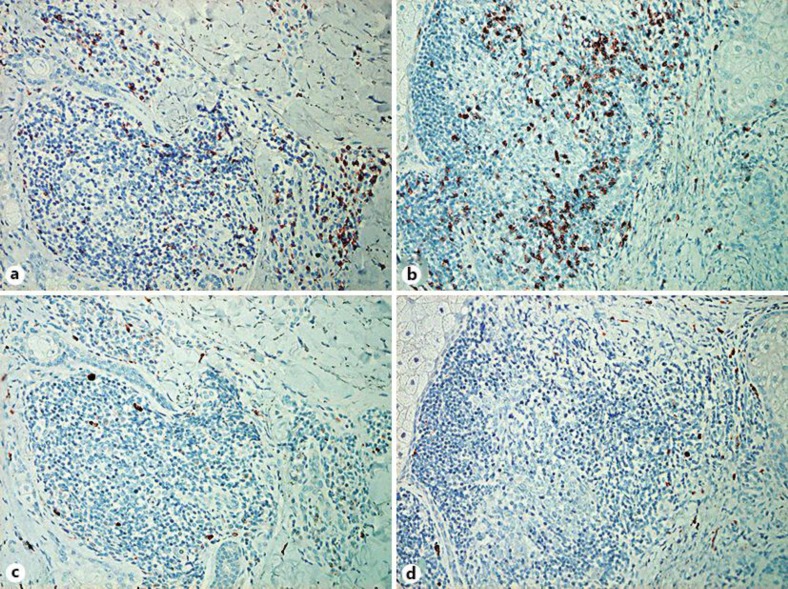
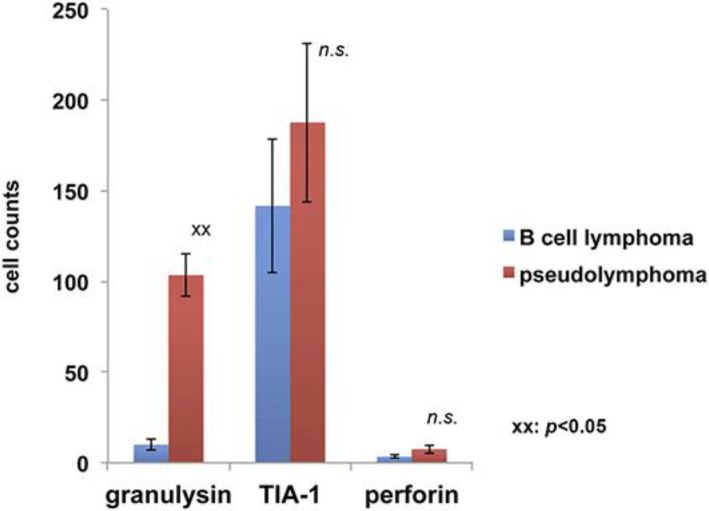
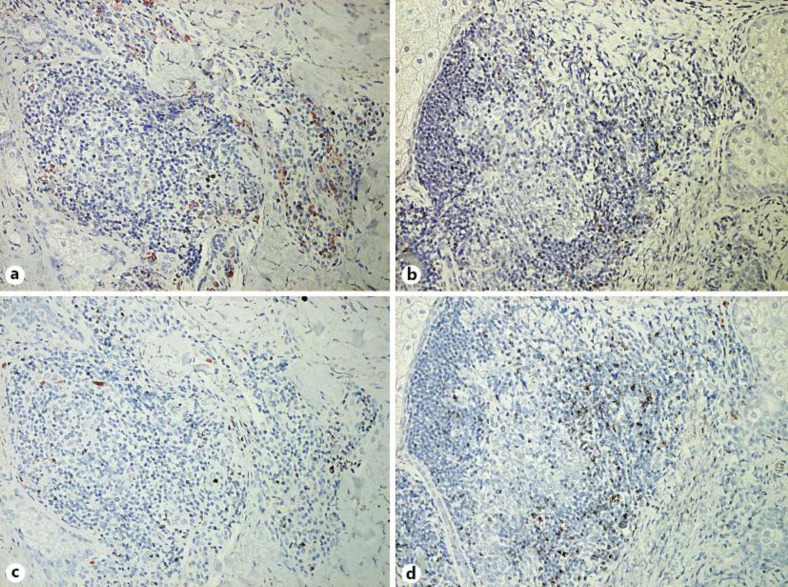
Cutaneous lymphoid hyperplasia (CLH) is difficult to differentiate from primary malignant cutaneous lymphomas that may present as solitary nodules, and sometimes it requires much time to achieve a final diagnosis. A recent report [Park et al.: Acta Haematol 2011;126:79-86] suggested that the expression of granulysin correlates with the prognosis of cancer patients, even in hematological disorders. In this report, we immunohistochemically examine the expression of cytotoxic molecules (e.g. granulysin, TIA-1 and perforin) in tumor-infiltrating lymphocytes of 10 patients with CLH and 3 patients with cutaneous diffuse large B cell lymphoma, not otherwise specified (CDLBCL-NOS) of the face. In the patients with CLH, the number of granulysin-bearing cells was higher than in the patients with CDLBCL-NOS. In contrast, there was no difference in the number of TIA-1(+) or perforin(+) cells. The present study attempts to explain the different biological behaviors of these two hematological disorders and suggests granulysin as a possible diagnostic tool for CLH and CDLBCL-NOS of the face.
皮肤淋巴细胞增生症(CLH)很难与可能表现为孤立性结节的原发性皮肤恶性淋巴瘤相鉴别,有时需要很长时间才能做出最终诊断。最近的一份报告[Park等人:《血液学学报》2011年;126:79 - 86]表明,颗粒溶素的表达与癌症患者的预后相关,即使在血液系统疾病中也是如此。在本报告中,我们采用免疫组织化学方法检测了10例CLH患者和3例面部皮肤弥漫性大B细胞淋巴瘤(未另行说明,CDLBCL - NOS)患者肿瘤浸润淋巴细胞中细胞毒性分子(如颗粒溶素、TIA - 1和穿孔素)的表达。在CLH患者中,携带颗粒溶素的细胞数量高于CDLBCL - NOS患者。相比之下,TIA - 1(+)或穿孔素(+)细胞的数量没有差异。本研究试图解释这两种血液系统疾病不同的生物学行为,并提示颗粒溶素可能作为面部CLH和CDLBCL - NOS的一种诊断工具。