Key Laboratory of Cardiovascular Remodeling and Function Research, Chinese Ministry of Education and Chinese Ministry of Public Health, Qilu Hospital, Shandong University, Jinan, Shandong, China.
PLoS One. 2013 May 14;8(5):e62788. doi: 10.1371/journal.pone.0062788. Print 2013.
We recently found that overexpression of angiotensin (Ang)-converting enzyme 2, which metabolizes Ang-II to Ang-(1-7) and Ang-I to Ang-(1-9), may prevent diabetes-induced left ventricular remodeling and dysfunction in rats. Our objective was to evaluate the association of plasma Ang-(1-7) level and left ventricular function in patients with type 2 diabetes mellitus.
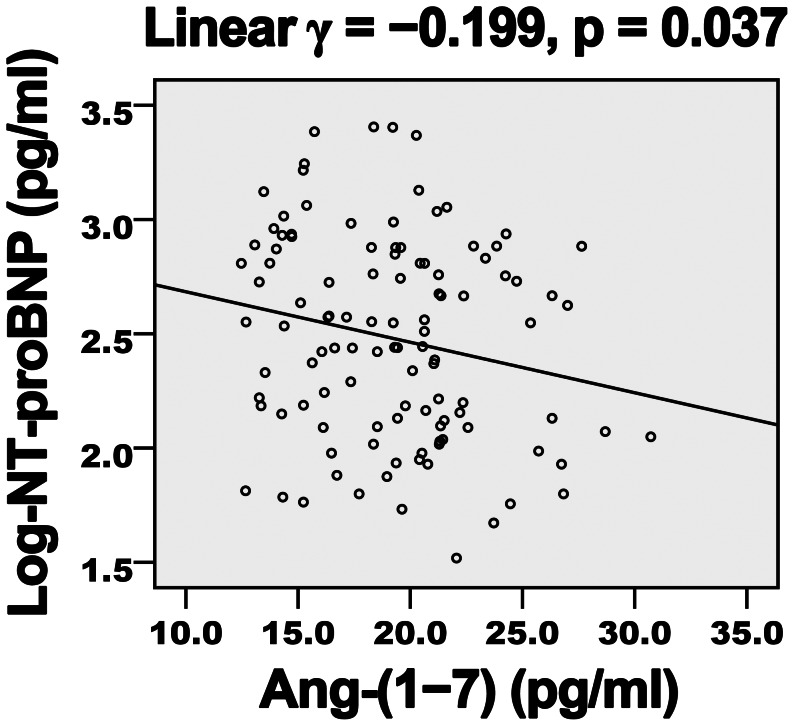
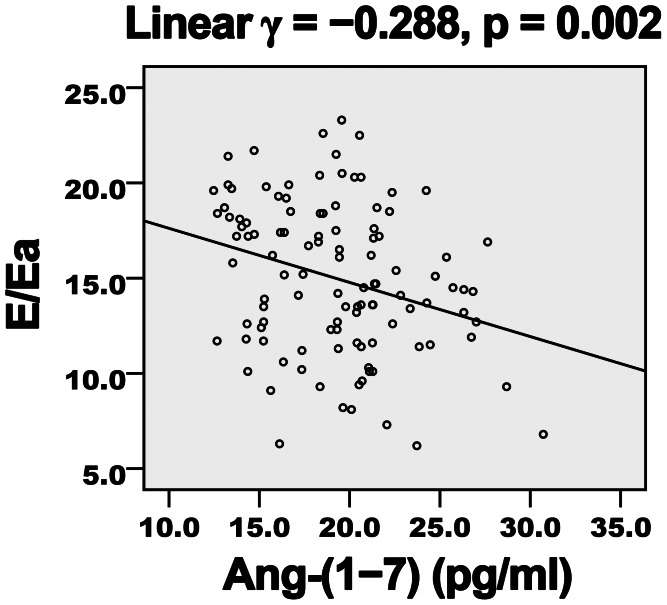
METHODOLOGY/PRINCIPAL FINDINGS: We measured the left ventricular ejection fraction (EF), ratio of early to late left ventricular filling velocity (E/A) and ratio of early diastolic mitral inflow to annular velocity (E/Ea) by ultrasonography in 110 patients with type 2 diabetes mellitus for more than 5 years. Anthropometric and fasting blood values were obtained from medical records. The plasma Ang-(1-7) level in patients with a poor EF (<50%) was significantly lower than that in patients with EF ≥50%; the level in patients with E/A <1 was significantly lower than that in patients with E/A ≥1; and the level in patients with E/Ea >15 was significantly lower than that in patients with E/Ea ≤15. Ang-(1-7) level was negatively correlated with E/Ea and Log-N-terminal pro-B-type natriuretic peptide and positively with EF and E/A. Stepwise multiple regression analysis revealed that Ang-(1-7), hemoglobin A1c and Ang-II levels as well as duration of diabetes predicted EF; Ang-(1-7) level, fasting blood glucose, low-density lipoprotein cholesterol level and duration of diabetes predicted E/A; and Ang-(1-7) and hemoglobin A1c levels predicted E/Ea.
CONCLUSIONS/SIGNIFICANCE: Plasma Ang-(1-7) level is independently associated with left ventricular function in patients with type 2 diabetes mellitus and may be a biomarker for assessing cardiac function in such patients.
我们最近发现,血管紧张素转换酶 2(ACE2)的过表达可将血管紧张素 II(Ang-II)代谢为血管紧张素(1-7)和血管紧张素 I(Ang-I)代谢为血管紧张素(1-9),可能预防糖尿病大鼠的左心室重构和功能障碍。我们的目的是评估 2 型糖尿病患者血浆血管紧张素(1-7)水平与左心室功能的关系。
方法/主要发现:我们通过超声心动图测量了 110 例 2 型糖尿病患者 5 年以上的左心室射血分数(EF)、左心室早期到晚期充盈速度比(E/A)和二尖瓣早期舒张流入与环速度比(E/Ea)。从病历中获取人体测量和空腹血值。EF(<50%)较差的患者的血浆血管紧张素(1-7)水平明显低于 EF≥50%的患者;E/A<1 的患者水平明显低于 E/A≥1 的患者;E/Ea>15 的患者水平明显低于 E/Ea≤15 的患者。血管紧张素(1-7)水平与 E/Ea 呈负相关,与 Log-N 末端脑钠肽前体呈正相关,与 EF 和 E/A 呈正相关。逐步多元回归分析显示,血管紧张素(1-7)、糖化血红蛋白和血管紧张素 II 水平以及糖尿病病程预测 EF;血管紧张素(1-7)水平、空腹血糖、低密度脂蛋白胆固醇水平和糖尿病病程预测 E/A;血管紧张素(1-7)和糖化血红蛋白水平预测 E/Ea。
结论/意义:血浆血管紧张素(1-7)水平与 2 型糖尿病患者的左心室功能独立相关,可能是评估此类患者心功能的生物标志物。