
与白鲑种间反转相关的松弛破坏性选择的基因组特征。
Genomic signatures of relaxed disruptive selection associated with speciation reversal in whitefish.
机构信息
Division of Aquatic Ecology & Macroevolution, Institute of Ecology & Evolution, University of Bern, Bern, Switzerland.
出版信息
BMC Evol Biol. 2013 May 30;13:108. doi: 10.1186/1471-2148-13-108.
BACKGROUND
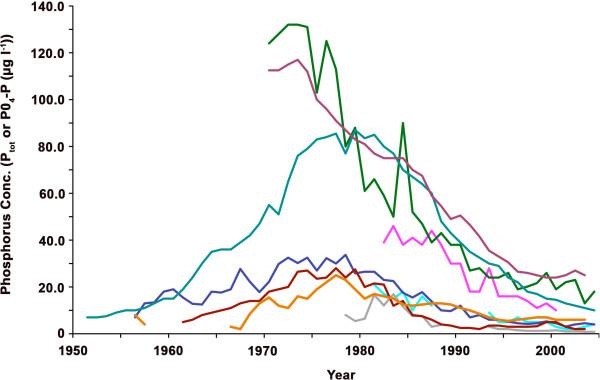
Speciation reversal: the erosion of species differentiation via an increase in introgressive hybridization due to the weakening of previously divergent selection regimes, is thought to be an important, yet poorly understood, driver of biodiversity loss. Our study system, the Alpine whitefish (Coregonus spp.) species complex is a classic example of a recent postglacial adaptive radiation: forming an array of endemic lake flocks, with the independent origination of similar ecotypes among flocks. However, many of the lakes of the Alpine radiation have been seriously impacted by anthropogenic nutrient enrichment, resulting in a collapse in neutral genetic and phenotypic differentiation within the most polluted lakes. Here we investigate the effects of eutrophication on the selective forces that have shaped this radiation, using population genomics. We studied eight sympatric species assemblages belonging to five independent parallel adaptive radiations, and one species pair in secondary contact. We used AFLP markers, and applied FST outlier (BayeScan, Dfdist) and logistic regression analyses (MatSAM), to identify candidate regions for disruptive selection in the genome and their associations with adaptive traits within each lake flock. The number of outlier and adaptive trait associated loci identified per lake were then regressed against two variables (historical phosphorus concentration and contemporary oxygen concentration) representing the strength of eutrophication.
RESULTS
Whilst we identify disruptive selection candidate regions in all lake flocks, we find similar trends, across analysis methods, towards fewer disruptive selection candidate regions and fewer adaptive trait/candidate loci associations in the more polluted lakes.
CONCLUSIONS
Weakened disruptive selection and a concomitant breakdown in reproductive isolating mechanisms in more polluted lakes has lead to increased gene flow between coexisting Alpine whitefish species. We hypothesize that the resulting higher rates of interspecific recombination reduce either the number or extent of genomic islands of divergence surrounding loci evolving under disruptive natural selection. This produces the negative trend seen in the number of selection candidate loci recovered during genome scans of whitefish species flocks, with increasing levels of anthropogenic eutrophication: as the likelihood decreases that AFLP restriction sites will fall within regions of heightened genomic divergence and therefore be classified as F(ST) outlier loci. This study explores for the first time the potential effects of human-mediated relaxation of disruptive selection on heterogeneous genomic divergence between coexisting species.
背景
物种反转:由于先前分化选择机制的削弱,导致物种分化的侵蚀,通过渐渗杂交的增加,被认为是生物多样性丧失的一个重要但尚未被充分理解的驱动因素。我们的研究系统,阿尔卑斯白鲑(Coregonus spp.)物种复合体是一个最近的后冰河时代适应性辐射的经典例子:形成一系列地方性湖泊群体,群体之间独立起源相似的生态型。然而,阿尔卑斯辐射的许多湖泊受到人为营养富化的严重影响,导致最污染的湖泊中性遗传和表型分化崩溃。在这里,我们使用种群基因组学研究富营养化对塑造这种辐射的选择压力的影响。我们研究了属于五个独立平行适应性辐射的八个共生物种组合,以及一对处于次级接触的物种。我们使用 AFLP 标记,并应用 FST 异常值(BayeScan、Dfdist)和逻辑回归分析(MatSAM),在每个湖泊群体中鉴定基因组中离散选择的候选区域及其与适应性特征的关联。然后,根据每个湖泊的历史磷浓度和当代氧浓度这两个代表富营养化强度的变量,对鉴定出的具有离散选择和适应性特征相关的基因座数量进行回归分析。
结果
尽管我们在所有的湖泊群体中都鉴定出了离散选择的候选区域,但我们发现,在不同的分析方法中,在污染更严重的湖泊中,离散选择的候选区域和与适应性特征相关的候选区域的数量都较少。
结论
在污染更严重的湖泊中,离散选择的减弱和生殖隔离机制的崩溃导致共存的阿尔卑斯白鲑物种之间的基因流动增加。我们假设,由此产生的更高的种间重组率减少了受离散自然选择进化的基因座周围基因组分歧的数量或范围。这导致了在对白鲑物种群体进行基因组扫描时,候选选择基因座数量的负趋势,随着人为富营养化程度的增加:AFLP 限制位点落在基因组高度分化区域的可能性降低,因此被归类为 F(ST)异常值位点的可能性降低。这项研究首次探讨了人类介导的离散选择放松对共存物种之间不均匀基因组分化的潜在影响。




 Zotero 插件