
重建加勒比和中美洲 HIV-1 亚型 B 流行的时间和传播途径:一个系统发育的故事。
Reconstructing the timing and dispersion routes of HIV-1 subtype B epidemics in the Caribbean and Central America: a phylogenetic story.
机构信息
Centro de Biotecnología y Genómica de Plantas (UPM-INIA) and E.T.S.I. Agrónomos, Universidad Politécnica de Madrid, Madrid, Spain.
出版信息
PLoS One. 2013 Jul 9;8(7):e69218. doi: 10.1371/journal.pone.0069218. Print 2013.
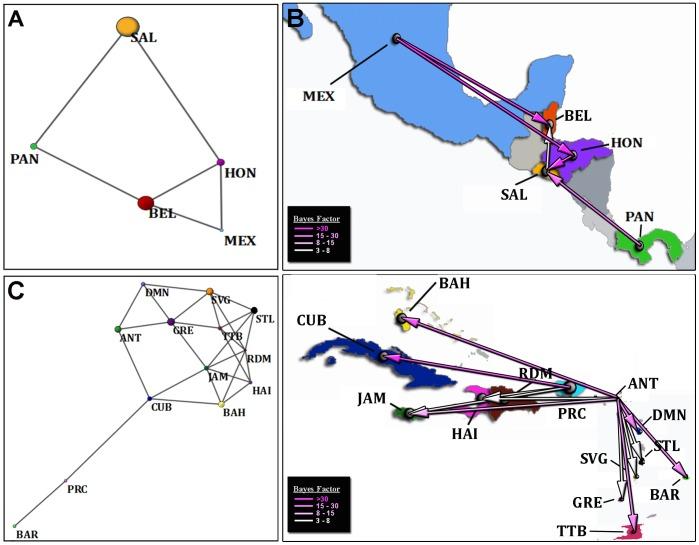
The Caribbean and Central America are among the regions with highest HIV-1B prevalence worldwide. Despite of this high virus burden, little is known about the timing and the migration patterns of HIV-1B in these regions. Migration is one of the major processes shaping the genetic structure of virus populations. Thus, reconstruction of epidemiological network may contribute to understand HIV-1B evolution and reduce virus prevalence. We have investigated the spatio-temporal dynamics of the HIV-1B epidemic in The Caribbean and Central America using 1,610 HIV-1B partial pol sequences from 13 Caribbean and 5 Central American countries. Timing of HIV-1B introduction and virus evolutionary rates, as well as the spatial genetic structure of the HIV-1B populations and the virus migration patterns were inferred. Results revealed that in The Caribbean and Central America most of the HIV-1B variability was generated since the 80 s. At odds with previous data suggesting that Haiti was the origin of the epidemic in The Caribbean, our reconstruction indicated that the virus could have been disseminated from Puerto Rico and Antigua. These two countries connected two distinguishable migration areas corresponding to the (mainly Spanish-colonized) Easter and (mainly British-colonized) Western islands, which indicates that virus migration patterns are determined by geographical barriers and by the movement of human populations among culturally related countries. Similar factors shaped the migration of HIV-1B in Central America. The HIV-1B population was significantly structured according to the country of origin, and the genetic diversity in each country was associated with the virus prevalence in both regions, which suggests that virus populations evolve mainly through genetic drift. Thus, our work contributes to the understanding of HIV-1B evolution and dispersion pattern in the Americas, and its relationship with the geography of the area and the movements of human populations.
加勒比和中美洲是世界上 HIV-1B 流行率最高的地区之一。尽管这些地区的病毒负担很高,但对于 HIV-1B 在这些地区的出现时间和传播模式知之甚少。迁移是塑造病毒群体遗传结构的主要过程之一。因此,重建流行病学网络可能有助于了解 HIV-1B 的进化并降低病毒流行率。我们使用来自 13 个加勒比国家和 5 个中美洲国家的 1610 个 HIV-1B 部分 pol 序列,研究了加勒比和中美洲地区的 HIV-1B 流行的时空动态。推断了 HIV-1B 的引入时间和病毒进化率、HIV-1B 群体的空间遗传结构以及病毒传播模式。结果表明,在加勒比和中美洲,大多数 HIV-1B 变异性是在 80 年代产生的。与先前的数据表明海地是加勒比地区流行的起源地相反,我们的重建表明,病毒可能是从波多黎各和安提瓜传播的。这两个国家连接了两个可区分的迁移区域,分别对应于(主要是西班牙殖民化的)复活节岛和(主要是英国殖民化的)西部岛屿,这表明病毒迁移模式是由地理障碍和人口在文化上相关的国家之间的迁移决定的。类似的因素塑造了中美洲 HIV-1B 的迁移。HIV-1B 群体根据原籍国显著分层,每个国家的遗传多样性与两个地区的病毒流行率相关,这表明病毒群体主要通过遗传漂变进化。因此,我们的工作有助于了解 HIV-1B 在美洲的进化和传播模式及其与该地区地理和人口流动的关系。


 Zotero 插件