Institute of System Analysis and Informatics (IASI) A. Ruberti, National Research Council (CNR), Rome, Italy.
PLoS One. 2013 Aug 29;8(8):e70875. doi: 10.1371/journal.pone.0070875. eCollection 2013.
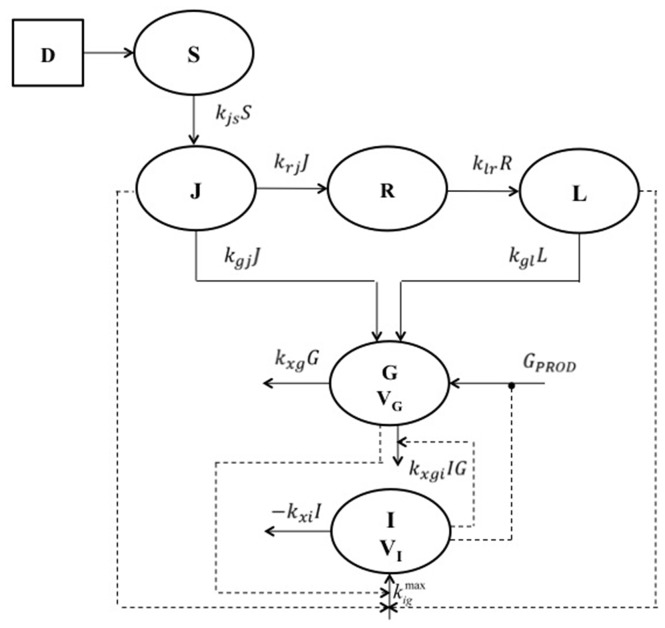
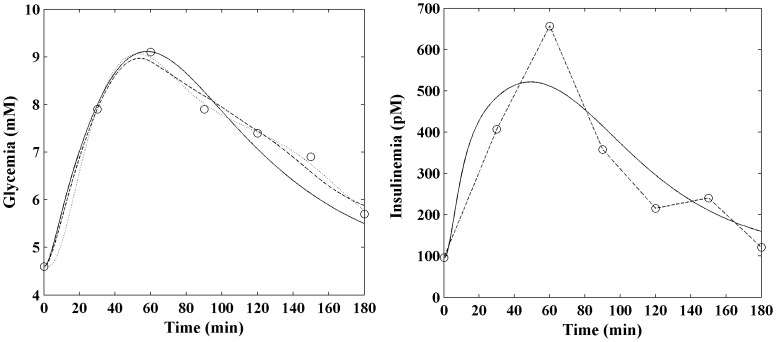
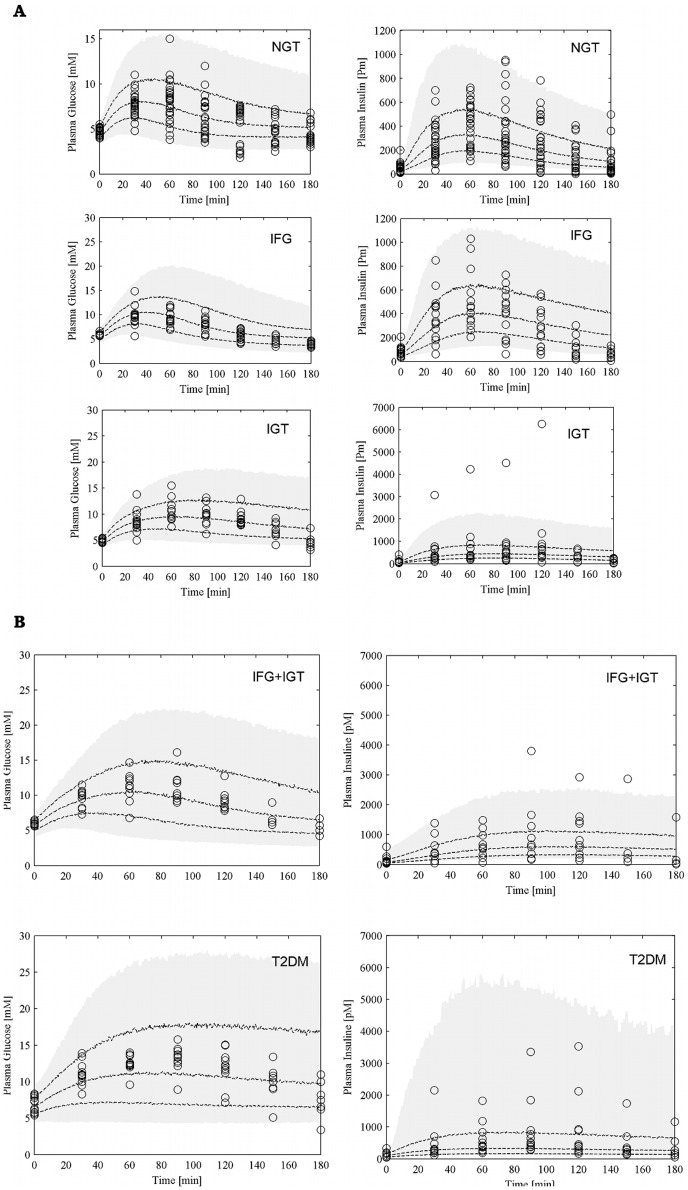
In order to provide a method for precise identification of insulin sensitivity from clinical Oral Glucose Tolerance Test (OGTT) observations, a relatively simple mathematical model (Simple Interdependent glucose/insulin MOdel SIMO) for the OGTT, which coherently incorporates commonly accepted physiological assumptions (incretin effect and saturating glucose-driven insulin secretion) has been developed. OGTT data from 78 patients in five different glucose tolerance groups were analyzed: normal glucose tolerance (NGT), impaired glucose tolerance (IGT), impaired fasting glucose (IFG), IFG+IGT, and Type 2 Diabetes Mellitus (T2DM). A comparison with the 2011 Salinari (COntinuos GI tract MOdel, COMO) and the 2002 Dalla Man (Dalla Man MOdel, DMMO) models was made with particular attention to insulin sensitivity indices ISCOMO, ISDMMO and kxgi (the insulin sensitivity index for SIMO). ANOVA on kxgi values across groups resulted significant overall (P<0.001), and post-hoc comparisons highlighted the presence of three different groups: NGT (8.62×10(-5)±9.36×10(-5) min(-1)pM(-1)), IFG (5.30×10(-5)±5.18×10(-5)) and combined IGT, IFG+IGT and T2DM (2.09×10(-5)±1.95×10(-5), 2.38×10(-5)±2.28×10(-5) and 2.38×10(-5)±2.09×10(-5) respectively). No significance was obtained when comparing ISCOMO or ISDMMO across groups. Moreover, kxgi presented the lowest sample average coefficient of variation over the five groups (25.43%), with average CVs for ISCOMO and ISDMMO of 70.32% and 57.75% respectively; kxgi also presented the strongest correlations with all considered empirical measures of insulin sensitivity. While COMO and DMMO appear over-parameterized for fitting single-subject clinical OGTT data, SIMO provides a robust, precise, physiologically plausible estimate of insulin sensitivity, with which habitual empirical insulin sensitivity indices correlate well. The kxgi index, reflecting insulin secretion dependency on glycemia, also significantly differentiates clinically diverse subject groups. The SIMO model may therefore be of value for the quantification of glucose homeostasis from clinical OGTT data.
为了提供一种从临床口服葡萄糖耐量试验(OGTT)观察中精确识别胰岛素敏感性的方法,我们开发了一种相对简单的 OGTT 数学模型(Simple Interdependent glucose/insulin MOdel SIMO),该模型一致地包含了普遍接受的生理假设(肠降血糖素效应和饱和葡萄糖驱动的胰岛素分泌)。对来自五个不同糖耐量组的 78 名患者的 OGTT 数据进行了分析:正常糖耐量(NGT)、糖耐量受损(IGT)、空腹血糖受损(IFG)、IFG+IGT 和 2 型糖尿病(T2DM)。特别关注了胰岛素敏感性指数 ISCOMO、ISDMMO 和 kxgi(SIMO 的胰岛素敏感性指数),并与 2011 年 Salinari(COntinuos GI tract MOdel,COMO)和 2002 年 Dalla Man(Dalla Man MOdel,DMMO)模型进行了比较。对各组 kxgi 值进行方差分析,结果具有统计学意义(P<0.001),事后比较突出了三组不同的存在:NGT(8.62×10(-5)±9.36×10(-5) min(-1)pM(-1))、IFG(5.30×10(-5)±5.18×10(-5))和 IGT、IFG+IGT 和 T2DM 合并组(2.09×10(-5)±1.95×10(-5)、2.38×10(-5)±2.28×10(-5) 和 2.38×10(-5)±2.09×10(-5))。比较各组的 ISCOMO 或 ISDMMO 时,没有统计学意义。此外,kxgi 在五个组中呈现出最低的样本平均变异系数(25.43%),而 ISCOMO 和 ISDMMO 的平均 CV 分别为 70.32%和 57.75%;kxgi 还与所有考虑的胰岛素敏感性经验性测量值具有最强的相关性。虽然 COMO 和 DMMO 似乎对拟合单个体临床 OGTT 数据过度参数化,但 SIMO 提供了对胰岛素敏感性的稳健、精确、生理上合理的估计,与习惯性经验性胰岛素敏感性指数相关性良好。反映血糖依赖性胰岛素分泌的 kxgi 指数也能显著区分临床不同的亚组。因此,SIMO 模型可能对从临床 OGTT 数据中定量评估葡萄糖稳态具有价值。