
基于脉搏诊断设备中传感器位移的脉搏深度新评估模型。
New assessment model of pulse depth based on sensor displacement in pulse diagnostic devices.
机构信息
Biomedical Engineering Research Division, Korea Institute of Oriental Medicine, Daejeon 305-811, Republic of Korea.
出版信息
Evid Based Complement Alternat Med. 2013;2013:938641. doi: 10.1155/2013/938641. Epub 2013 Sep 26.
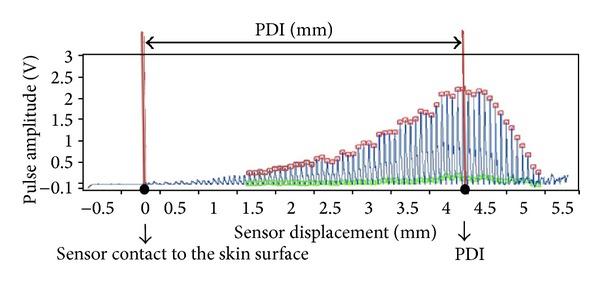
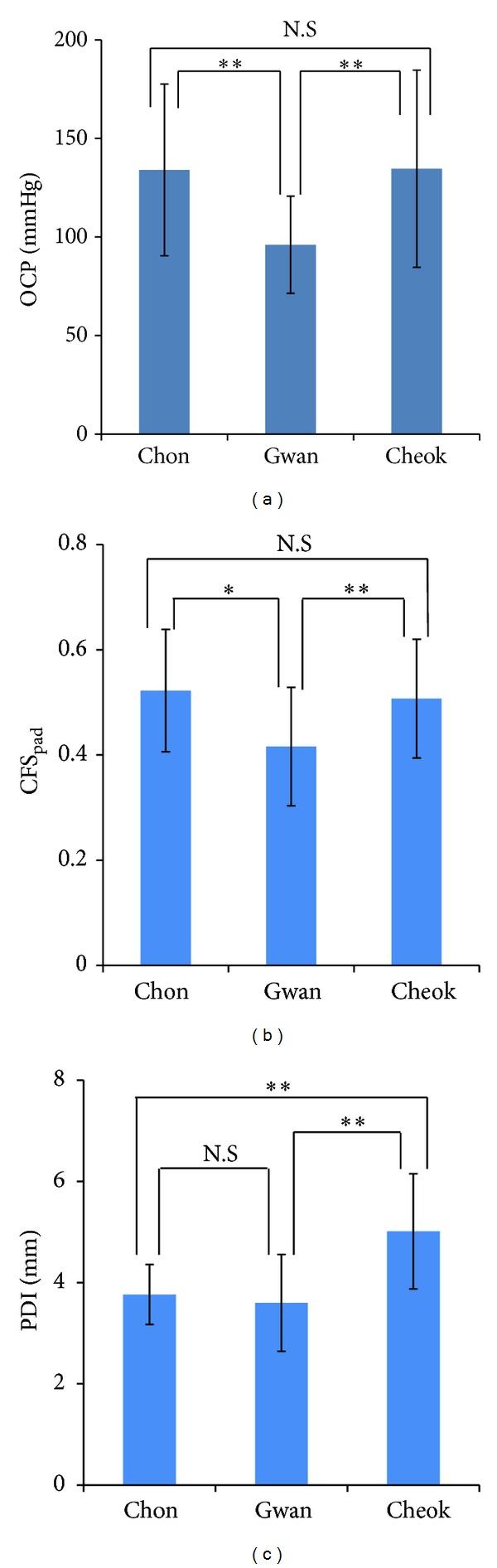
An accurate assessment of the pulse depth in pulse diagnosis is vital to determine the floating and sunken pulse qualities (PQs), which are two of the four most basic PQs. In this work, we proposed a novel model of assessing the pulse depth based on sensor displacement (SD) normal to the skin surface and compared this model with two previous models which assessed the pulse depth using contact pressure (CP). In contrast to conventional stepwise CP variation tonometry, we applied a continuously evolving tonometric mechanism at a constant velocity and defined the pulse depth index as the optimal SD where the largest pulse amplitude was observed. By calculating the pulse depth index for 18 volunteers, we showed that the pulse was deepest at Cheok (significance level: P < 0.01), while no significant difference was found between Chon and Gwan. In contrast, the two CP-based models estimated that the pulse was shallowest at Gwan (P < 0.05). For the repeated measures, the new SD-based model showed a smaller coefficient of variation (CV ≈ 7.6%) than the two CP-based models (CV ≈ 13.5% and 12.3%, resp.). The SD-based pulse depth assessment is not sensitive to the complex geometry around the palpation locations and temperature variation of contact sensors, which allows cost-effective sensor technology.
在脉诊中,准确评估脉象的脉搏深度对于确定浮脉和沉脉这两种最基本脉象中的两种至关重要。在这项工作中,我们提出了一种基于传感器垂直于皮肤表面的位移(SD)评估脉搏深度的新模型,并将其与使用接触压力(CP)评估脉搏深度的两个先前模型进行了比较。与传统的分步 CP 变化测压法不同,我们以恒定速度应用了连续变化的测压机制,并将脉搏深度指数定义为观察到最大脉搏幅度的最佳 SD。通过计算 18 名志愿者的脉搏深度指数,我们发现脉搏在尺(显著水平:P<0.01)处最深,而寸和关之间没有发现显著差异。相比之下,两个 CP 模型估计关处的脉搏最浅(P<0.05)。对于重复测量,新的基于 SD 的模型显示的变异系数(CV≈7.6%)小于两个基于 CP 的模型(CV≈13.5%和 12.3%,分别)。基于 SD 的脉搏深度评估不受触诊位置周围复杂几何形状和接触传感器温度变化的影响,这允许使用经济有效的传感器技术。





 Zotero 插件