Galandrini Ricciarda, Capuano Cristina, Santoni Angela
Department of Experimental Medicine, Istituto Pasteur-Fondazione Cenci-Bolognetti, Fondazione Eleonora Lorillard Spencer Cenci, Sapienza University , Rome , Italy.
Front Immunol. 2013 Nov 19;4:390. doi: 10.3389/fimmu.2013.00390.
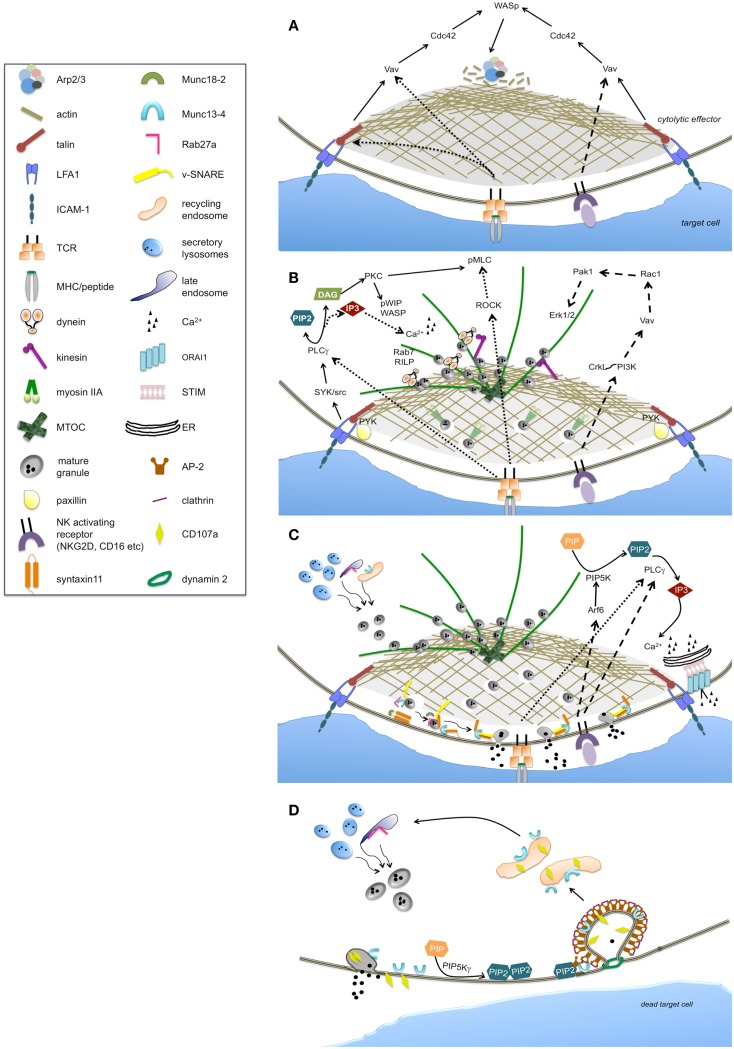
Target cell recognition by cytotoxic lymphocytes implies the simultaneous engagement and clustering of adhesion and activating receptors followed by the activation of an array of signal transduction pathways. The cytotoxic immune synapse represents the highly specialized dynamic interface formed between the cytolytic effector and its target that allows temporal and spatial integration of signals responsible for a defined sequence of processes culminating with the polarized secretion of lytic granules. Over the last decades, much attention has been given to the molecular signals coupling receptor ligation to the activation of cytolytic machinery. Moreover, in the last 10 years the discovery of genetic defects affecting cytotoxic responses greatly boosted our knowledge on the molecular effectors involved in the regulation of discrete phases of cytotoxic process at post-receptor levels. More recently, the use of super resolution and total internal reflection fluorescence imaging technologies added new insights on the dynamic reorganization of receptor and signaling molecules at lytic synapse as well as on the relationship between granule dynamics and cytoskeleton remodeling. To date we have a solid knowledge of the molecular mechanisms governing granule movement and secretion, being not yet fully unraveled the machinery that couples early receptor signaling to the late stage of synapse remodeling and granule dynamics. Here we highlight recent advances in our understanding of the molecular mechanisms acting in the activation of cytolytic machinery, also discussing similarities and differences between Natural killer cells and cytotoxic CD8(+) T cells.
细胞毒性淋巴细胞对靶细胞的识别意味着黏附受体和激活受体同时结合并聚集,随后一系列信号转导途径被激活。细胞毒性免疫突触代表了溶细胞效应器与其靶细胞之间形成的高度特化的动态界面,它允许对负责特定过程序列的信号进行时空整合,最终导致溶细胞颗粒的极化分泌。在过去几十年中,人们对将受体连接与溶细胞机制激活相偶联的分子信号给予了极大关注。此外,在过去10年中,影响细胞毒性反应的基因缺陷的发现极大地促进了我们对受体后水平细胞毒性过程离散阶段调控中涉及的分子效应器的认识。最近,超分辨率和全内反射荧光成像技术的应用为裂解突触处受体和信号分子的动态重组以及颗粒动态与细胞骨架重塑之间的关系提供了新的见解。迄今为止,我们对控制颗粒运动和分泌的分子机制有了扎实的了解,但将早期受体信号与突触重塑和颗粒动态后期相偶联的机制尚未完全阐明。在这里,我们重点介绍了我们对溶细胞机制激活中作用的分子机制的最新认识,同时也讨论了自然杀伤细胞和细胞毒性CD8(+) T细胞之间的异同。