Reno Philip L, McLean Cory Y, Hines Jasmine E, Capellini Terence D, Bejerano Gill, Kingsley David M
Department of Anthropology, The Pennsylvania State University, University Park, Pennsylvania, United States of America.
Department of Computer Science, Stanford University, Stanford, California, United States of America.
PLoS One. 2013 Dec 19;8(12):e84258. doi: 10.1371/journal.pone.0084258. eCollection 2013.
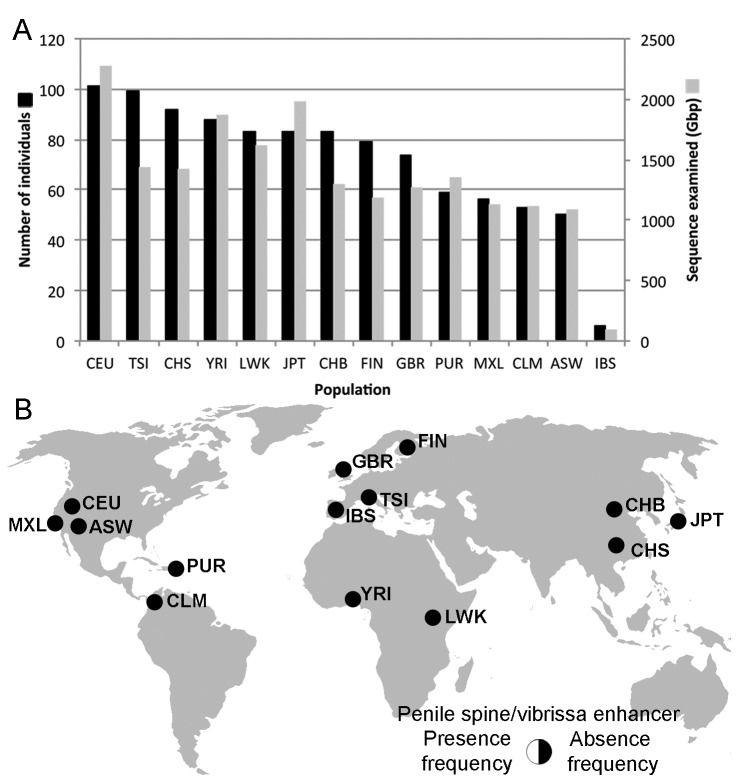
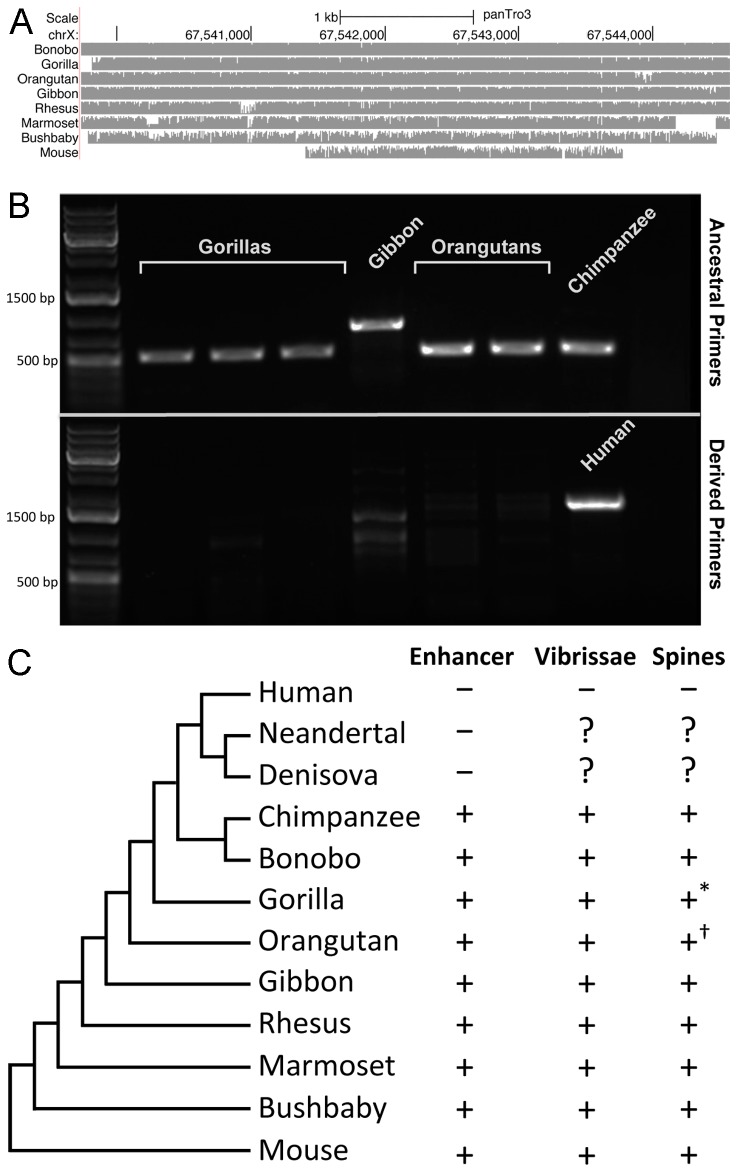
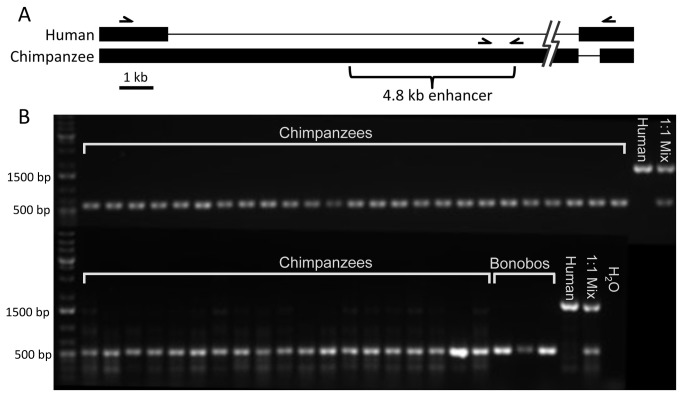
Previous studies show that humans have a large genomic deletion downstream of the Androgen Receptor gene that eliminates an ancestral mammalian regulatory enhancer that drives expression in developing penile spines and sensory vibrissae. Here we use a combination of large-scale sequence analysis and PCR amplification to demonstrate that the penile spine/vibrissa enhancer is missing in all humans surveyed and in the Neandertal and Denisovan genomes, but is present in DNA samples of chimpanzees and bonobos, as well as in multiple other great apes and primates that maintain some form of penile integumentary appendage and facial vibrissae. These results further strengthen the association between the presence of the penile spine/vibrissa enhancer and the presence of penile spines and macro- or micro- vibrissae in non-human primates as well as show that loss of the enhancer is both a distinctive and characteristic feature of the human lineage.
先前的研究表明,人类雄激素受体基因下游存在一个大的基因组缺失,该缺失消除了一个在发育中的阴茎棘和感觉触须中驱动表达的祖传哺乳动物调控增强子。在这里,我们结合大规模序列分析和PCR扩增,证明在所调查的所有人类以及尼安德特人和丹尼索瓦人的基因组中,阴茎棘/触须增强子均缺失,但在黑猩猩和倭黑猩猩的DNA样本中存在,在其他多种保持某种形式阴茎体表附属物和面部触须的大型猿类和灵长类动物中也存在。这些结果进一步加强了阴茎棘/触须增强子的存在与非人类灵长类动物中阴茎棘以及大或小触须的存在之间的关联,同时表明增强子的缺失是人类谱系的一个独特且特征性的特征。