• 文献检索
  • 文档翻译
  • 深度研究
  • 学术资讯
  • Suppr Zotero 插件Zotero 插件
  • 邀请有礼
  • 套餐&价格
  • 历史记录
应用&插件
Suppr Zotero 插件Zotero 插件浏览器插件Mac 客户端Windows 客户端微信小程序
定价
高级版会员购买积分包购买API积分包
服务
文献检索文档翻译深度研究API 文档MCP 服务
关于我们
关于 Suppr公司介绍联系我们用户协议隐私条款
关注我们

Suppr 超能文献

核心技术专利:CN118964589B侵权必究
粤ICP备2023148730 号-1Suppr @ 2026

文献检索

告别复杂PubMed语法,用中文像聊天一样搜索,搜遍4000万医学文献。AI智能推荐,让科研检索更轻松。

立即免费搜索

文件翻译

保留排版,准确专业,支持PDF/Word/PPT等文件格式,支持 12+语言互译。

免费翻译文档

深度研究

AI帮你快速写综述,25分钟生成高质量综述,智能提取关键信息,辅助科研写作。

立即免费体验

螺旋断层放疗治疗肺癌放射性肺炎的预测因素。

Predictive factors for radiation pneumonitis in lung cancer treated with helical tomotherapy.

机构信息

Department of Radiation Oncology, Kyung Hee University Medical Center, Kyung Hee University School of Medicine, Seoul, Korea.

出版信息

Cancer Res Treat. 2013 Dec;45(4):295-302. doi: 10.4143/crt.2013.45.4.295. Epub 2013 Dec 31.

DOI:10.4143/crt.2013.45.4.295
PMID:24454002
原文链接:https://pmc.ncbi.nlm.nih.gov/articles/PMC3893327/
Abstract

PURPOSE

Predictive factors for radiation pneumonitis (RP) after helical tomotherapy (HT) may differ from those after linac-based radiotherapy. In this study, we identified predictive factors for RP in patients with lung cancer treated with HT.

MATERIALS AND METHODS

We retrospectively analyzed clinical, treatment-related and dosimetric factors from 31 patients with lung cancer treated with HT. RP was graded according to Common Terminology Criteria for Adverse Events version 4.0 and grade ≥2 RP was defined as a RP event. We used Kaplan-Meier methods to compute the actuarial incidence of RP. For univariate and multivariate analysis, the log-rank test and the Cox proportional regression hazard model were used. We generated receiver-operating characteristics (ROC) curves to define the cutoff values for significant parameters.

RESULTS

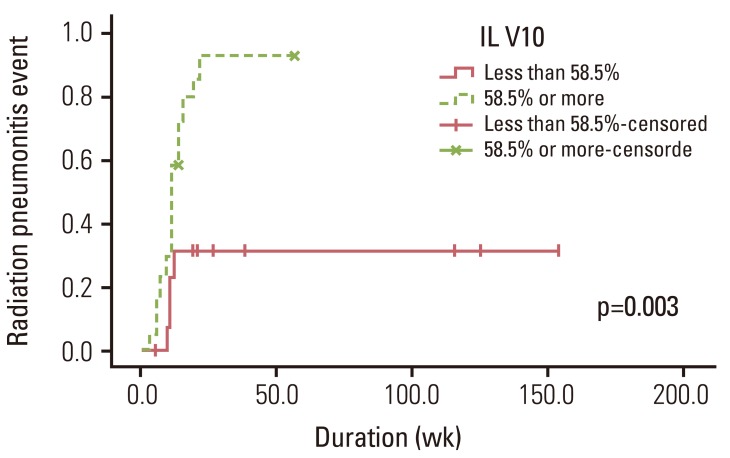
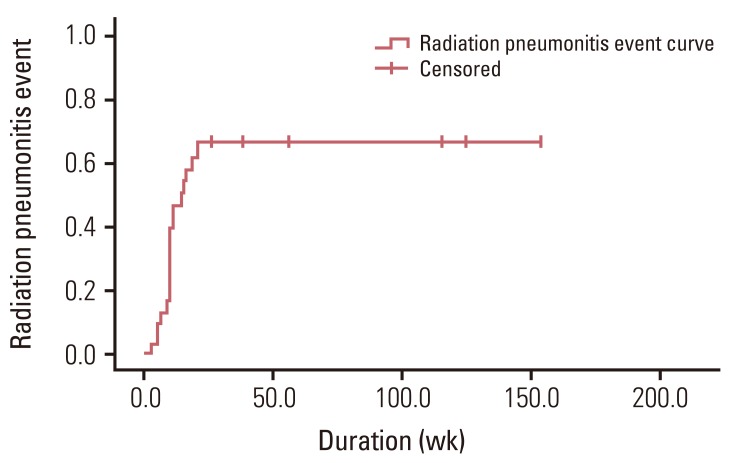
The median follow-up duration was 6.6 months (range, 1.6 to 38.5 months). The 2-, 4-, and 6-month actuarial RP event rates were 13.2%, 58.5%, and 67.0%, respectively. There was no grade 4 or more RP. Ipsilateral V5, V10, V15, and contralateral V5 were related with RP event on univariate analysis. By multivariate analysis, ipsilateral V10 was factor most strongly associated with RP event. On the ROC curve, the cutoff values of ipsilateral V5, V10, V15, and contralateral V5 were 67.5%, 58.5%, 50.0%, and 55.5%, respectively.

CONCLUSION

In our study, ipsilateral V5, V10, V15, and contralateral V5 were significant predictive factors for RP after HT.

摘要

目的

螺旋断层放疗(HT)后放射性肺炎(RP)的预测因素可能与直线加速器放疗后不同。本研究旨在确定接受 HT 治疗的肺癌患者发生 RP 的预测因素。

材料与方法

我们回顾性分析了 31 例接受 HT 治疗的肺癌患者的临床、治疗相关和剂量学因素。RP 按不良事件通用术语标准 4.0 版进行分级,≥2 级 RP 定义为 RP 事件。我们使用 Kaplan-Meier 方法计算 RP 的累积发生率。采用对数秩检验和 Cox 比例风险回归模型进行单因素和多因素分析。我们生成了受试者工作特征(ROC)曲线来确定显著参数的截断值。

结果

中位随访时间为 6.6 个月(范围 1.6 至 38.5 个月)。2、4 和 6 个月的累积 RP 事件发生率分别为 13.2%、58.5%和 67.0%。无 4 级或更高级别的 RP。单因素分析显示,同侧 V5、V10、V15 和对侧 V5 与 RP 事件相关。多因素分析显示,同侧 V10 是与 RP 事件最相关的因素。ROC 曲线显示,同侧 V5、V10、V15 和对侧 V5 的截断值分别为 67.5%、58.5%、50.0%和 55.5%。

结论

在本研究中,同侧 V5、V10、V15 和对侧 V5 是 HT 后 RP 的显著预测因素。
https://cdn.ncbi.nlm.nih.gov/pmc/blobs/e467/3893327/af79484adb0b/crt-45-295-g002.jpg
https://cdn.ncbi.nlm.nih.gov/pmc/blobs/e467/3893327/1ca7b8666395/crt-45-295-g001.jpg
https://cdn.ncbi.nlm.nih.gov/pmc/blobs/e467/3893327/af79484adb0b/crt-45-295-g002.jpg
https://cdn.ncbi.nlm.nih.gov/pmc/blobs/e467/3893327/1ca7b8666395/crt-45-295-g001.jpg
https://cdn.ncbi.nlm.nih.gov/pmc/blobs/e467/3893327/af79484adb0b/crt-45-295-g002.jpg

相似文献

1
Predictive factors for radiation pneumonitis in lung cancer treated with helical tomotherapy.螺旋断层放疗治疗肺癌放射性肺炎的预测因素。
Cancer Res Treat. 2013 Dec;45(4):295-302. doi: 10.4143/crt.2013.45.4.295. Epub 2013 Dec 31.
2
Outcome and toxicity of stereotactic body radiotherapy with helical tomotherapy for inoperable lung tumor: analysis of Grade 5 radiation pneumonitis.螺旋断层放疗立体定向体部放疗对不可手术切除的肺肿瘤的疗效及毒性:5级放射性肺炎分析
J Radiat Res. 2014 May;55(3):575-82. doi: 10.1093/jrr/rrt146. Epub 2014 Jan 23.
3
Significance of low-dose radiation distribution in development of radiation pneumonitis after helical-tomotherapy-based hypofractionated radiotherapy for pulmonary metastases.基于螺旋断层放疗的低分割放疗治疗肺转移瘤后低剂量辐射分布在放射性肺炎发生中的意义
J Radiat Res. 2014 Jan 1;55(1):105-12. doi: 10.1093/jrr/rrt080. Epub 2013 Jun 11.
4
Radiation pneumonitis in non-small-cell lung cancer patients treated with helical tomotherapy.接受螺旋断层放疗的非小细胞肺癌患者的放射性肺炎
Niger J Clin Pract. 2016 Jan-Feb;19(1):25-9. doi: 10.4103/1119-3077.173709.
5
Clinical and Dosimetric Factors Predicting Grade ≥2 Radiation Pneumonitis After Postoperative Radiotherapy for Patients With Non-Small Cell Lung Carcinoma.临床和剂量学因素预测非小细胞肺癌术后放疗后≥2 级放射性肺炎。
Int J Radiat Oncol Biol Phys. 2018 Jul 15;101(4):919-926. doi: 10.1016/j.ijrobp.2018.04.012. Epub 2018 Apr 12.
6
Prognostic analysis of radiation pneumonitis: carbon-ion radiotherapy in patients with locally advanced lung cancer.放射性肺炎的预后分析:局部晚期肺癌患者的碳离子放疗
Radiat Oncol. 2017 May 30;12(1):91. doi: 10.1186/s13014-017-0830-z.
7
Study of the predictors for radiation pneumonitis in patient with non-small cell lung cancer received radiotherapy after pneumonectomy.非小细胞肺癌全肺切除术后放疗患者放射性肺炎预测因素的研究。
Cancer Radiother. 2021 Jun;25(4):323-329. doi: 10.1016/j.canrad.2020.11.001. Epub 2021 Jan 11.
8
Comparison of Radiation Pneumonitis in Lung Cancer Patients Treated with HT versus IMRT and Circulating Lymphocyte Subsets as Predicting Risk Factors.肺癌患者接受调强放疗(HT)与调强适形放疗(IMRT)治疗后的放射性肺炎比较以及循环淋巴细胞亚群作为预测风险因素的研究
J Inflamm Res. 2021 Aug 28;14:4205-4215. doi: 10.2147/JIR.S328955. eCollection 2021.
9
Comparison of clinical, tumour-related and dosimetric factors in grade 0-1, grade 2 and grade 3 radiation pneumonitis after stereotactic body radiotherapy for lung tumours.比较肺癌立体定向体部放疗后 0-1 级、2 级和 3 级放射性肺炎的临床、肿瘤相关和剂量学因素。
Br J Radiol. 2012 May;85(1013):636-42. doi: 10.1259/bjr/71635286. Epub 2012 Jan 17.
10
Risk factors for radiation pneumonitis after stereotactic radiation therapy for lung tumours: clinical usefulness of the planning target volume to total lung volume ratio.肺部肿瘤立体定向放射治疗后放射性肺炎的危险因素:计划靶体积与全肺体积比的临床应用价值
Br J Radiol. 2018 Jun;91(1086):20170453. doi: 10.1259/bjr.20170453. Epub 2018 Apr 16.

引用本文的文献

1
Deep-Learning Model Prediction of Radiation Pneumonitis Using Pretreatment Chest Computed Tomography and Clinical Factors.使用预处理胸部 CT 和临床因素的深度学习模型预测放射性肺炎。
Technol Cancer Res Treat. 2024 Jan-Dec;23:15330338241254060. doi: 10.1177/15330338241254060.
2
Lack of dose dependency for radiation pneumonitis after chemoradiotherapy with the use of tomotherapy for lung cancer.肺癌调强放疗联合同步化疗后放射性肺炎与剂量无关。
Nagoya J Med Sci. 2022 Feb;84(1):180-184. doi: 10.18999/nagjms.84.1.180.
3
Pulmonary toxicity of craniospinal irradiation using helical tomotherapy.

本文引用的文献

1
Factors predicting radiation pneumonitis in locally advanced non-small cell lung cancer.局部晚期非小细胞肺癌放射性肺炎的预测因素
Radiat Oncol J. 2011 Sep;29(3):181-90. doi: 10.3857/roj.2011.29.3.181. Epub 2011 Sep 30.
2
Long-term clinical outcome of intensity-modulated radiotherapy for inoperable non-small cell lung cancer: the MD Anderson experience.不能手术的非小细胞肺癌调强放疗的长期临床结果:MD 安德森经验。
Int J Radiat Oncol Biol Phys. 2012 May 1;83(1):332-9. doi: 10.1016/j.ijrobp.2011.06.1963. Epub 2011 Nov 11.
3
Analysis of clinical and dosimetric factors associated with severe acute radiation pneumonitis in patients with locally advanced non-small cell lung cancer treated with concurrent chemotherapy and intensity-modulated radiotherapy.
螺旋断层放疗的颅脑脊柱照射的肺毒性。
Sci Rep. 2022 Feb 25;12(1):3221. doi: 10.1038/s41598-022-07224-1.
4
Comparison of Radiation Pneumonitis in Lung Cancer Patients Treated with HT versus IMRT and Circulating Lymphocyte Subsets as Predicting Risk Factors.肺癌患者接受调强放疗(HT)与调强适形放疗(IMRT)治疗后的放射性肺炎比较以及循环淋巴细胞亚群作为预测风险因素的研究
J Inflamm Res. 2021 Aug 28;14:4205-4215. doi: 10.2147/JIR.S328955. eCollection 2021.
5
The Efficacy and Safety of Acupuncture for Preventing Radiation Pneumonitis in Patients With Lung Cancer: A Prospective, Single-Blinded, Randomized Pilot Proof-of-Principle Study.针刺预防肺癌患者放射性肺炎的疗效和安全性:一项前瞻性、单盲、随机验证性初步研究。
Integr Cancer Ther. 2020 Jan-Dec;19:1534735420908327. doi: 10.1177/1534735420908327.
6
Diabetes mellitus is a predictive factor for radiation pneumonitis after thoracic radiotherapy in patients with lung cancer.糖尿病是肺癌患者胸部放疗后放射性肺炎的一个预测因素。
Cancer Manag Res. 2019 Jul 26;11:7103-7110. doi: 10.2147/CMAR.S210095. eCollection 2019.
7
Phase II study of compensator-based non-coplanar intensity-modulated radiotherapy for Stage I non-small-cell lung cancer.基于补偿器的非共面强度调制放疗治疗 I 期非小细胞肺癌的 II 期研究。
J Radiat Res. 2019 May 1;60(3):387-393. doi: 10.1093/jrr/rrz009.
8
Dosimetric Comparison Between Jaw Tracking and No Jaw Tracking in Intensity-Modulated Radiation Therapy.在调强放射治疗中,下颌追踪与无下颌追踪的剂量学比较。
Technol Cancer Res Treat. 2019 Jan 1;18:1533033819841061. doi: 10.1177/1533033819841061.
9
Treatment outcomes and patterns of radiologic appearance after hypofractionated image-guided radiotherapy delivered with helical tomotherapy (HHT) for lung tumours.螺旋断层放疗(HHT)用于肺部肿瘤的低分割影像引导放疗后的治疗结果及放射学表现模式
Br J Radiol. 2017 Mar;90(1071):20160853. doi: 10.1259/bjr.20160853.
10
Comparison of survival rates between 3D conformal radiotherapy and intensity-modulated radiotherapy in patients with stage III non-small cell lung cancer.III期非小细胞肺癌患者三维适形放疗与调强放疗生存率的比较。
Onco Targets Ther. 2016 Nov 24;9:7227-7234. doi: 10.2147/OTT.S124311. eCollection 2016.
分析局部晚期非小细胞肺癌患者同期化疗和调强放疗后发生严重急性放射性肺炎的临床和剂量学因素。
Radiat Oncol. 2010 May 12;5:35. doi: 10.1186/1748-717X-5-35.
4
Treatment-related pneumonitis and acute esophagitis in non-small-cell lung cancer patients treated with chemotherapy and helical tomotherapy.接受化疗和螺旋断层放疗的非小细胞肺癌患者的治疗相关肺炎和急性食管炎。
Int J Radiat Oncol Biol Phys. 2010 Nov 1;78(3):651-8. doi: 10.1016/j.ijrobp.2009.08.068. Epub 2010 Mar 6.
5
Prediction of radiation pneumonitis following high-dose thoracic radiation therapy by 3 Gy/fraction for non-small cell lung cancer: analysis of clinical and dosimetric factors.非小细胞肺癌大剂量胸部放疗(每次分割剂量3Gy)后放射性肺炎的预测:临床和剂量学因素分析
Jpn J Clin Oncol. 2009 Mar;39(3):151-7. doi: 10.1093/jjco/hyn158. Epub 2009 Feb 3.
6
Treatment planning comparison between conformal radiotherapy and helical tomotherapy in the case of locally advanced-stage NSCLC.局部晚期非小细胞肺癌病例中适形放疗与螺旋断层放疗的治疗计划比较
Radiother Oncol. 2008 Sep;88(3):310-8. doi: 10.1016/j.radonc.2008.06.006. Epub 2008 Aug 7.
7
Initial evaluation of treatment-related pneumonitis in advanced-stage non-small-cell lung cancer patients treated with concurrent chemotherapy and intensity-modulated radiotherapy.同步化疗联合调强放疗治疗晚期非小细胞肺癌患者时治疗相关性肺炎的初步评估
Int J Radiat Oncol Biol Phys. 2007 May 1;68(1):94-102. doi: 10.1016/j.ijrobp.2006.12.031. Epub 2007 Feb 22.
8
Analysis of clinical and dosimetric factors associated with treatment-related pneumonitis (TRP) in patients with non-small-cell lung cancer (NSCLC) treated with concurrent chemotherapy and three-dimensional conformal radiotherapy (3D-CRT).对接受同步化疗和三维适形放疗(3D-CRT)的非小细胞肺癌(NSCLC)患者中与治疗相关肺炎(TRP)相关的临床和剂量学因素的分析。
Int J Radiat Oncol Biol Phys. 2006 Dec 1;66(5):1399-407. doi: 10.1016/j.ijrobp.2006.07.1337. Epub 2006 Sep 25.
9
Radiation pneumonitis following concurrent accelerated hyperfractionated radiotherapy and chemotherapy for limited-stage small-cell lung cancer: Dose-volume histogram analysis and comparison with conventional chemoradiation.局限期小细胞肺癌同步加速超分割放疗与化疗后的放射性肺炎:剂量体积直方图分析及与传统放化疗的比较
Int J Radiat Oncol Biol Phys. 2006 Mar 15;64(4):1100-5. doi: 10.1016/j.ijrobp.2005.09.025. Epub 2005 Dec 20.
10
The use of lung dose-volume histograms in predicting post-radiation pneumonitis after non-conventionally fractionated radiotherapy for thoracic carcinoma.
Clin Oncol (R Coll Radiol). 2005 Dec;17(8):599-603. doi: 10.1016/j.clon.2005.07.016.