
抗淀粉样蛋白化合物可抑制由错误折叠循环扩增(PMCA)引起的α-突触核蛋白聚集。
Anti-amyloid compounds inhibit α-synuclein aggregation induced by protein misfolding cyclic amplification (PMCA).
机构信息
John Van Geest Centre for Brain Repair, E. D. Adrian Building, Robinson Way, Cambridge CB2 0PY, United Kingdom.
Medical Research Council Laboratory of Molecular Biology, Francis Crick Avenue, Cambridge Biomedical Campus, Cambridge CB2 0QH, United Kingdom.
出版信息
J Biol Chem. 2014 Apr 25;289(17):11897-11905. doi: 10.1074/jbc.M113.542340. Epub 2014 Feb 28.
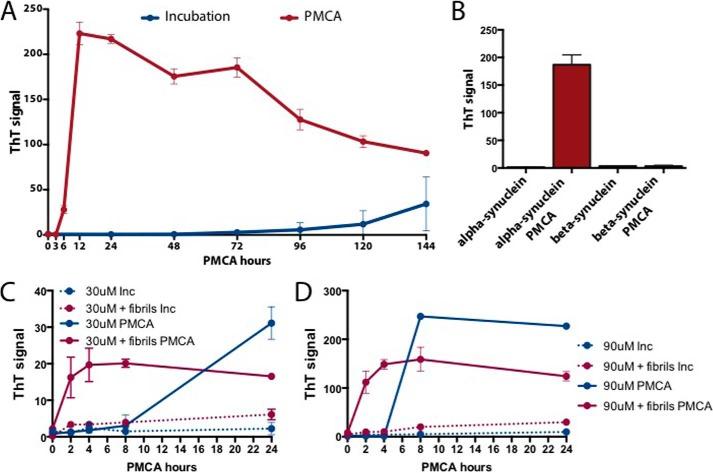
Filaments made of α-synuclein form the characteristic Lewy pathology in Parkinson and other diseases. The formation of α-synuclein filaments can be reproduced in vitro by incubation of recombinant protein, but the filament growth is very slow and highly variable and so unsuitable for fast high throughput anti-aggregation drug screening. To overcome this obstacle we have investigated whether the protein misfolding cyclic amplification (PMCA) technique, used for fast amplification of prion protein aggregates, could be adapted for growing α-synuclein aggregates and thus suitable for screening of drugs to affect α-synuclein aggregation for the treatment of the yet incurable α-synucleinopathies. Circular dichroism, electron microscopy, and native and SDS-polyacrylamide gels were used to demonstrate α-synuclein aggregate formation by PMCA, and the strain imprint of the α-synuclein fibrils was studied by proteinase K digestion. We also demonstrated that α-synuclein fibrils are able to seed new α-synuclein PMCA reactions and to enter and aggregate in cells in culture. In particular, we have generated a line of "chronically infected" cells, which transmit α-synuclein aggregates even after multiple passages. To evaluate the sensitivity of the PMCA system as an α-synuclein anti-aggregating drug screening assay a panel of 10 drugs was tested. Anti-amyloid compounds proved efficient in inhibiting α-synuclein fibril formation induced by PMCA. Our results show that α-synuclein PMCA is a fast and reproducible system that could be used as a high throughput screening method for finding new α-synuclein anti-aggregating compounds.
由α-突触核蛋白组成的纤维形成了帕金森病和其他疾病的典型路易体病理。通过重组蛋白的孵育,可以在体外再现α-突触核蛋白纤维的形成,但是纤维的生长非常缓慢且高度可变,因此不适合快速高通量的抗聚集药物筛选。为了克服这一障碍,我们研究了蛋白质错误折叠循环扩增(PMCA)技术是否可以用于快速扩增朊病毒蛋白聚集物,从而可以用于生长α-突触核蛋白聚集物,从而适合筛选影响α-突触核蛋白聚集的药物,以治疗目前尚无法治愈的α-突触核蛋白病。圆二色性,电子显微镜以及天然和 SDS-聚丙烯酰胺凝胶电泳用于证明 PMCA 诱导的α-突触核蛋白聚集物的形成,并通过蛋白酶 K 消化研究了α-突触核蛋白纤维的应变印记。我们还证明了α-突触核蛋白纤维能够引发新的α-突触核蛋白 PMCA 反应,并进入和聚集在培养中的细胞中。特别是,我们已经产生了一条“慢性感染”的细胞系,即使经过多次传代,它也能传递α-突触核蛋白聚集物。为了评估 PMCA 系统作为α-突触核蛋白抗聚集药物筛选测定的灵敏度,测试了 10 种药物的组合。抗淀粉样蛋白化合物被证明能有效抑制 PMCA 诱导的α-突触核蛋白纤维形成。我们的结果表明,α-突触核蛋白 PMCA 是一种快速且可重复的系统,可用于寻找新的α-突触核蛋白抗聚集化合物的高通量筛选方法。



 Zotero 插件