
腺样囊性癌的颅内扩展:EphA2表达及上皮-间质转化在肿瘤转移中的潜在作用:一例报告
Intracranial extension of adenoid cystic carcinoma: potential involvement of EphA2 expression and epithelial-mesenchymal transition in tumor metastasis: a case report.
作者信息
Fukai Junya, Fujita Koji, Yamoto Toshikazu, Sasaki Takahiro, Uematsu Yuji, Nakao Naoyuki
机构信息
Department of Neurological Surgery, Wakayama Medical University School of Medicine, Kimiidera 811-1, Wakayama 641-0012, Japan.
出版信息
BMC Res Notes. 2014 Mar 7;7:131. doi: 10.1186/1756-0500-7-131.
BACKGROUND
Adenoid cystic carcinoma is a malignant epithelial tumor derived from salivary glands and tends to invade the surrounding structures including nervous system. We present a case of adenoid cystic carcinoma with intracranial extension and propose a novel molecular mechanism of adenoid cystic carcinoma metastasis.
CASE PRESENTATION
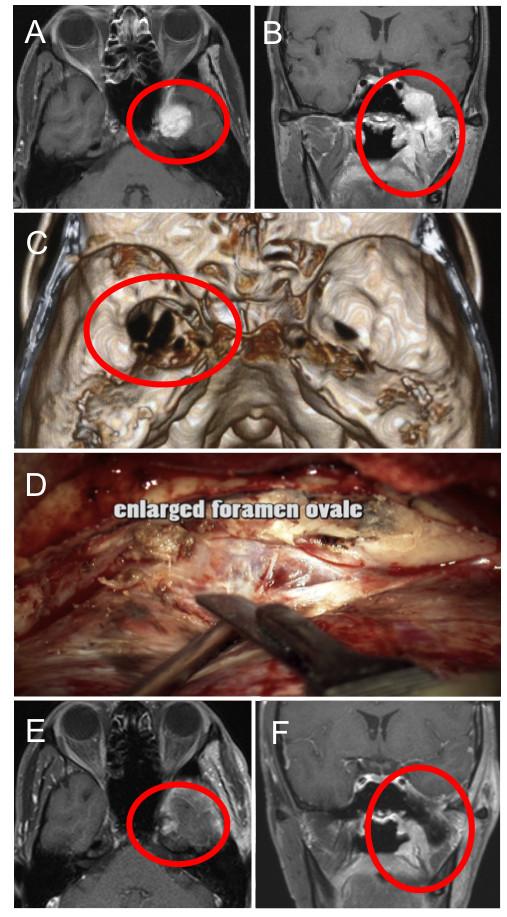
A 29-year-old Japanese male presented with left trigeminal nerve disturbance. Neuroimaging revealed a tumor located at the right middle cranial and infratemporal fossa. The tumor was removed via a subtemporal extradural and infratemporal fossa approach and histologically diagnosed as adenoid cystic carcinoma. Radiological and operative findings confirmed a perineural spread of the tumor along the mandibular nerve. Immunohistochemical analyses of molecular consequences in this case were performed for better understanding of the biological processes associated with adenoid cystic carcinoma metastasis. First, the neoplastic cells were not immunoreactive for E-cadherin, an epithelial marker, but for vimentin, a mesenchymal marker, suggesting changes in cell phenotype from epithelial to mesenchymal states. Correspondingly, immunoreactivity of transcriptional factors, such as Slug, Twist, matrix metalloproteinase-2 and -9, which are involved in epithelial-mesenchymal transition, were observed. Second, elevated expression of EphA2 receptor, not ephrin-A1, was notable in the neoplastic cells, suggesting morphological changes reminiscent of epithelial-mesenchymal transition and ligand-independent promotion of tumor cell migration and invasion.
CONCLUSIONS
We report a case of adenoid cystic carcinoma with perineural spread and provide the first published evidence that EphA2 expression without ephrin-A1 and epithelial-mesenchymal transition might play important roles in adenoid cystic carcinoma progression.
背景
腺样囊性癌是一种起源于唾液腺的恶性上皮性肿瘤,易于侵犯包括神经系统在内的周围结构。我们报告一例伴有颅内扩展的腺样囊性癌病例,并提出腺样囊性癌转移的一种新的分子机制。
病例介绍
一名29岁的日本男性出现左侧三叉神经功能障碍。神经影像学检查显示肿瘤位于右侧中颅窝和颞下窝。通过颞下硬膜外和颞下窝入路切除肿瘤,组织学诊断为腺样囊性癌。影像学和手术结果证实肿瘤沿下颌神经出现神经周围扩散。对该病例分子后果进行免疫组织化学分析,以更好地了解与腺样囊性癌转移相关的生物学过程。首先,肿瘤细胞对上皮标志物E-钙黏蛋白无免疫反应,但对间充质标志物波形蛋白有免疫反应,提示细胞表型从上皮状态向间充质状态转变。相应地,观察到参与上皮-间充质转化的转录因子如Slug、Twist、基质金属蛋白酶-2和-9的免疫反应性。其次,肿瘤细胞中EphA2受体而非ephrin-A1的表达升高,提示出现类似于上皮-间充质转化的形态学变化以及肿瘤细胞迁移和侵袭的配体非依赖性促进。
结论
我们报告一例伴有神经周围扩散的腺样囊性癌病例,并提供了首个已发表的证据,即无ephrin-A1的EphA2表达和上皮-间充质转化可能在腺样囊性癌进展中起重要作用。



 Zotero 插件