Author affiliations: Division of Asthma, Allergy and Lung Biology, Medical Research Council Centre for Allergic Mechanisms in Asthma (S.Z., M.A.-P., A.L., A.G.), and the Division of Health and Social Care Research (J.P., J.W.L.), King's College London, the National Institute for Health Research Biomedical Research Centre at Guy's and St. Thomas' National Health Service Foundation Trust and King's College London (S.Z., J.P., J.W.L., A.L., A.G.), the Institute for Women's Health, University College London (N.M.), and the Department of Child Health, St. George's, University of London (S.C.) - all in London.
N Engl J Med. 2014 Mar 20;370(12):1121-1130. doi: 10.1056/NEJMoa1309220.
Results from an observational study involving neonates suggested that high-frequency oscillatory ventilation (HFOV), as compared with conventional ventilation, was associated with superior small-airway function at follow-up. Data from randomized trials are needed to confirm this finding.
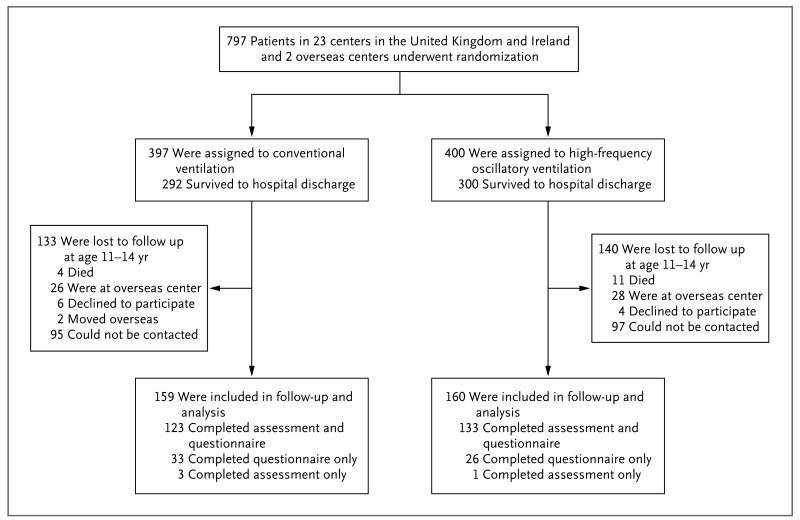
We studied 319 adolescents who had been born before 29 weeks of gestation and had been enrolled in a multicenter, randomized trial that compared HFOV with conventional ventilation immediately after birth. The trial involved 797 neonates, of whom 592 survived to hospital discharge. We compared follow-up data from adolescents who had been randomly assigned to HFOV with follow-up data from those who had been randomly assigned to conventional ventilation, with respect to lung function and respiratory health, health-related quality of life, and functional status, as assessed with the use of questionnaires completed when the participants were 11 to 14 years of age. The primary outcome was forced expiratory flow at 75% of the expired vital capacity (FEF75).
The HFOV group had superior results on a test of small-airway function (z score for FEF75, -0.97 with HFOV vs. -1.19 with conventional therapy; adjusted difference, 0.23 [95% confidence interval, 0.02 to 0.45]). There were significant differences in favor of HFOV in several other measures of respiratory function, including forced expiratory volume in 1 second, forced vital capacity, peak expiratory flow, diffusing capacity, and impulse-oscillometric findings. As compared with the conventional-therapy group, the HFOV group had significantly higher ratings from teachers in three of eight school subjects assessed, but there were no other significant differences in functional outcomes.
In a randomized trial involving children who had been born extremely prematurely, those who had undergone HFOV, as compared with those who had received conventional ventilation, had superior lung function at 11 to 14 years of age, with no evidence of poorer functional outcomes. (Funded by the National Institute for Health Research Health Technology Assessment Programme and others.).
一项涉及早产儿的观察性研究结果表明,高频振荡通气(HFOV)与常规通气相比,在随访时与更好的小气道功能相关。需要随机试验的数据来证实这一发现。
我们研究了 319 名在 29 周前出生的青少年,他们参加了一项多中心、随机试验,该试验比较了出生后立即使用 HFOV 与常规通气。该试验涉及 797 名新生儿,其中 592 人存活至出院。我们比较了随机分配到 HFOV 的青少年的随访数据与随机分配到常规通气的青少年的随访数据,比较了肺功能和呼吸健康、健康相关生活质量和功能状态,使用参与者在 11 至 14 岁时完成的问卷进行评估。主要结局是呼气量的 75%时的强制呼气流量(FEF75)。
在小气道功能测试中,HFOV 组的结果更好(FEF75 的 z 分数,HFOV 为-0.97,常规治疗为-1.19;调整后的差异为 0.23 [95%置信区间,0.02 至 0.45])。在其他几个呼吸功能测量中,HFOV 组也有显著的优势,包括 1 秒用力呼气量、用力肺活量、呼气峰流量、弥散量和脉冲振荡测量结果。与常规治疗组相比,HFOV 组在 8 个评估科目中有 3 个科目的教师评分显著更高,但在功能结果方面没有其他显著差异。
在一项涉及出生极早的儿童的随机试验中,与接受常规通气的儿童相比,接受 HFOV 的儿童在 11 至 14 岁时的肺功能更好,没有证据表明功能结果更差。(由英国国家卫生研究院卫生技术评估计划和其他机构资助)。