Division of Applied Life Sciences, Graduate School of Agriculture, Kyoto University Sakyo, Kyoto, Japan.
Division of Applied Biosciences, Graduate School of Agriculture, Kyoto University Sakyo, Kyoto, Japan.
Front Physiol. 2014 Apr 1;5:121. doi: 10.3389/fphys.2014.00121. eCollection 2014.
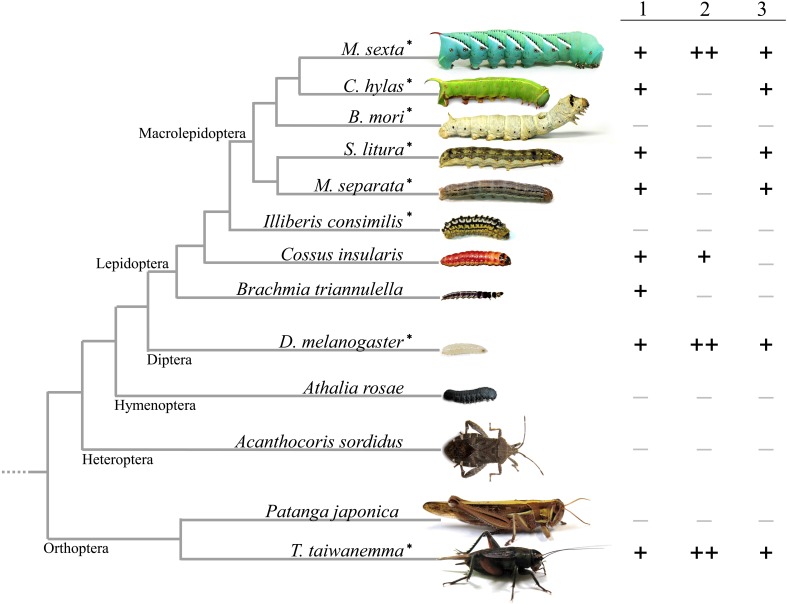
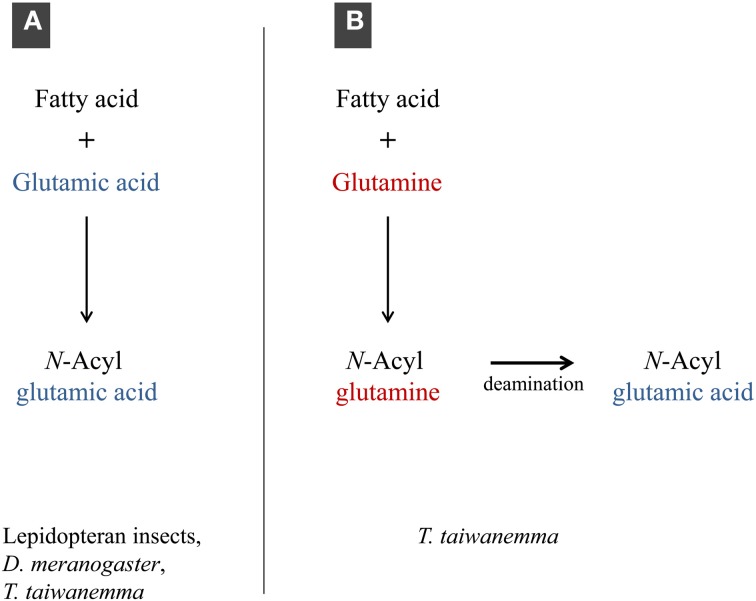
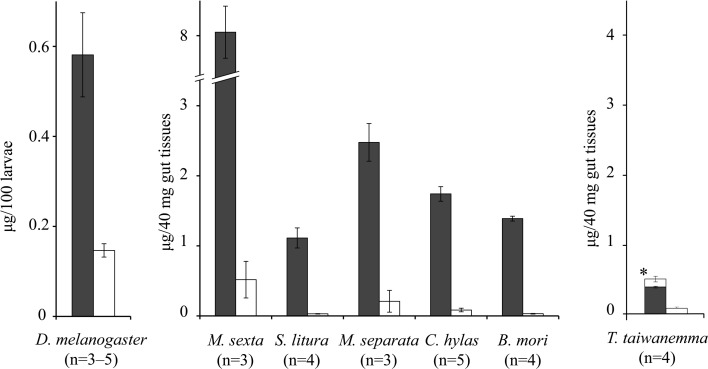
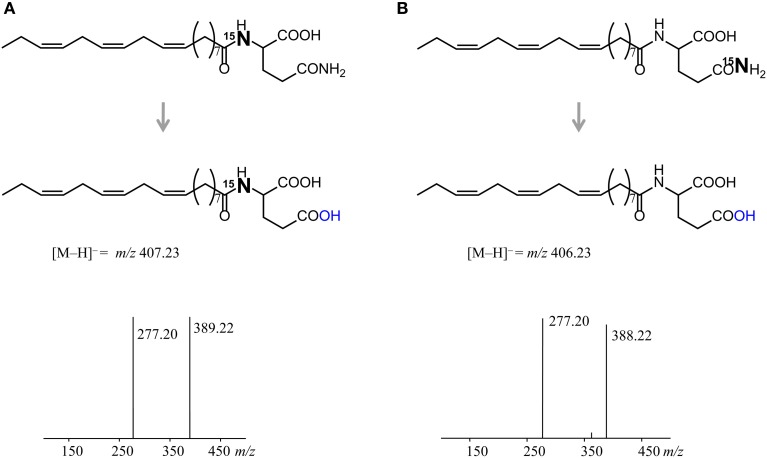
Fatty acid amino acid conjugates (FACs), first identified in lepidopteran caterpillar spit as elicitors of plant volatile emission, also have been reported as major components in gut tracts of Drosophila melanogaster and cricket Teleogryllus taiwanemma. The profile of FAC analogs in these two insects was similar to that of tobacco hornworm Manduca sexta, showing glutamic acid conjugates predominantly over glutamine conjugates. The physiological function of FACs is presumably to enhance nitrogen assimilation in Spodoptera litura larvae, but in other insects it is totally unknown. Whether these insects share a common synthetic mechanism of FACs is also unclear. In this study, the biosynthesis of FACs was examined in vitro in five lepidopteran species (M. sexta, Cephonodes hylas, silkworm, S. litura, and Mythimna separata), fruit fly larvae and T. taiwanemma. The fresh midgut tissues of all of the tested insects showed the ability to synthesize glutamine conjugates in vitro when incubated with glutamine and sodium linolenate. Such direct conjugation was also observed for glutamic acid conjugates in all the insects but the product amount was very small and did not reflect the in vivo FAC patterns in each species. In fruit fly larvae, the predominance of glutamic acid conjugates could be explained by a shortage of substrate glutamine in midgut tissues, and in M. sexta, a rapid hydrolysis of glutamine conjugates has been reported. In crickets, we found an additional unique biosynthetic pathway for glutamic acid conjugates. T. taiwanemma converted glutamine conjugates to glutamic acid conjugates by deaminating the side chain of the glutamine moiety. Considering these findings together with previous results, a possibility that FACs in these insects are results of convergent evolution cannot be ruled out, but it is more likely that the ancestral insects had the glutamine conjugates and crickets and other insects developed glutamic acid conjugates in a different way.
脂肪酸-氨基酸缀合物 (FACs) 最初在鳞翅目毛毛虫的唾液中被鉴定为诱导植物挥发性物质排放的物质,也被报道为黑腹果蝇和蟋蟀 Teleogryllus taiwanemma 肠道中的主要成分。这两种昆虫中的 FAC 类似物的特征与烟草天蛾 Manduca sexta 相似,表现出谷氨酸缀合物明显多于谷氨酰胺缀合物。FACs 的生理功能可能是增强斜纹夜蛾幼虫的氮同化,但在其他昆虫中则完全未知。这些昆虫是否具有共同的 FAC 合成机制也不清楚。在这项研究中,我们在五种鳞翅目昆虫(M. sexta、Cephonodes hylas、家蚕、S. litura 和 My thimna separata)、果蝇幼虫和蟋蟀 T. taiwanemma 中进行了体外 FACs 的生物合成研究。当用谷氨酰胺和亚麻木酚素孵育所有测试昆虫的新鲜中肠组织时,它们都显示出体外合成谷氨酰胺缀合物的能力。在所有昆虫中也观察到谷氨酸缀合物的直接缀合,但产物量非常少,并且不能反映每种物种的体内 FAC 模式。在果蝇幼虫中,谷氨酸缀合物的优势可能是由于中肠组织中谷氨酰胺底物短缺所致,并且在 M. sexta 中,已报道谷氨酰胺缀合物的快速水解。在蟋蟀中,我们发现了一种用于谷氨酸缀合物的独特生物合成途径。T. taiwanemma 通过脱氨侧链将谷氨酰胺缀合物转化为谷氨酸缀合物。考虑到这些发现以及以前的结果,这些昆虫中的 FACs 可能是趋同进化的结果,但更有可能是原始昆虫具有谷氨酰胺缀合物,而蟋蟀和其他昆虫以不同的方式产生谷氨酸缀合物。