
焦谷氨酸化淀粉样β肽通过类朊病毒机制逆转交叉β-折叠。
Pyroglutamylated amyloid-β peptide reverses cross β-sheets by a prion-like mechanism.
作者信息
Matos Jason O, Goldblatt Greg, Jeon Jaekyun, Chen Bo, Tatulian Suren A
机构信息
Biotechnology Graduate Program, University of Central Florida , 4000 Central Florida Boulevard, Orlando, Florida 32816, United States.
出版信息
J Phys Chem B. 2014 May 29;118(21):5637-43. doi: 10.1021/jp412743s. Epub 2014 May 19.
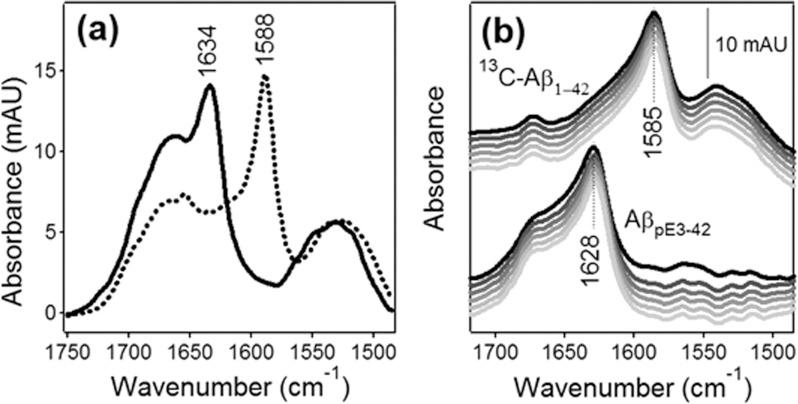
The amyloid hypothesis causatively relates the fibrillar deposits of amyloid β peptide (Aβ) to Alzheimer's disease (AD). More recent data, however, identify the soluble oligomers as the major cytotoxic entities. Pyroglutamylated Aβ (pE-Aβ) is present in AD brains and exerts augmented neurotoxicity, which is believed to result from its higher β-sheet propensity and faster fibrillization. While this concept is based on a set of experimental results, others have reported similar β-sheet contents in unmodified and pyroglutamylated Aβ, and slower aggregation of pE-Aβ as compared to unmodified Aβ, leaving the issue unresolved. Here, we assess the structural differences between Aβ and pE-Aβ peptides that may underlie their distinct cytotoxicities. Transmission electron microscopy identifies a larger number of prefibrillar aggregates of pE-Aβ at early stages of aggregation and suggests that pE-Aβ affects the fibrillogenesis even at low molar fractions. Circular dichroism and FTIR data indicate that while the unmodified Aβ readily forms β-sheet fibrils in aqueous media, pE-Aβ displays increased α-helical and decreased β-sheet propensity. Moreover, isotope-edited FTIR spectroscopy shows that pE-Aβ reverses β-sheet formation and hence fibrillogenesis of the unmodified Aβ peptide via a prion-like mechanism. These data provide a novel structural mechanism for pE-Aβ hypertoxicity; pE-Aβ undergoes faster formation of prefibrillar aggregates due to its increased hydrophobicity, thus shifting the initial stages of fibrillogenesis toward smaller, hypertoxic oligomers of partial α-helical structure.
淀粉样蛋白假说认为淀粉样β肽(Aβ)的纤维状沉积物与阿尔茨海默病(AD)存在因果关系。然而,最近的数据表明可溶性寡聚体才是主要的细胞毒性实体。焦谷氨酸化Aβ(pE-Aβ)存在于AD大脑中,并具有增强的神经毒性,据信这是由于其更高的β-折叠倾向和更快的纤维化速度所致。虽然这一概念基于一系列实验结果,但也有其他人报告称未修饰的Aβ和焦谷氨酸化Aβ具有相似的β-折叠含量,并且与未修饰的Aβ相比,pE-Aβ的聚集速度较慢,这一问题仍未得到解决。在此,我们评估了Aβ和pE-Aβ肽之间可能是其不同细胞毒性基础的结构差异。透射电子显微镜发现在聚集早期pE-Aβ有大量的前纤维聚集体,这表明即使在低摩尔分数下pE-Aβ也会影响纤维形成。圆二色性和傅里叶变换红外光谱数据表明,未修饰的Aβ在水性介质中容易形成β-折叠纤维,而pE-Aβ则显示出增加的α-螺旋倾向和降低的β-折叠倾向。此外,同位素编辑傅里叶变换红外光谱表明,pE-Aβ通过一种朊病毒样机制逆转未修饰Aβ肽的β-折叠形成,从而逆转其纤维形成。这些数据为pE-Aβ的高毒性提供了一种新的结构机制;由于其疏水性增加,pE-Aβ会更快地形成前纤维聚集体,从而将纤维形成的初始阶段转向具有部分α-螺旋结构的更小、毒性更强的寡聚体。



 Zotero 插件