
基于数字设计与制造的下颌骨重建模板引导手术技术流程
Technical procedures for template-guided surgery for mandibular reconstruction based on digital design and manufacturing.
作者信息
Liu Yun-feng, Xu Liang-wei, Zhu Hui-yong, Liu Sean Shih-Yao
机构信息
Key Laboratory of E&M (Zhejiang University of Technology), Ministry of Education & Zhejiang Province, Hangzhou 310014, China.
出版信息
Biomed Eng Online. 2014 May 23;13:63. doi: 10.1186/1475-925X-13-63.
BACKGROUND
The occurrence of mandibular defects caused by tumors has been continuously increasing in China in recent years. Conversely, results of the repair of mandibular defects affect the recovery of oral function and patient appearance, and the requirements for accuracy and high surgical quality must be more stringent. Digital techniques--including model reconstruction based on medical images, computer-aided design, and additive manufacturing--have been widely used in modern medicine to improve the accuracy and quality of diagnosis and surgery. However, some special software platforms and services from international companies are not always available for most of researchers and surgeons because they are expensive and time-consuming.
METHODS
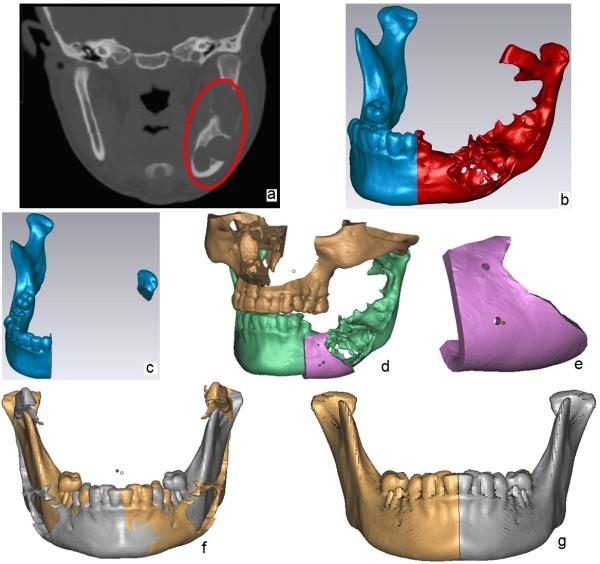
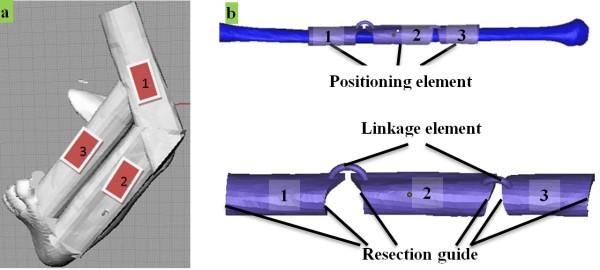
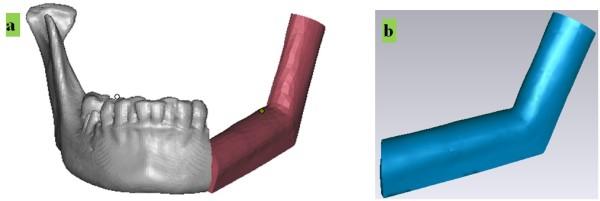
Here, a new technical solution for guided surgery for the repair of mandibular defects is proposed, based on general popular tools in medical image processing, 3D (3 dimension) model reconstruction, digital design, and fabrication via 3D printing. First, CT (computerized tomography) images are processed to reconstruct the 3D model of the mandible and fibular bone. The defect area is then replaced by healthy contralateral bone to create the repair model. With the repair model as reference, the graft shape and cutline are designed on fibular bone, as is the guide for cutting and shaping. The physical model, fabricated via 3D printing, including surgical guide, the original model, and the repair model, can be used to preform a titanium locking plate, as well as to design and verify the surgical plan and guide. In clinics, surgeons can operate with the help of the surgical guide and preformed plate to realize the predesigned surgical plan.
RESULTS
With sufficient communication between engineers and surgeons, an optimal surgical plan can be designed via some common software platforms but needs to be translated to the clinic. Based on customized models and tools, including three surgical guides, preformed titanium plate for fixation, and physical models of the mandible, grafts for defect repair can be cut from fibular bone, shaped with high accuracy during surgery, and fixed with a well-fitting preformed locking plate, so that the predesigned plan can be performed in the clinic and the oral function and appearance of the patient are recovered. This method requires 20% less operating time compared with conventional surgery, and the advantages in cost and convenience are significant compared with those of existing commercial services in China.
CONCLUSIONS
This comparison between two groups of cases illustrates that, with the proposed method, the accuracy of mandibular defect repair surgery is increased significantly and is less time-consuming, and patients are satisfied with both the recovery of oral function and their appearance. Until now, more than 15 cases have been treated with the proposed methods, so their feasibility and validity have been verified.
背景
近年来,中国因肿瘤导致的下颌骨缺损发生率持续上升。相反,下颌骨缺损的修复效果影响口腔功能恢复和患者容貌,对手术精度和高质量的要求必须更加严格。数字技术——包括基于医学图像的模型重建、计算机辅助设计和增材制造——已在现代医学中广泛应用,以提高诊断和手术的准确性与质量。然而,国际公司的一些特殊软件平台和服务对大多数研究人员和外科医生来说并不总是可用,因为它们昂贵且耗时。
方法
在此,基于医学图像处理、三维(3D)模型重建、数字设计以及通过3D打印制造等常用工具,提出一种用于下颌骨缺损修复的引导手术新技术方案。首先,对计算机断层扫描(CT)图像进行处理,以重建下颌骨和腓骨的3D模型。然后用健康的对侧骨替换缺损区域,创建修复模型。以修复模型为参考,在腓骨上设计移植骨的形状和切割线,以及切割和塑形的导向。通过3D打印制造的物理模型,包括手术导板、原始模型和修复模型,可用于预制钛锁定板,以及设计和验证手术方案与导板。在临床上,外科医生可借助手术导板和预制板进行手术,以实现预先设计的手术方案。
结果
通过工程师与外科医生之间的充分沟通,可借助一些通用软件平台设计出最佳手术方案,但需要将其转化到临床实践中。基于定制的模型和工具,包括三个手术导板、用于固定的预制钛板以及下颌骨的物理模型,可从腓骨上切取用于缺损修复的移植骨,在手术过程中高精度塑形,并用贴合良好的预制锁定板固定,从而使预先设计的方案能够在临床实施,患者的口腔功能和容貌得以恢复。与传统手术相比,该方法所需手术时间减少20%,与中国现有商业服务相比,在成本和便利性方面优势显著。
结论
两组病例的比较表明,采用所提出的方法,下颌骨缺损修复手术的准确性显著提高,耗时更少,患者对口腔功能恢复和容貌都很满意。截至目前,已采用所提出的方法治疗了15例以上病例,因此其可行性和有效性得到了验证。



 Zotero 插件