
EAAT2启动子区三个紧密相邻单核苷酸多态性的检测:单链构象多态性(SSCP)、焦磷酸测序和桑格测序的比较
Detection of three closely located single nucleotide polymorphisms in the EAAT2 promoter: comparison of single-strand conformational polymorphism (SSCP), pyrosequencing and Sanger sequencing.
作者信息
Rajatileka Shavanthi, Luyt Karen, Williams Maggie, Harding David, Odd David, Molnár Elek, Váradi Anikó
机构信息
Centre for Research in Biosciences, Department of Biological, Biomedical and Analytical Sciences, Faculty of Health and Applied Sciences, University of the West of England, Bristol BS16 1QY, UK.
出版信息
BMC Genet. 2014 Jul 5;15:80. doi: 10.1186/1471-2156-15-80.
BACKGROUND
Single-strand conformational polymorphism (SSCP) is still a frequently used genotyping method across different fields for the detection of single nucleotide polymorphisms (SNPs) due to its simplicity, requirement for basic equipment accessible in most laboratories and low cost. This technique was previously used to detect rs4354668:A > C (g.-181A > C) SNP in the promoter of astroglial glutamate transporter (EAAT2) and the same approach was initially used here to investigate this promoter region in a cohort of newborns.
RESULTS
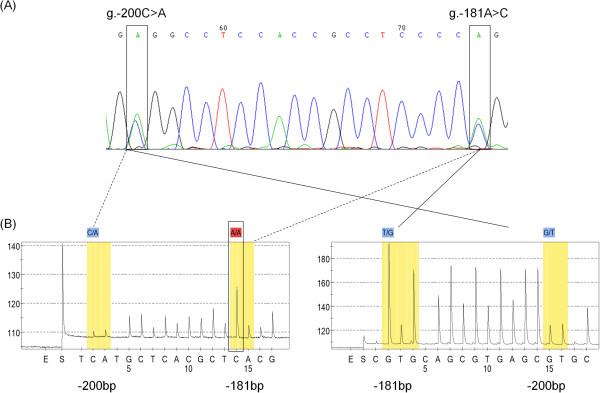
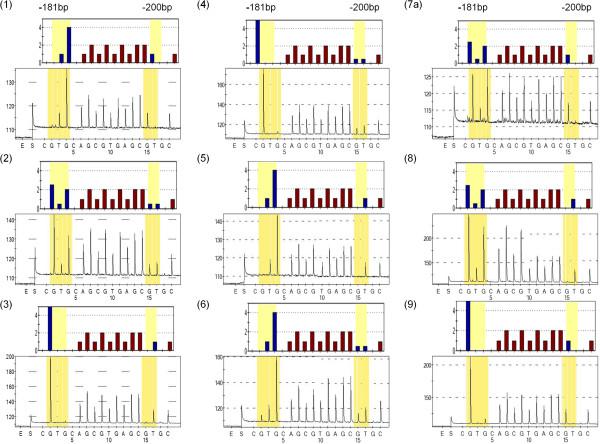
Unexpectedly, four distinct DNA migration patterns were identified by SSCP. Sanger sequencing revealed two additional SNPs: g.-200C > A and g.-168C > T giving a rise to a total of ten EAAT2 promoter variants. SSCP failed to distinguish these variants reliably and thus pyrosequencing assays were developed. g.-168C > T was found in heterozygous form in one infant only with minor allele frequency (MAF) of 0.0023. In contrast, g.-200C > A and -181A > C were more common (with MAF of 0.46 and 0.49, respectively) and showed string evidence of linkage disequilibrium (LD). In a systematic comparison, 16% of samples were miss-classified by SSCP with 25-31% errors in the identification of the wild-type and homozygote mutant genotypes compared to pyrosequencing or Sanger sequencing. In contrast, SSCP and pyrosequencing of an unrelated single SNP (rs1835740:C > T), showed 94% concordance.
CONCLUSION
Our data suggest that SSCP cannot always detect reliably several closely located SNPs. Furthermore, caution is needed in the interpretation of the association studies linking only one of the co-inherited SNPs in the EAAT2 promoter to human diseases.
背景
单链构象多态性(SSCP)因其操作简单、大多数实验室均可使用基本设备且成本低廉,至今仍是不同领域用于检测单核苷酸多态性(SNP)的常用基因分型方法。该技术曾用于检测星形胶质细胞谷氨酸转运体(EAAT2)启动子中的rs4354668:A>C(g.-181A>C)SNP,本文最初采用相同方法对一组新生儿的该启动子区域进行研究。
结果
出乎意料的是,通过SSCP鉴定出四种不同的DNA迁移模式。桑格测序揭示了另外两个SNP:g.-200C>A和g.-168C>T,从而产生了总共十种EAAT2启动子变体。SSCP无法可靠地区分这些变体,因此开发了焦磷酸测序分析方法。仅在一名婴儿中发现g.-168C>T以杂合形式存在,其次要等位基因频率(MAF)为0.0023。相比之下,g.-200C>A和-181A>C更为常见(MAF分别为0.46和0.49),并显示出明显的连锁不平衡(LD)证据。在系统比较中,与焦磷酸测序或桑格测序相比,16%的样本通过SSCP被错误分类,在野生型和纯合突变基因型的鉴定中存在25%-31%的错误。相比之下,对一个不相关的单SNP(rs1835740:C>T)进行SSCP和焦磷酸测序显示一致性为94%。
结论
我们的数据表明,SSCP并非总能可靠地检测出几个紧密相邻的SNP。此外,在解释仅将EAAT2启动子中共遗传的一个SNP与人类疾病联系起来的关联研究时需要谨慎。



 Zotero 插件