Xue Yuguo, Sun Lizhong, Zheng Jun, Huang Xiaoyong, Guo Xi, Li Tiezheng, Huang Lianjun
Interventional Department, Beijing Anzhen Hospital, Capital Medical University, Beijing Institute of Heart, Lung and Blood Vascular Diseases, Beijing, China.
Department of Cardiovascular Surgery, Beijing Anzhen Hospital, Capital Medical University, Beijing Institute of Heart, Lung and Blood Vascular Diseases, Beijing, China.
Eur J Cardiothorac Surg. 2015 Apr;47(4):623-9. doi: 10.1093/ejcts/ezu266. Epub 2014 Jul 9.
The objective of the present study was to evaluate short- and mid-term outcomes of the left subclavian artery (LSA) chimney stent implantation (LSACSI) during thoracic endovascular aortic repair (TEVAR), and to summarize our experience with this technique.
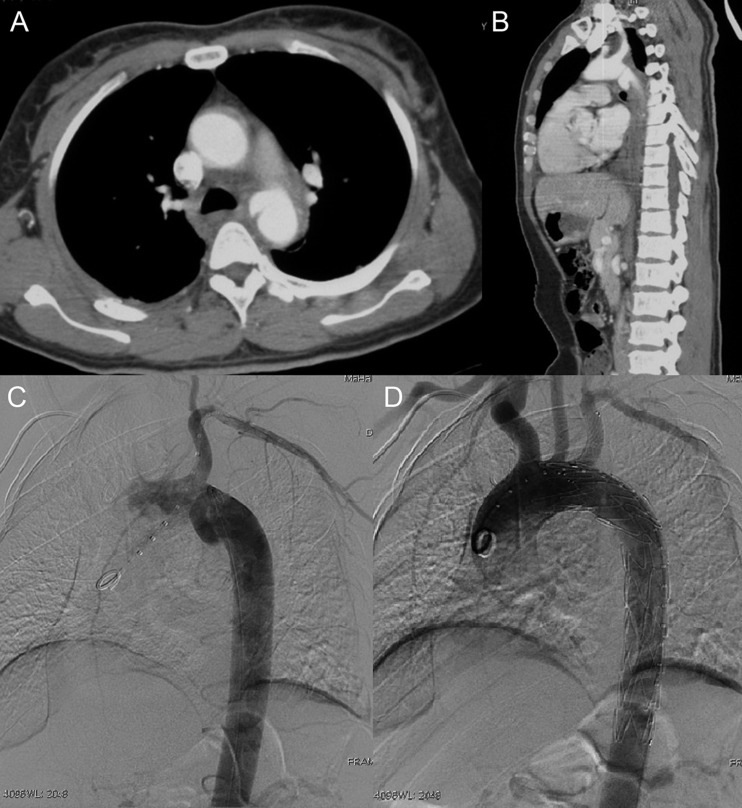
From June 2010 to September 2012, 59 patients (49 men; mean age of 57.4 ± 13.3 years, range from 26 to 83 years) who underwent TEVAR and LSACSI were enrolled. Patients suffered from Stanford type B aortic dissection (n = 27), penetrating aortic ulcer (n = 18), aortic arch aneurysm (n = 9), pseudoaneurysm of the aortic arch (n = 4) and proximal type I endoleak after TEVAR of aortic dissection (n = 1). Elective settings were performed in 72% and emergent in 38% of all patients. Follow-up was performed at postoperative 3 months, 6 months and yearly thereafter.
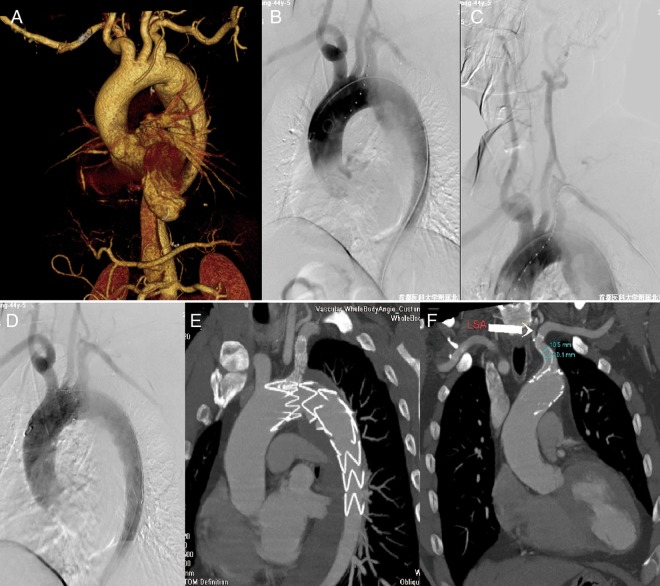
The technical success rate was 98.3% (58/59), and 69 thoracic stent grafts were used. Sixty-two chimney stents, including 55 uncovered and 7 covered stents, were implanted in 59 LSAs. The overall immediate endoleak rate was 15.3% (9/59); type I endoleak was observed in 5 patients and type II in 4 patients. The difference in the immediate endoleak rate related to the anatomy between the outer and the inner curvature was statistically significant (35 vs 4%, P = 0.018). Chimney stent compression was observed in 3 patients and another stent was deployed inside the first one. Perioperative complications included stroke (3.4%, 2/59) and left upper limb ischaemia (1.7%, 1/59). The median follow-up period was 16.5 (range 1-39 months). The mortality rate during follow-up was 5.4% (3/56). Complications during follow-up included endoleak [overall, n = 8 (14.3%, 8/56); type I, n = 5; type II, n = 3], retrograde type A aortic dissection (n = 1), collapse (n = 3, 5.4%) or occlusion (n = 2, 3.6%) of the chimney stent.
Short- and mid-term results showed that it is feasible to preserve the patency of the LSA in TEVAR with the chimney technique for thoracic aortic pathologies close to the LSA. However, TEVAR combined with LSACSI was not advocated for lesions located at the outer curve of the aortic arch due to a high possibility of endoleak.
本研究的目的是评估胸主动脉腔内修复术(TEVAR)期间左锁骨下动脉(LSA)烟囱式支架植入术(LSACSI)的短期和中期结果,并总结我们在该技术方面的经验。
2010年6月至2012年9月,纳入59例行TEVAR和LSACSI的患者(49例男性;平均年龄57.4±13.3岁,范围26至83岁)。患者患有斯坦福B型主动脉夹层(n = 27)、穿透性主动脉溃疡(n = 18)、主动脉弓动脉瘤(n = 9)、主动脉弓假性动脉瘤(n = 4)以及主动脉夹层TEVAR术后近端I型内漏(n = 1)。所有患者中72%为择期手术,38%为急诊手术。术后3个月、6个月及此后每年进行随访。
技术成功率为98.3%(58/59),共使用了69个胸主动脉覆膜支架。59条LSA植入了62个烟囱式支架,其中55个为裸支架,7个为覆膜支架。总体即刻内漏率为15.3%(9/59);5例患者观察到I型内漏,4例患者观察到II型内漏。与解剖结构相关的外曲和内曲即刻内漏率差异具有统计学意义(35%对4%,P = 0.018)。3例患者观察到烟囱式支架受压,随后在第一个支架内置入了另一个支架。围手术期并发症包括卒中(3.4%,2/59)和左上肢缺血(1.7%,1/59)。中位随访期为16.5个月(范围1至39个月)。随访期间死亡率为5.4%(3/56)。随访期间的并发症包括内漏[总体,n = 8(14.3%,8/56);I型,n = 5;II型,n = 3]、逆行性A型主动脉夹层(n = 1)、烟囱式支架塌陷(n = 3,5.4%)或闭塞(n = 2,3.6%)。
短期和中期结果表明,对于靠近LSA 的胸主动脉病变,采用烟囱技术在TEVAR中保留LSA通畅是可行的。然而,由于内漏可能性高,不主张将TEVAR与LSACSI联合用于位于主动脉弓外曲的病变。