
DNA 甲基转移酶在成年背根神经节中的表达具有细胞类型特异性,并在神经病理性疼痛的啮齿动物模型中上调。
Expression of DNA methyltransferases in adult dorsal root ganglia is cell-type specific and up regulated in a rodent model of neuropathic pain.
机构信息
Department of Physiology, Northwestern University Feinberg School of Medicine Chicago, IL, USA.
出版信息
Front Cell Neurosci. 2014 Aug 8;8:217. doi: 10.3389/fncel.2014.00217. eCollection 2014.
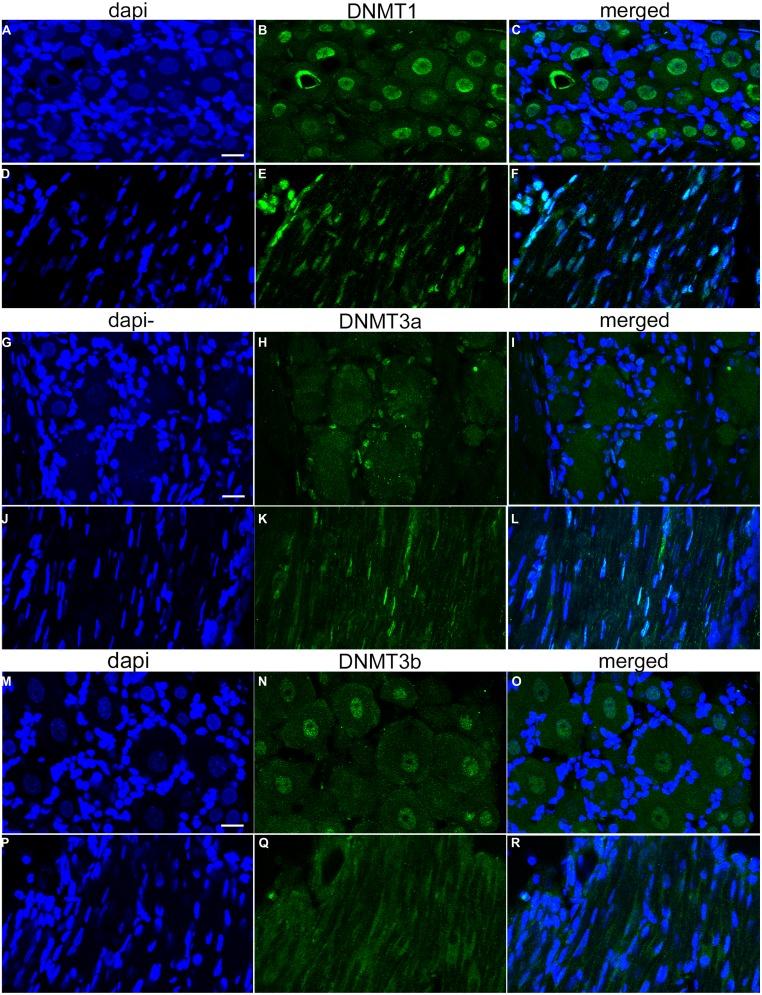
Neuropathic pain is associated with hyperexcitability and intrinsic firing of dorsal root ganglia (DRG) neurons. These phenotypical changes can be long lasting, potentially spanning the entire life of animal models, and depend on altered expression of numerous proteins, including many ion channels. Yet, how DRGs maintain long-term changes in protein expression in neuropathic conditions remains unclear. DNA methylation is a well-known mechanism of epigenetic control of gene expression and is achieved by the action of three enzymes: DNA methyltransferase (DNMT) 1, 3a, and 3b, which have been studied primarily during development. We first performed immunohistochemical analysis to assess whether these enzymes are expressed in adult rat DRGs (L4-5) and found that DNMT1 is expressed in both glia and neurons, DNMT3a is preferentially expressed in glia and DNMT3b is preferentially expressed in neurons. A rat model of neuropathic pain was then used to determine whether nerve injury may induce epigenetic changes in DRGs at multiple time points after pain onset. Real-time RT PCR analysis revealed robust and time-dependent changes in DNMT transcript expression in ipsilateral DRGs from spared nerve injury (SNI) but not sham rats. Interestingly, DNMT3b transcript showed a robust upregulation that appeared already 1 week after surgery and persisted at 4 weeks (our endpoint); in contrast, DNMT1 and DNMT3a transcripts showed only moderate upregulation that was transient and did not appear until the second week. We suggest that DNMT regulation in adult DRGs may be a contributor to the pain phenotype and merits further study.
神经病理性疼痛与背根神经节(DRG)神经元的过度兴奋和内在放电有关。这些表型变化可能是持久的,潜在地贯穿动物模型的整个生命周期,并且取决于许多蛋白质表达的改变,包括许多离子通道。然而,DRG 如何在神经病理性条件下维持蛋白质表达的长期变化仍不清楚。DNA 甲基化是一种众所周知的基因表达表观遗传调控机制,是通过三种酶的作用实现的:DNA 甲基转移酶(DNMT)1、3a 和 3b,它们主要在发育过程中进行研究。我们首先进行免疫组织化学分析,以评估这些酶是否在成年大鼠 DRG(L4-5)中表达,并发现 DNMT1 在神经胶质和神经元中均有表达,DNMT3a 主要在神经胶质中表达,DNMT3b 主要在神经元中表达。然后使用神经病理性疼痛大鼠模型来确定神经损伤是否会在疼痛发作后多个时间点引起 DRG 中的表观遗传变化。实时 RT-PCR 分析显示,在 spared nerve injury(SNI)而不是假手术大鼠的对侧 DRG 中,DNMT 转录表达出现了强大的、时间依赖性的变化。有趣的是,DNMT3b 转录本表现出强烈的上调,这种上调在手术后 1 周就已经出现,并持续到 4 周(我们的终点);相比之下,DNMT1 和 DNMT3a 转录本仅表现出适度的上调,这种上调是短暂的,直到第二周才出现。我们认为,成年 DRG 中的 DNMT 调节可能是疼痛表型的一个贡献因素,值得进一步研究。



 Zotero 插件