Kalesan Bindu, Vasan Sowmya, Mobily Matthew E, Villarreal Marcos D, Hlavacek Patrick, Teperman Sheldon, Fagan Jeffrey A, Galea Sandro
Department of Surgery, Columbia University, New York, New York, USA Department of Epidemiology, Columbia University, New York, New York, USA.
Department of Surgery, Columbia University, New York, New York, USA.
BMJ Open. 2014 Aug 14;4(9):e005628. doi: 10.1136/bmjopen-2014-005628.
To document overall, racial, ethnic and intent-specific spatiotemporal trends of firearm-related fatality rates (FRF rates) in the USA.
Cross-sectional study per year from 2000 to 2010.
Aggregate count of all people in the USA from 2000 to 2010.
Data from the Web-based Injury Statistics Query and Reporting System from 2000 to 2010 was used to determine annual FRF rates per 100,000 and by states, race, ethnicity and intent.
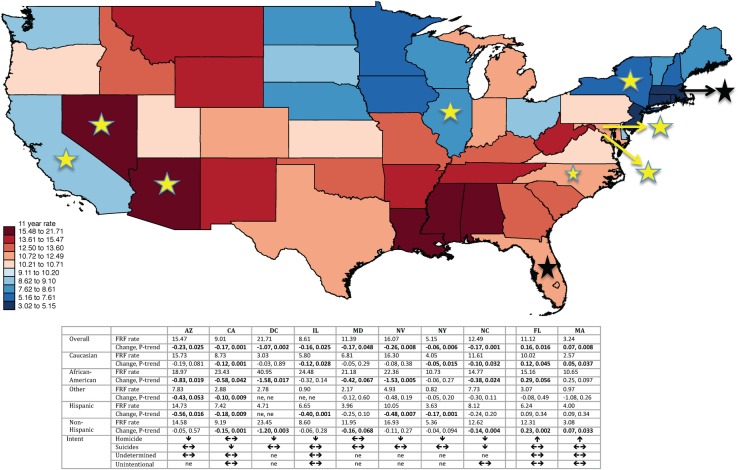
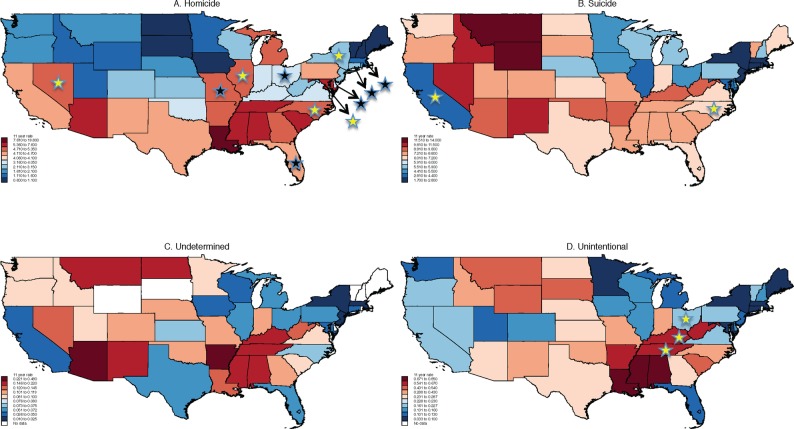
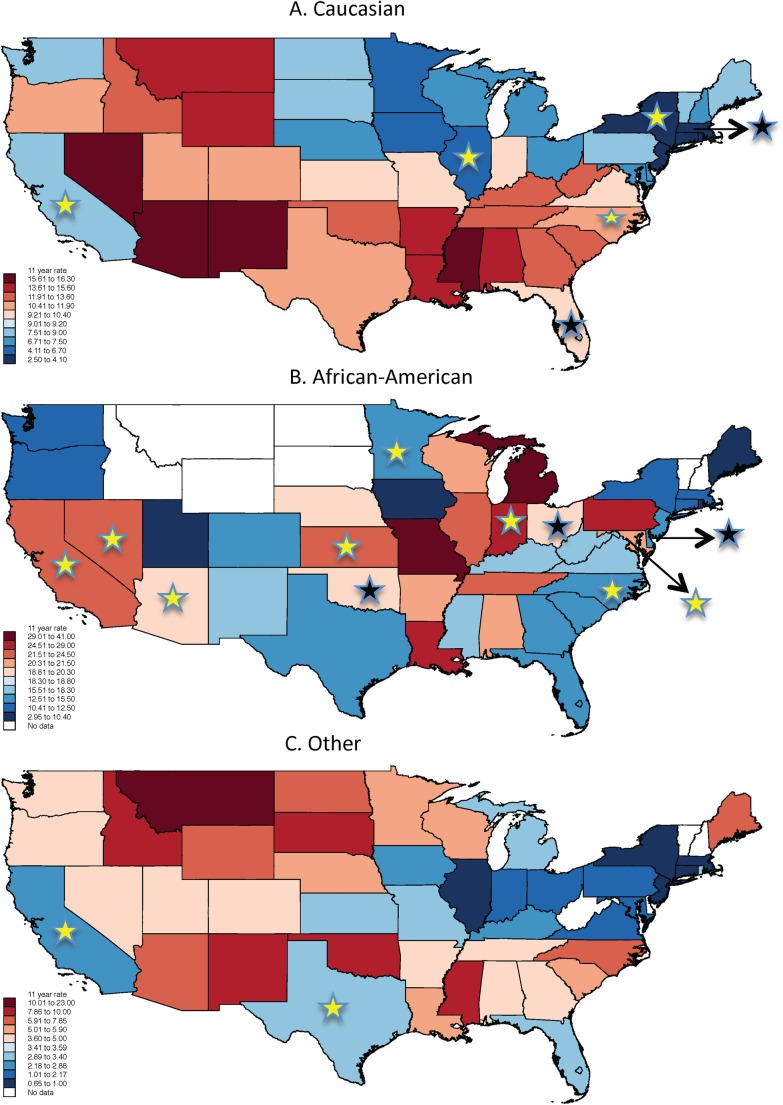
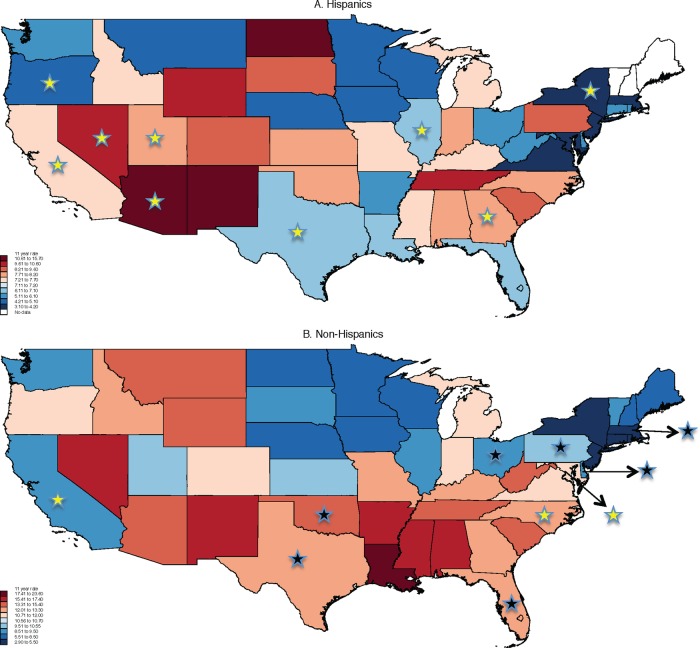
The average national 11-year FRF rate was 10.21/100,000, from 3.02 in Hawaii to 18.62 in Louisiana: 60% of states had higher than national rates and 41 states showed no temporal change. The average national FRF rates among African-Americans and Caucasians were 18.51 and 9.05/100,000 and among Hispanics and non-Hispanics were 7.13 and 10.13/100,000; Hispanics had a decreasing change of -0.18, p trend<0.0001. In states with increasing trends (Florida and Massachusetts), Caucasians and non-Hispanics drove the rise; while in states with decreasing trends (California, North Carolina, Arizona, Nevada, New York, Illinois, Maryland), Hispanics and African-Americans drove the fall. The average national FRF rates due to homicides (4.1/100,000) and suicides (5.8/100,000) remained constant, but varied between states.
Endemic national FRF rates mask a wide variation in time trends between states. FRF rates were twice as high in African-Americans than Caucasians but decreased among Hispanics. Efforts to identify state-specific best practices can contribute to changes in national FRF rates that remain high.
记录美国枪支相关死亡率(FRF率)的总体、种族、民族和意图特定的时空趋势。
2000年至2010年的横断面研究。
美国
2000年至2010年美国所有人的总数。
使用2000年至2010年基于网络的伤害统计查询和报告系统的数据,确定每10万人的年度FRF率,并按州、种族、民族和意图进行统计。
全国11年的平均FRF率为10.21/10万,从夏威夷的3.02到路易斯安那州的18.62:60%的州高于全国平均水平,41个州没有时间变化。非裔美国人和白种人的全国平均FRF率分别为18.51和9.05/10万,西班牙裔和非西班牙裔分别为7.13和10.13/10万;西班牙裔的变化率为-0.18,p趋势<0.0001。在呈上升趋势的州(佛罗里达州和马萨诸塞州)白种人和非西班牙裔推动了上升;而在呈下降趋势的州(加利福尼亚州、北卡罗来纳州、亚利桑那州、内华达州、纽约州、伊利诺伊州、马里兰州),西班牙裔和非裔美国人推动了下降。因凶杀案(4.1/10万)和自杀(5.8/10万)导致的全国平均FRF率保持不变,但各州之间存在差异。
全国普遍的FRF率掩盖了各州时间趋势的广泛差异。非裔美国人的FRF率是白种人的两倍,但西班牙裔的FRF率有所下降。识别各州特定最佳做法的努力有助于改变居高不下的全国FRF率。