Gall J G, Callan H G
Department of Embryology, Carnegie Institution, Baltimore, MD 21210.
Proc Natl Acad Sci U S A. 1989 Sep;86(17):6635-9. doi: 10.1073/pnas.86.17.6635.
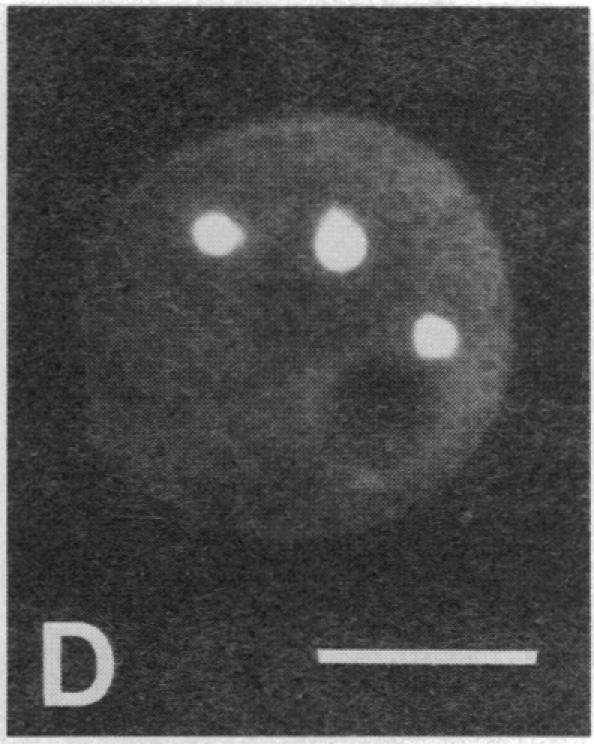
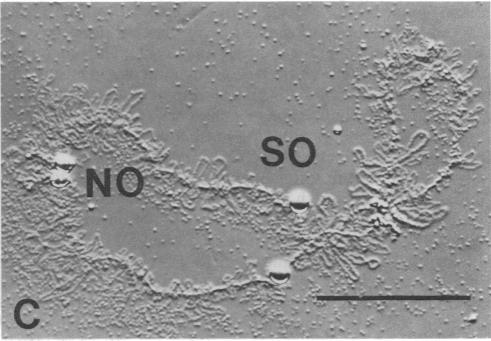
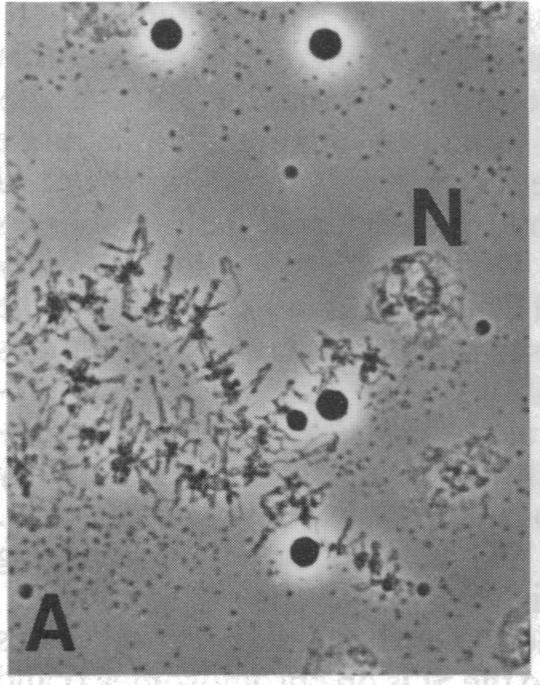
We show by immunofluorescence microscopy of amphibian oocyte nuclei that small nuclear ribonucleoproteins (snRNPs) occur in lampbrush chromosome loops, in a few dozen extrachromosomal organelles previously described as "spheres," and in thousands of smaller granules. Spheres are variable in size (up to approximately 20 microns in diameter in the newt Notophthalmus and approximately 10 microns in the frog Xenopus) and are easily distinguishable from nucleoli by morphology and composition. Spheres occur both free in the nucleoplasm and attached to specific chromosome loci, the sphere organizers. Oocyte nuclei of a cricket and a spider contain essentially similar organelles, suggesting that spheres may be common throughout the animal kingdom. We suggest that spheres play a role in the assembly of snRNP complexes for the nucleus comparable to the way that nucleoli assemble ribosomal RNP complexes for the cytoplasm.
我们通过对两栖类卵母细胞核进行免疫荧光显微镜观察发现,小核核糖核蛋白(snRNP)存在于灯刷染色体环、先前被描述为“球体”的几十种染色体外细胞器以及数千个较小的颗粒中。球体大小不一(在蝾螈眼斑钝口螈中直径可达约20微米,在非洲爪蟾中约为10微米),通过形态和组成很容易与核仁区分开来。球体既游离于核质中,也附着于特定的染色体位点,即球体组织者。蟋蟀和蜘蛛的卵母细胞核含有基本相似的细胞器,这表明球体可能在整个动物界都很常见。我们认为,球体在细胞核snRNP复合物的组装中发挥作用,其方式类似于核仁在细胞质中组装核糖体RNP复合物的方式。