Kaartinen Kati, Syrjänen Jaana, Pörsti Ilkka, Harmoinen Aimo, Huhtala Heini, Mustonen Jukka
School of Medicine, University of Tampere, Savonlinna, Finland.
School of Medicine, University of Tampere, Savonlinna, Finland ; Department of Internal Medicine, Tampere University Hospital, Tampere, Savonlinna, Finland.
Nephron Extra. 2014 Aug 19;4(2):138-45. doi: 10.1159/000365591. eCollection 2014 May.
BACKGROUND/AIMS: Metabolic syndrome (MetS) may have an independent impact on the development of chronic kidney disease. This study examines the prevalence of MetS in subjects with IgA glomerulonephritis (IgAGN) and its impact on disease progression in a retrospective fashion.
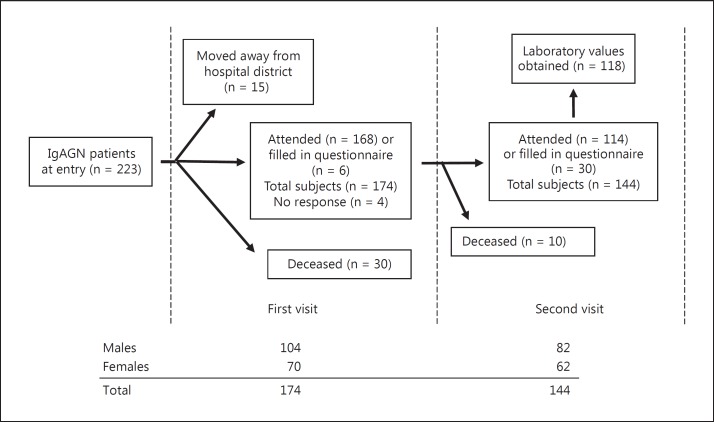
Altogether, 174 subjects (104 males) were examined 11 years (first visit) after IgAGN diagnosis and again after 16 years (second visit; 144 subjects responded). Different glomerular filtration markers were utilized. The MetS criteria by Alberti et al. [Circulation 2009;120:1640-1645] were applied, in which the presence of any three of five risk factors (elevated waist circumference, triglycerides, glucose, existence of hypertension, or reduced high-density lipoprotein cholesterol) constitutes the diagnosis.
The prevalence of MetS at the first visit was 39%, corresponding to that of the general Finnish population. In univariate analyses, MetS was significantly associated with the progression of IgAGN at the second visit. However, in multivariate analyses, the existence of MetS was not a significant prognostic determinant.
The number of subjects with MetS among IgAGN patients and the general population is equal in Finland. MetS does not seem to be an independent prognostic variable.
背景/目的:代谢综合征(MetS)可能对慢性肾脏病的发展产生独立影响。本研究以回顾性方式探讨IgA肾小球肾炎(IgAGN)患者中MetS的患病率及其对疾病进展的影响。
共对174例患者(104例男性)进行了研究,在IgAGN诊断后11年(首次就诊)进行检查,并在16年后(第二次就诊;144例患者有回应)再次检查。采用了不同的肾小球滤过标志物。应用了阿尔贝蒂等人[《循环》2009年;120:1640 - 1645]提出的MetS标准,即五个危险因素(腰围增加、甘油三酯升高、血糖升高、高血压或高密度脂蛋白胆固醇降低)中存在任意三项即构成诊断。
首次就诊时MetS的患病率为39%,与芬兰普通人群的患病率相当。在单因素分析中,MetS与第二次就诊时IgAGN的进展显著相关。然而,在多因素分析中,MetS的存在并非显著的预后决定因素。
在芬兰,IgAGN患者中MetS患者的数量与普通人群相等。MetS似乎不是一个独立的预后变量。