
大豆(Glycine max)在脱水和盐胁迫期间HD-Zip转录因子家族的全面表征及RNA测序分析
Comprehensive characterization and RNA-Seq profiling of the HD-Zip transcription factor family in soybean (Glycine max) during dehydration and salt stress.
作者信息
Belamkar Vikas, Weeks Nathan T, Bharti Arvind K, Farmer Andrew D, Graham Michelle A, Cannon Steven B
机构信息
Department of Agronomy, Iowa State University, Ames, IA 50011, USA.
出版信息
BMC Genomics. 2014 Nov 3;15:950. doi: 10.1186/1471-2164-15-950.
BACKGROUND
The homeodomain leucine zipper (HD-Zip) transcription factor family is one of the largest plant specific superfamilies, and includes genes with roles in modulation of plant growth and response to environmental stresses. Many HD-Zip genes are characterized in Arabidopsis (Arabidopsis thaliana), and members of the family are being investigated for abiotic stress responses in rice (Oryza sativa), maize (Zea mays), poplar (Populus trichocarpa) and cucumber (Cucmis sativus). Findings in these species suggest HD-Zip genes as high priority candidates for crop improvement.
RESULTS
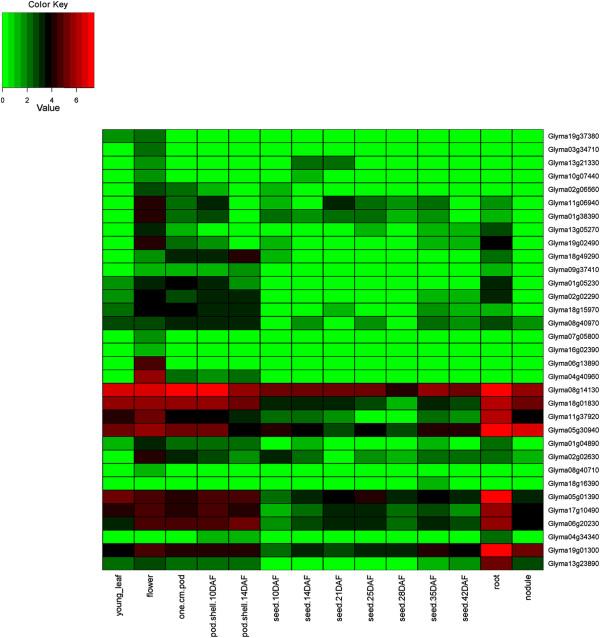
In this study we have identified members of the HD-Zip gene family in soybean cv. 'Williams 82', and characterized their expression under dehydration and salt stress. Homology searches with BLASTP and Hidden Markov Model guided sequence alignments identified 101 HD-Zip genes in the soybean genome. Phylogeny reconstruction coupled with domain and gene structure analyses using soybean, Arabidopsis, rice, grape (Vitis vinifera), and Medicago truncatula homologues enabled placement of these sequences into four previously described subfamilies. Of the 101 HD-Zip genes identified in soybean, 88 exist as whole-genome duplication-derived gene pairs, indicating high retention of these genes following polyploidy in Glycine ~13 Mya. The HD-Zip genes exhibit ubiquitous expression patterns across 24 conditions that include 17 tissues of soybean. An RNA-Seq experiment performed to study differential gene expression at 0, 1, 6 and 12 hr soybean roots under dehydration and salt stress identified 20 differentially expressed (DE) genes. Several of these DE genes are orthologs of genes previously reported to play a role under abiotic stress, implying conservation of HD-Zip gene functions across species. Screening of HD-Zip promoters identified transcription factor binding sites that are overrepresented in the DE genes under both dehydration and salt stress, providing further support for the role of HD-Zip genes in abiotic stress responses.
CONCLUSIONS
We provide a thorough description of soybean HD-Zip genes, and identify potential candidates with probable roles in dehydration and salt stress. Expression profiles generated for all soybean genes, under dehydration and salt stress, at four time points, will serve as an important resource for the soybean research community, and will aid in understanding plant responses to abiotic stress.
背景
同源异型域亮氨酸拉链(HD-Zip)转录因子家族是最大的植物特有的超家族之一,包含在调节植物生长和响应环境胁迫中起作用的基因。许多HD-Zip基因在拟南芥(Arabidopsis thaliana)中得到了表征,并且该家族成员正在水稻(Oryza sativa)、玉米(Zea mays)、杨树(Populus trichocarpa)和黄瓜(Cucmis sativus)中进行非生物胁迫响应的研究。这些物种的研究结果表明HD-Zip基因是作物改良的高优先级候选基因。
结果
在本研究中,我们鉴定了大豆品种‘Williams 82’中的HD-Zip基因家族成员,并表征了它们在脱水和盐胁迫下的表达。使用BLASTP进行同源性搜索以及隐马尔可夫模型指导的序列比对,在大豆基因组中鉴定出101个HD-Zip基因。通过系统发育重建,并结合使用大豆、拟南芥、水稻、葡萄(Vitis vinifera)和蒺藜苜蓿(Medicago truncatula)同源物进行的结构域和基因结构分析,可将这些序列归入先前描述的四个亚家族。在大豆中鉴定出的101个HD-Zip基因中,有88个以全基因组复制衍生的基因对形式存在,这表明在约1300万年前大豆多倍体化后这些基因具有较高的保留率。HD-Zip基因在包括大豆17个组织在内的24种条件下呈现普遍的表达模式。一项用于研究脱水和盐胁迫下大豆根在0、1、6和12小时差异基因表达的RNA测序实验,鉴定出20个差异表达(DE)基因。其中一些DE基因是先前报道在非生物胁迫下起作用的基因的直系同源物,这意味着HD-Zip基因功能在物种间具有保守性。对HD-Zip启动子的筛选鉴定出在脱水和盐胁迫下DE基因中过度富集的转录因子结合位点,为HD-Zip基因在非生物胁迫响应中的作用提供了进一步支持。
结论
我们对大豆HD-Zip基因进行了全面描述,并鉴定出在脱水和盐胁迫中可能起作用的潜在候选基因。在脱水和盐胁迫下四个时间点为所有大豆基因生成的表达谱,将成为大豆研究群体的重要资源,并有助于理解植物对非生物胁迫的响应。




 Zotero 插件