Jochems Jeanine, Teegarden Sarah L, Chen Yong, Boulden Janette, Challis Collin, Ben-Dor Gabriel A, Kim Sangwon F, Berton Olivier
Department of Psychiatry, University of Pennsylvania, Perelman School of Medicine, Philadelphia Pennsylvania.
Department of Psychiatry, University of Pennsylvania, Perelman School of Medicine, Philadelphia Pennsylvania..
Biol Psychiatry. 2015 Feb 15;77(4):345-55. doi: 10.1016/j.biopsych.2014.07.036. Epub 2014 Aug 28.
Acetylation of heat shock protein 90 (Hsp90) regulates downstream hormone signaling via the glucocorticoid receptor (GR), but the role of this molecular mechanism in stress homeostasis is poorly understood. We tested whether acetylation of Hsp90 in the brain predicts and modulates the behavioral sequelae of a mouse model of social stress.
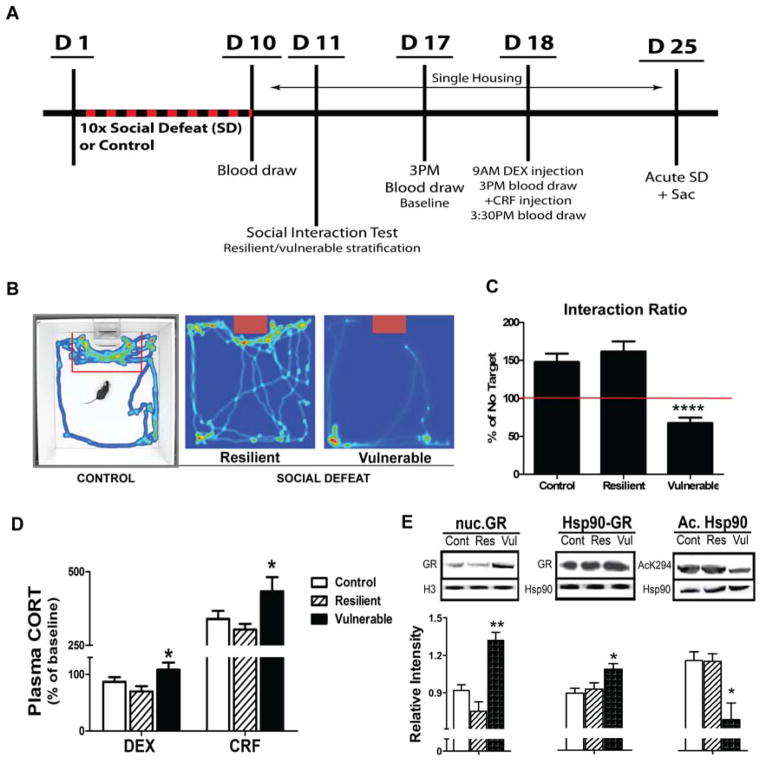
Mice subjected to chronic social defeat stress were stratified into resilient and vulnerable subpopulations. Hypothalamic-pituitary-adrenal axis function was probed using a dexamethasone/corticotropin-releasing factor test. Measurements of Hsp90 acetylation, Hsp90-GR interactions, and GR translocation were performed in the dorsal raphe nucleus. To manipulate Hsp90 acetylation, we pharmacologically inhibited histone deacetylase 6, a known deacetylase of Hsp90, or overexpressed a point mutant that mimics the hyperacetylated state of Hsp90 at lysine K294.
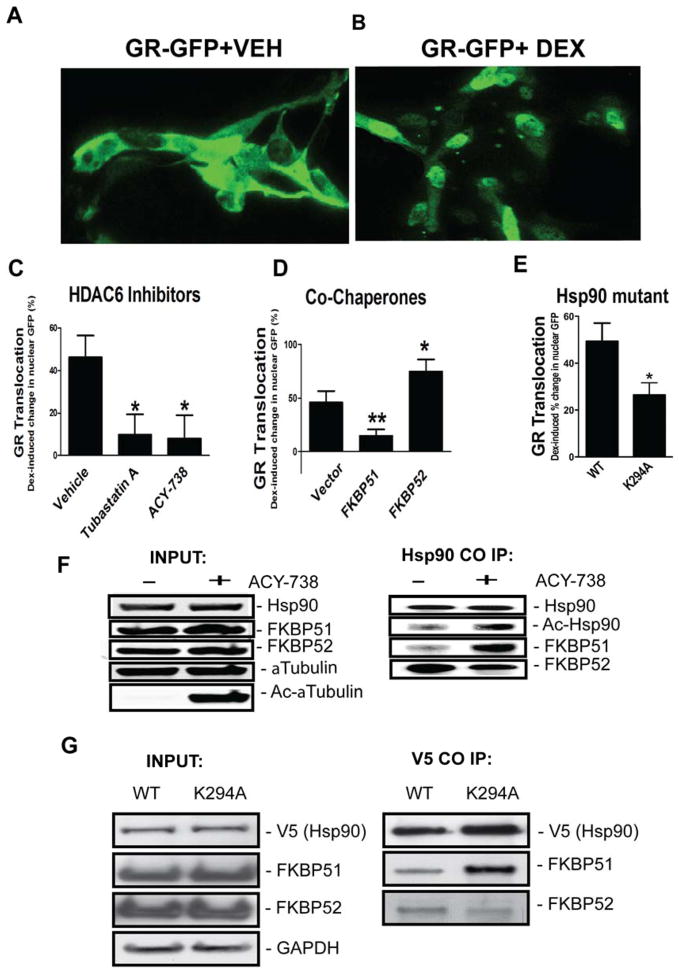
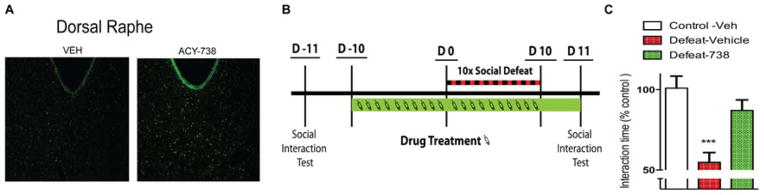
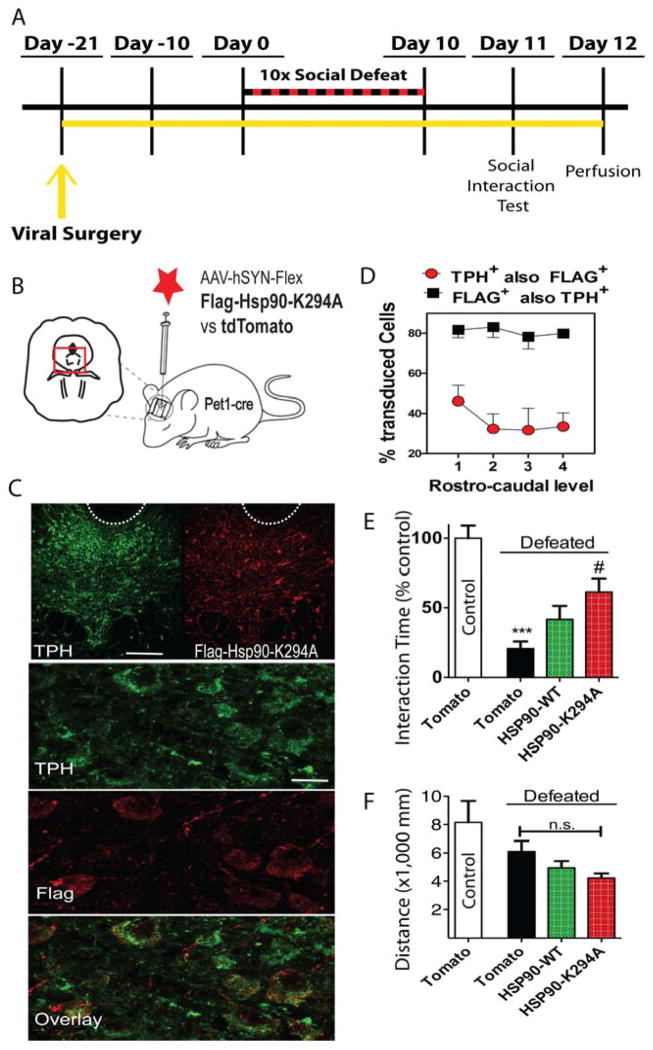
Lower acetylated Hsp90, higher GR-Hsp90 association, and enhanced GR translocation were observed in dorsal raphe nucleus of vulnerable mice after chronic social defeat stress. Administration of ACY-738, a histone deacetylase 6-selective inhibitor, led to Hsp90 hyperacetylation in brain and in neuronal culture. In cell-based assays, ACY-738 increased the relative association of Hsp90 with FK506 binding protein 51 versus FK506 binding protein 52 and inhibited hormone-induced GR translocation. This effect was replicated by overexpressing the acetylation-mimic point mutant of Hsp90. In vivo, ACY-738 promoted resilience to chronic social defeat stress, and serotonin-selective viral overexpression of the acetylation-mimic mutant of Hsp90 in raphe neurons reproduced the behavioral effect of ACY-738.
Hyperacetylation of Hsp90 is a predictor and causal molecular determinant of stress resilience in mice. Brain-penetrant histone deacetylase 6 inhibitors increase Hsp90 acetylation and modulate GR chaperone dynamics offering a promising strategy to curtail deleterious socioaffective effects of stress and glucocorticoids.
热休克蛋白90(Hsp90)的乙酰化通过糖皮质激素受体(GR)调节下游激素信号传导,但这种分子机制在应激稳态中的作用尚不清楚。我们测试了大脑中Hsp90的乙酰化是否能预测和调节社会应激小鼠模型的行为后遗症。
将遭受慢性社会挫败应激的小鼠分为恢复力强和易受影响的亚群。使用地塞米松/促肾上腺皮质激素释放因子试验探测下丘脑-垂体-肾上腺轴功能。在中缝背核中测量Hsp90乙酰化、Hsp90-GR相互作用和GR易位。为了操纵Hsp90乙酰化,我们用药物抑制组蛋白脱乙酰酶6(一种已知的Hsp90脱乙酰酶),或过表达一个模拟Hsp90赖氨酸K294位点高乙酰化状态的点突变体。
在慢性社会挫败应激后,易受影响小鼠的中缝背核中观察到较低的乙酰化Hsp90、较高的GR-Hsp90结合以及增强的GR易位。组蛋白脱乙酰酶6选择性抑制剂ACY-738的给药导致大脑和神经元培养物中Hsp90的高乙酰化。在基于细胞的试验中,ACY-738增加了Hsp90与FK506结合蛋白51相对于FK506结合蛋白52的相对结合,并抑制了激素诱导的GR易位。过表达Hsp90的乙酰化模拟点突变体可复制这种效应。在体内,ACY-738促进了对慢性社会挫败应激的恢复力,并且在中缝神经元中血清素选择性病毒过表达Hsp90的乙酰化模拟突变体重现了ACY-738的行为效应。
Hsp90的高乙酰化是小鼠应激恢复力的预测因子和因果分子决定因素。可穿透大脑的组蛋白脱乙酰酶6抑制剂增加Hsp90乙酰化并调节GR伴侣动力学,为减少应激和糖皮质激素的有害社会情感效应提供了一种有前景的策略。