Yin Yueyan, Zheng Kuanyu, Dong Jiahong, Fang Qi, Wu Shiping, Wang Lishuang, Zhang Zhongkai
Yunnan Key Laboratory of Agricultural Biotechnology, Key Lab of Southwestern Crop Gene Resources and Germplasm Innovation, Biotechnology and Germplasm Resources Institute, Ministry of Agriculture, Yunnan Academy of Agricultural Sciences, Kunming, 650223, China.
Institute of Alpine Economic Plants, Yunnan Academy of Agricultural Sciences, Lijiang, 674100, China.
Virol J. 2014 Dec 3;11:213. doi: 10.1186/s12985-014-0213-0.
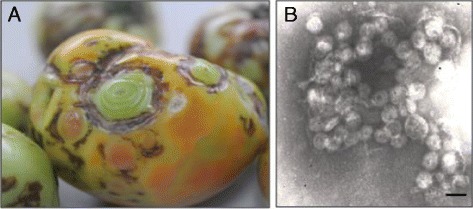
Emerging tospoviruses cause significant yield losses and quality reduction in vegetables, ornamentals, and legumes throughout the world. So far, eight tospoviruses were reported in China. Tomato fruits displaying necrotic and concentric ringspot symptoms were found in Guizhou province of southwest China.
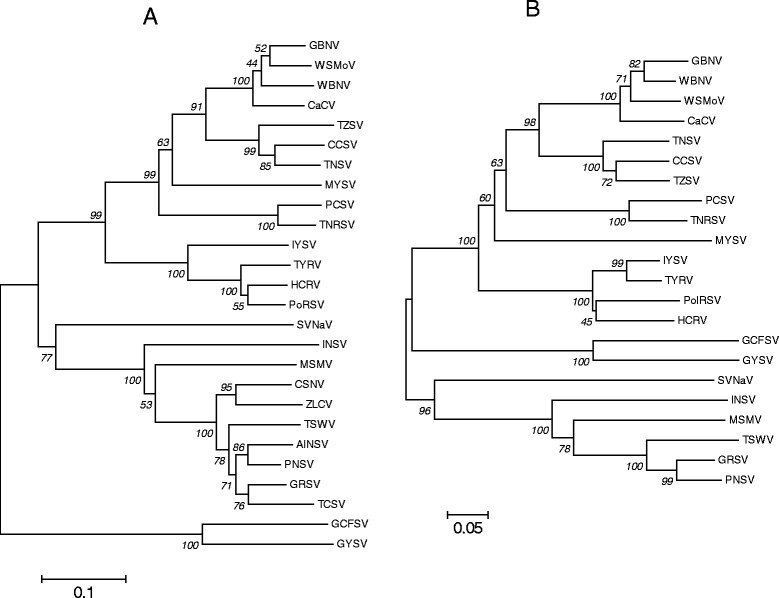
ELISA experiments showed that crude saps of the diseased tomato fruit samples reacted with antiserum against Tomato zonate spot virus (TZSV). Electron microscopy detected presence of quasi-spherical, enveloped particles of 80-100 nm in such saps. The putative virus isolate was designated 2009-GZT. Mechanical back-inoculation showed that 2009-GZT could infect systemically some solanaceous crop and non-crop plants including Capiscum annuum, Datura stramonium, Nicotiana benthamiana, N. rustica, N. tabacum and Solanum lycopersicum. The 3012 nt full-length sequence of 2009-GZT S RNA shared 68.2% nt identity with that of Calla lily chlorotic spot virus (CCSV), the highest among all compared viruses. This RNA was predicted to encode a non-structural protein (NSs) (459 aa, 51.7 kDa) and a nucleocapsid protein (N) (278 aa, 30.3 kDa). The N protein shared 85.8% amino acid identity with that of CCSV. The NSs protein shared 82.7% amino acid identity with that of Tomato zonate spot virus(TZSV).
Our results indicate that the isolate 2009-GZT is a new species of Tospovirus, which is named Tomato necrotic spot virus (TNSV). This finding suggests that a detailed survey in China is warranted to further understand the occurrence and distribution of tospoviruses.
新出现的番茄斑萎病毒属病毒在世界各地的蔬菜、观赏植物和豆类作物中造成显著的产量损失和品质下降。迄今为止,中国已报道了8种番茄斑萎病毒属病毒。在中国西南部的贵州省发现了出现坏死和同心环斑症状的番茄果实。
酶联免疫吸附测定(ELISA)实验表明,患病番茄果实样品的粗汁液与抗番茄环斑病毒(TZSV)的抗血清发生反应。电子显微镜检测到这些汁液中存在80 - 100纳米的准球形包膜颗粒。假定的病毒分离株被命名为2009 - GZT。机械回接实验表明,2009 - GZT能够系统感染一些茄科作物和非作物植物,包括辣椒、曼陀罗、本氏烟草、黄花烟草、烟草和番茄。2009 - GZT的S RNA全长3012个核苷酸序列与马蹄莲褪绿斑点病毒(CCSV)的序列具有68.2%的核苷酸同一性,在所有比较的病毒中是最高的。该RNA预计编码一个非结构蛋白(NSs)(459个氨基酸,51.7千道尔顿)和一个核衣壳蛋白(N)(278个氨基酸,30.3千道尔顿)。N蛋白与CCSV的N蛋白具有85.8%的氨基酸同一性。NSs蛋白与番茄环斑病毒(TZSV)的NSs蛋白具有82.7%的氨基酸同一性。
我们的结果表明,分离株2009 - GZT是番茄斑萎病毒属的一个新种,被命名为番茄坏死斑病毒(TNSV)。这一发现表明有必要在中国进行详细调查,以进一步了解番茄斑萎病毒属病毒的发生和分布情况。