Terek Demet, Yalaz Mehmet, Ulger Zulal, Koroglu Ozge Altun, Kultursay Nilgun
Deparment of Pediatrics, Ege University Hospital, Bornova, İzmir, Turkey.
J Res Med Sci. 2014 Nov;19(11):1074-9.
Although, patent ductus arteriosus (PDA) is associated with significant morbidity due to hemodynamic instability in preterm infants, the effect of ductus closure on mortality and morbidity is a controversial issue. The aim is to evaluate the efficacy of oral and intravenous (IV) ibuprofen treatment on ductal closure and effects on mortality and bronchoplumonary dysplasia.
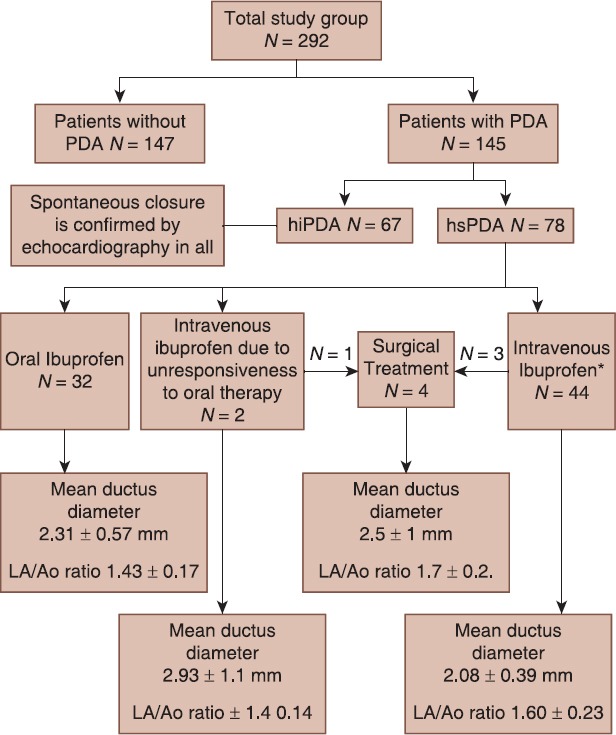
The medical records of 292 premature infants treated at Ege University Neonatal Intensive Care Unit were retrospectively evaluated. Patients were classified into 3 groups as; No PDA, hemodynamically insignificant PDA (hiPDA) and hemodynamically significant PDA (hsPDA) according to the presence and hemodynamical significance of PDA by echocardiography. hsPDA group was treated with IV or oral ibuprofen.
Patent ductus arteriosus was diagnosed by routine echocardiography in 145 patients, of whom 78 (53.7%) had hsPDA. All 65 infants with hiPDA had spontaneous PDA closure. Echocardiographic measurements were similar to those patients treated with oral or IV ibuprofen, as in the response rate to treatment without serious adverse effects. The presence of respiratory distress syndrome, surfactant therapy, late sepsis, bronchopulmonary dysplasia (BPD) and mortality rates were significantly higher in patients with hsPDA. However, with stepwise logistic regression; 5(th) min Apgar score (odds ratio [OR], 1.321, 95% confidence interval [CI], 1.063-1.641, P = 0.012) and gestational age (OR, 1.422, 95% CI, 1.212-1.662, P < 0.001) were the only significant variables associated with mortality. Gestational age (OR, 0.680, 95% CI, 0.531-0.871, P = 0.002) was the only significant variable associated with BPD shown with logistic regression.
Ibuprofen treatment is effective for hsPDA closure with minimal side effects. HiPDA can close spontaneously; therefore treatment decision should be individualized. However, medical treatment of PDA does not reduce mortality and BPD.
尽管动脉导管未闭(PDA)因早产儿血流动力学不稳定而与显著的发病率相关,但动脉导管闭合对死亡率和发病率的影响是一个有争议的问题。目的是评估口服和静脉注射(IV)布洛芬治疗动脉导管闭合的疗效以及对死亡率和支气管肺发育不良的影响。
回顾性评估在伊兹密尔大学新生儿重症监护病房接受治疗的292例早产儿的病历。根据超声心动图检查中PDA的存在情况和血流动力学意义,将患者分为3组:无PDA、血流动力学无显著意义的PDA(hiPDA)和血流动力学有显著意义的PDA(hsPDA)。hsPDA组接受静脉或口服布洛芬治疗。
145例患者通过常规超声心动图诊断为动脉导管未闭,其中78例(53.7%)患有hsPDA。所有65例hiPDA婴儿的动脉导管均自然闭合。超声心动图测量结果与口服或静脉注射布洛芬治疗的患者相似,治疗反应率也相似,且无严重不良反应。hsPDA患者的呼吸窘迫综合征、表面活性剂治疗、晚期败血症、支气管肺发育不良(BPD)的发生率和死亡率显著更高。然而,通过逐步逻辑回归分析;出生后5分钟阿氏评分(优势比[OR],1.321,95%置信区间[CI],1.063 - 1.641,P = 0.012)和胎龄(OR,1.422,95% CI,1.212 - 1.662,P < 0.001)是与死亡率相关的仅有的显著变量。胎龄(OR,0.680,95% CI,0.531 - 0.871,P = 0.002)是通过逻辑回归分析显示的与BPD相关的仅有的显著变量。
布洛芬治疗对hsPDA闭合有效,且副作用最小。hiPDA可自然闭合;因此治疗决策应个体化。然而,PDA的药物治疗并不能降低死亡率和BPD。